

Quick answer: Project prioritization is the process of ranking competing project requests against a shared set of criteria — usually strategic value, cost, risk, and capacity — so an organization funds the work that matters most instead of whichever request has the loudest sponsor. A prioritization framework only works if it does two things most spreadsheets don't: it forces every request through the same scoring lens, and it checks the ranked list against actual available capacity before anything gets approved. Skip the capacity check and you've built a very well-organized wish list, not a portfolio plan.
Most organizations don't lack a prioritization method. They have three or four, all disagreeing with each other, none of them checked against whether the team doing the work actually has room to do it. The scoring spreadsheet says Project A is the top priority. The department budget already funded Project B. The CEO mentioned Project C twice in the last town hall. All three get staffed, on top of the ten already in flight, and the PMO spends the quarter explaining why nothing's shipping on time.
What prioritization is actually solving for
Prioritization isn't a ranking exercise for its own sake — it's the mechanism that connects "here's our strategy" to "here's what we're actually building this quarter." Every organization has more good ideas than it has budget and people to execute them. Without a shared method for choosing among them, that gap gets filled by whoever has the most organizational leverage, not whoever has the strongest business case.
The tell that prioritization is broken isn't that projects get delayed — that happens everywhere. It's that nobody can explain, in the same terms twice, why one project got funded over another. If the honest answer to "why is this our top priority" varies depending on who you ask, there's no framework — there's politics wearing a framework's clothes.
Three prioritization methods worth actually using
Skip the debate over which single method is "correct." Different situations call for different tools, and the strongest PMOs use more than one depending on the decision in front of them.
Weighted scoring is best for comparing a diverse portfolio across several strategic dimensions. MoSCoW is best for categorical commitment decisions inside one release or planning window. ICE (Impact, Confidence, Ease) is best for fast triage of a long backlog of smaller ideas.
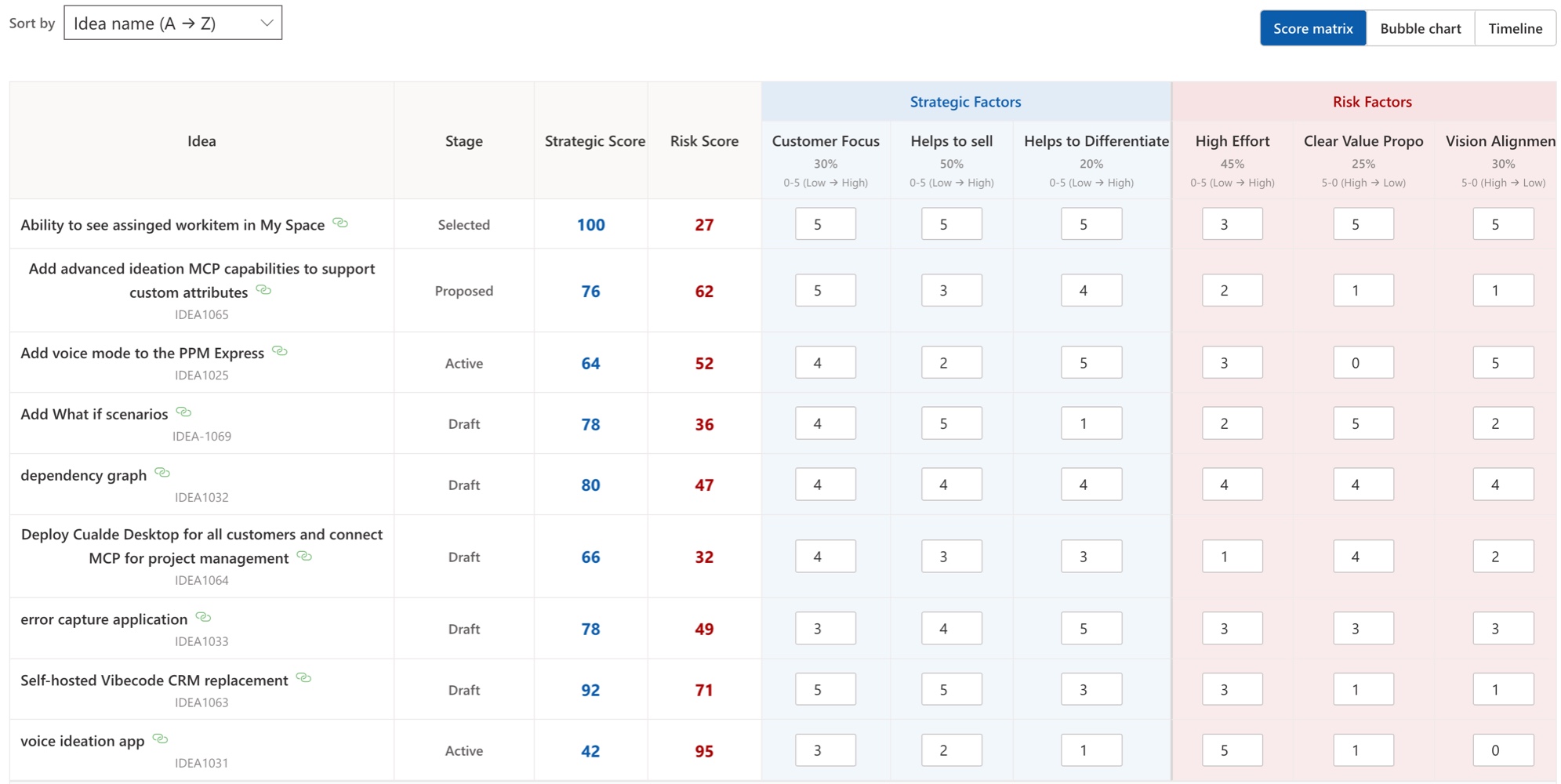
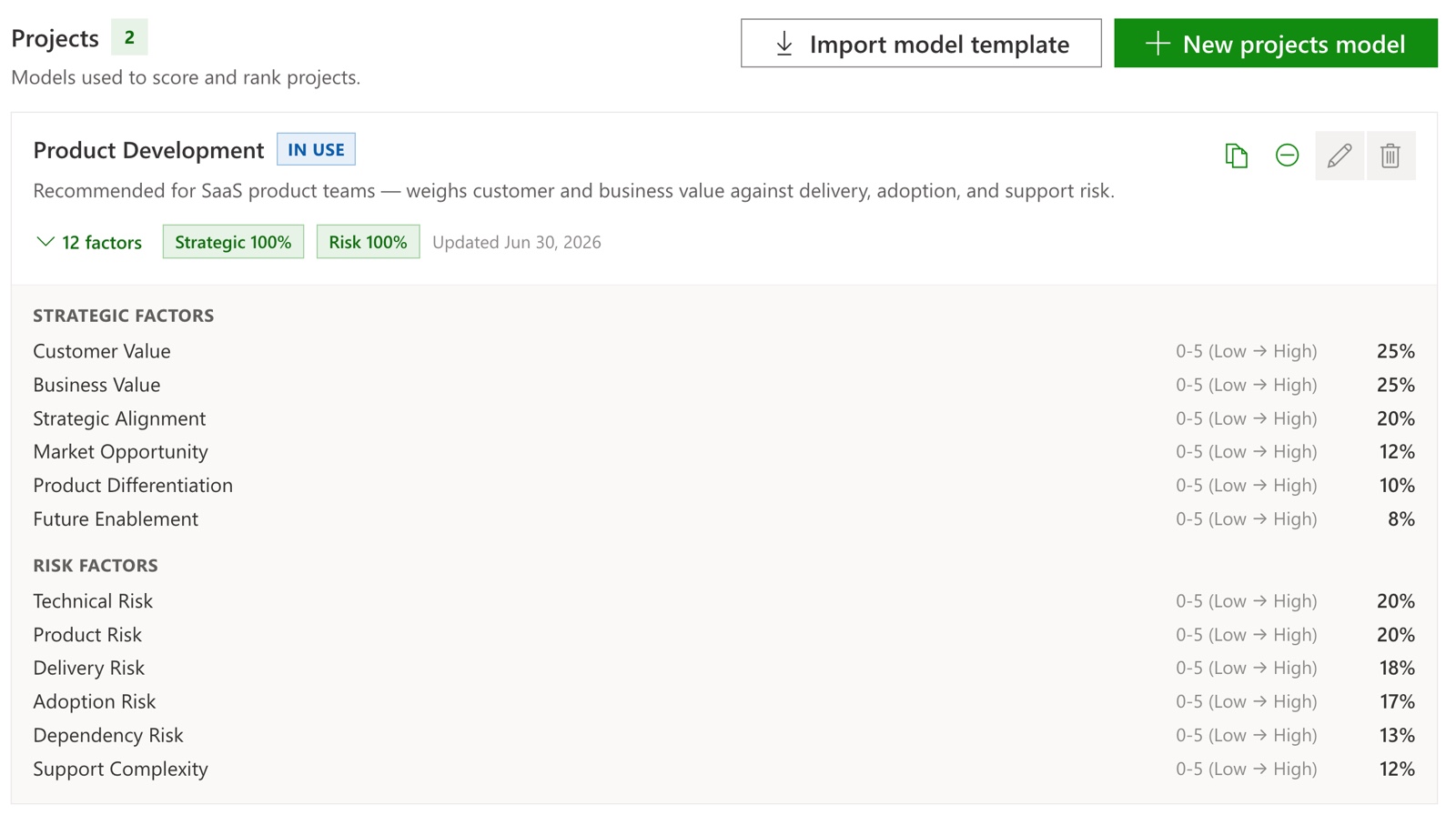
Weighted scoring models work best when you're comparing a portfolio of dissimilar projects against multiple strategic dimensions at once. You define the criteria that matter to your organization — strategic alignment, financial return, risk, customer impact, regulatory necessity — assign each a weight reflecting how much it should matter, then score every project against each criterion. The output is a ranked list with the reasoning attached to it, which is the part a spreadsheet ranking by gut feeling can never produce. The catch: garbage weights produce a garbage ranking just as confidently as good ones do, so the weighting conversation with stakeholders matters more than the scoring math.
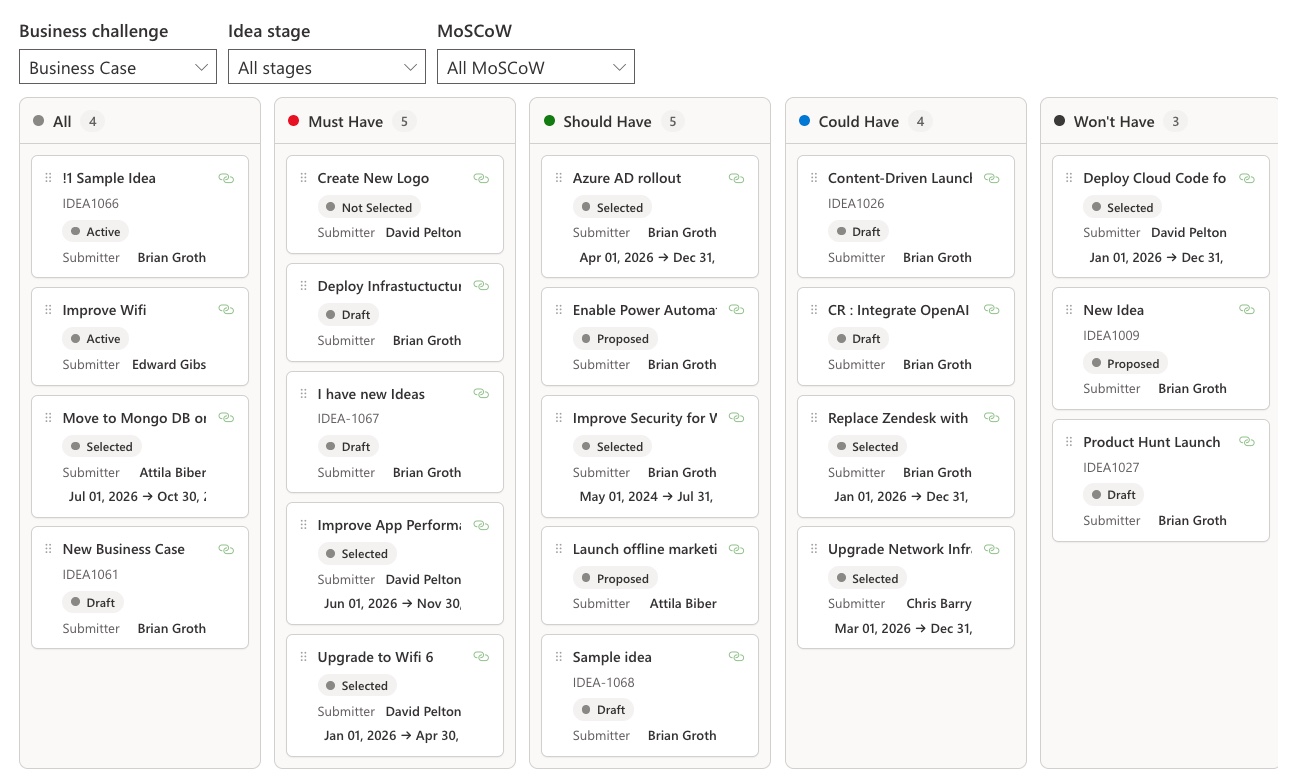
MoSCoW (Must-have, Should-have, Could-have, Won't-have) works best for forcing a hard conversation inside a single release, program, or planning cycle, rather than ranking an entire multi-year portfolio. Its real value isn't the four buckets — it's the discipline of making someone defend why something belongs in "Must" instead of "Should." The common failure mode is letting "Must-have" absorb 80% of the list, which defeats the entire point. Some teams cap Must-have at roughly a third to half of total scope to keep the label meaningful. That threshold is an internal governance convention, not part of the formal MoSCoW definition.
ICE scoring (Impact, Confidence, Ease) works best when you're triaging a long list of smaller ideas fast — a backlog of feature requests or minor initiatives where a full weighted-criteria model would be overkill. Each item gets a score for expected impact, confidence in that estimate, and how easy it is to execute. Score each on a simple scale, combine them consistently, and you get a defensible first pass in an afternoon instead of a week. It trades precision for speed, which is exactly the right trade when the list is long and the individual stakes are low. Some organizations prefer to score Effort directly instead of Ease; that is a modified ICE model, and the score has to be inverted so that higher effort does not accidentally improve an item's priority.
None of these three methods replaces judgment. They replace the alternative to judgment, which can otherwise become whoever asked most recently or most loudly.
The step many prioritization exercises skip: checking capacity
Here's where scoring models quietly fall apart. An organization runs a clean, well-facilitated scoring exercise, produces a ranked list of twelve projects, and approves the top eight because that's what last year's budget supported. Nobody checked whether the team has the actual people — with the actual skills — to deliver eight projects in parallel without cannibalizing each other's resources.
A ranked list is not a plan until it's been checked against capacity. This is the step that turns prioritization from a strategy exercise into an execution reality: take the ranked list, model it against available resource capacity by skill and by team, and find the point where the list stops being deliverable. Everything above that line is your actual portfolio for the period. Everything below it isn't deprioritized in some abstract sense — it's explicitly not happening yet, which is a different and more honest thing to tell stakeholders than "it's still on the roadmap."
This is also where scenario modeling earns its place next to a scoring framework rather than instead of it. PPM Express's Scenario Planner, for example, is built around exactly this sequence: score projects using a weighted model, MoSCoW, or an ICE-style model, set a budget ceiling, then check the ranked list against real resource capacity and free capacity before anything gets published to live projects. Run two or three funding scenarios side by side — "top 8 by score," "top 8 within this budget cap," "top 8 that also fit current team capacity" — and you frequently find the three lists disagree, which is the whole point of running the comparison before committing.
What weak prioritization actually costs
The consequences rarely show up as one dramatic failure. They show up as a slow accumulation of friction:
— Everything becomes priority one, which functionally means nothing is, and teams default to whichever request came with the most pressure attached.
— Resources get spread thin across too many initiatives at once, so nothing finishes on the timeline anyone committed to, and partial progress on fifteen things looks worse on every dashboard than finished progress on six.
— Low-value work survives because it has a department budget line, not because it earned its place, while a higher-value cross-functional idea never gets funded because it doesn't belong to any single budget owner.
— The PMO loses credibility the moment stakeholders notice that "priority" tracks influence more reliably than it tracks value — after that, every future prioritization conversation starts from a position of skepticism instead of trust.
A practical framework: five steps, not fifteen criteria
Complex frameworks with a dozen weighted criteria look rigorous in a slide deck and collapse the first time someone has to fill one out for forty requests. A leaner version tends to actually survive contact with a real intake queue:
1. Set three to five criteria that reflect real strategic priorities — not an exhaustive list, a short one everyone can hold in their head. Strategic alignment, expected value, risk, and effort covers most organizations' actual decision-making needs.
2. Score every request the same way, at intake, not after it's already been informally promised to someone. Scoring after the fact just rationalizes decisions that were already made politically.
3. Rank the list and show the ranking, criteria and weights included, to whoever's asking why their project isn't at the top. Transparency is what keeps a scoring model from being quietly overridden the first time it produces an inconvenient answer.
4. Check the ranked list against capacity and budget, and draw the actual cutoff line — the point where you stop having the people or the money to do more, regardless of how good the ideas below it are.
5. Revisit the ranking on a fixed cadence, not only when something goes wrong. Quarterly is a practical cadence for many portfolios; anything less frequent lets stale priorities calcify into the plan simply because nobody rechecked them.
Frequently asked questions
It's the process of evaluating and ranking competing project requests against a shared set of criteria — typically strategic alignment, value, cost, and risk — so an organization funds the highest-value work first instead of defaulting to whichever request has the most organizational pressure behind it.
There isn't a single best method across every situation. Weighted scoring models suit ranking a diverse portfolio against multiple strategic dimensions; MoSCoW suits forcing hard trade-off conversations within a single release or planning cycle; ICE scoring suits fast triage of a long backlog of smaller ideas. Most mature PMOs use more than one depending on the decision.
Most commonly because the ranked list is never checked against actual resource capacity and budget. A scoring exercise produces a defensible order of priorities; it doesn't guarantee the organization can deliver everything above the cutoff line, and skipping that capacity check is what turns a good framework into an unrealistic roadmap.
Quarterly is a practical cadence for many portfolios — frequent enough to catch shifting strategy or capacity changes, infrequent enough that teams aren't re-litigating priorities every sprint. Reassess sooner if a major budget, staffing, or strategic change happens outside that cycle.
MoSCoW sorts requirements or projects into four categories (Must, Should, Could, Won't) and is best used within a defined release or planning window. ICE scores each item on Impact, Confidence, and Ease, and is best used for fast triage across a long list of smaller, lower-stakes ideas where a full weighted-criteria model would take longer than the decision warrants. Teams that prefer to score Effort directly are using a modified ICE model and should invert that score.
Key takeaways
Prioritization only works when every request goes through the same criteria and the resulting ranking is checked against real capacity before anything gets approved — skip either step and you get a wish list dressed up as a plan. Match the method to the decision: weighted scoring for a diverse portfolio, MoSCoW for a single release, ICE for fast backlog triage. And revisit the ranking on a fixed cadence, because a prioritization exercise done once at the start of the year is already stale by the time the second quarter's budget conversation happens.
.svg)


