
PPM For Banks and Credit Unions
Not ready for a demo?
Read the bank buyer guide: five questions to ask before you choose a PPM platform →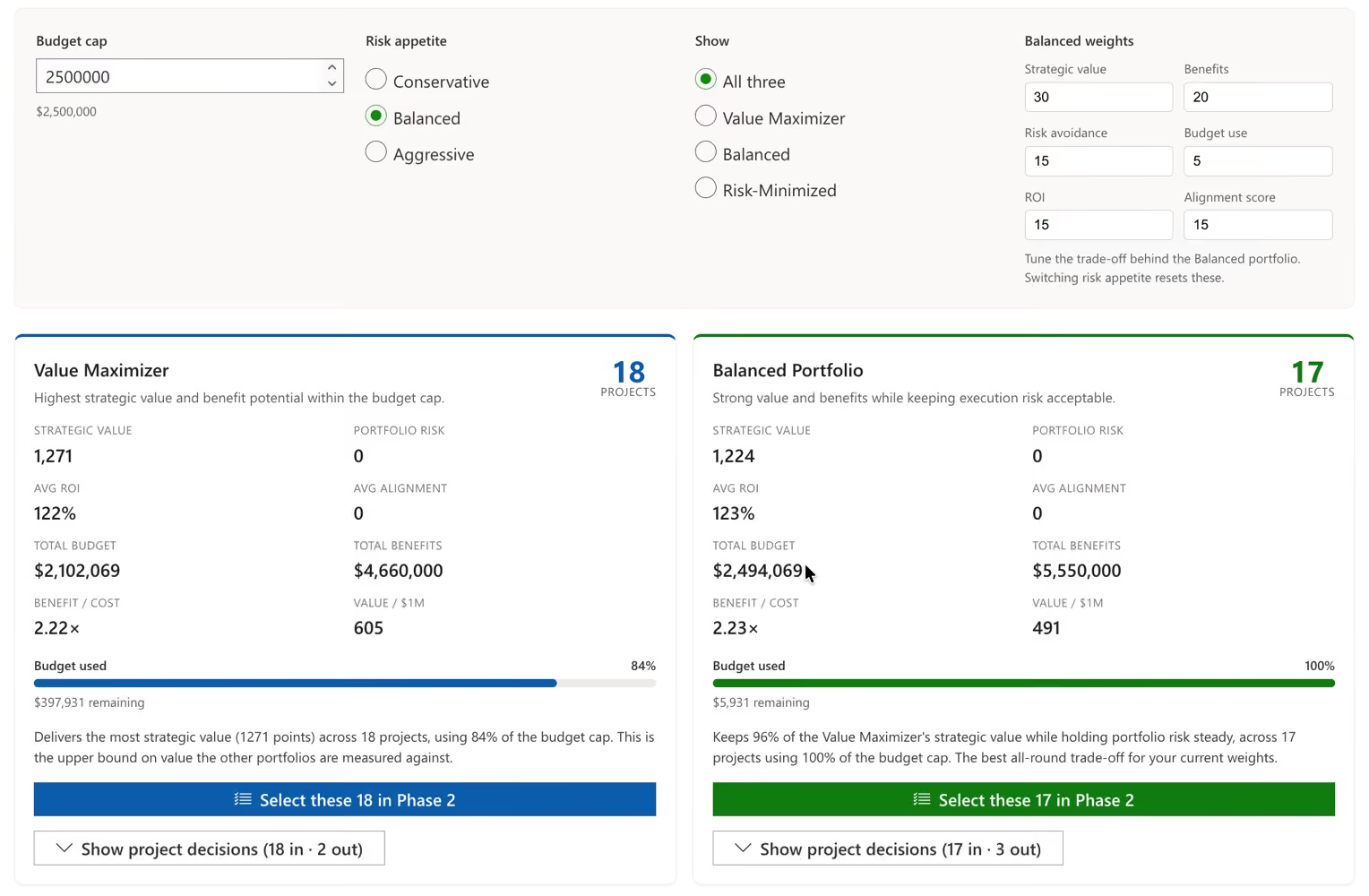
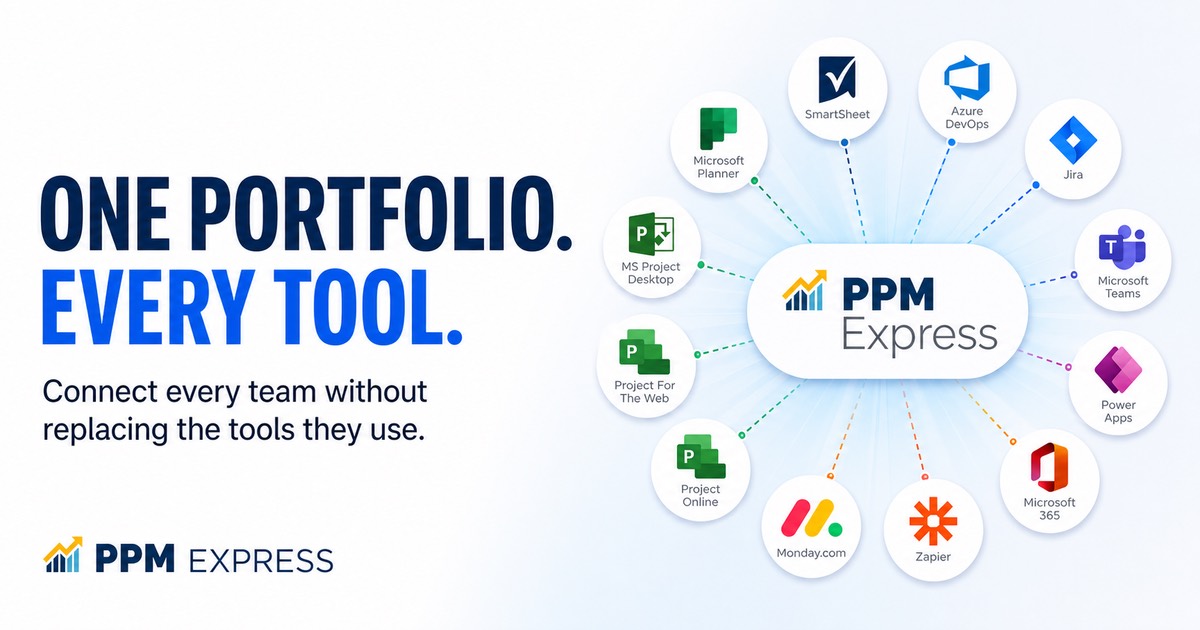
Bring work from Azure DevOps, Jira, Microsoft Project, Planner, Project for the Web, Smartsheet and Monday.com into one portfolio view. Teams keep their delivery workflows while leadership sees regulatory, technology, operational and customer initiatives together.
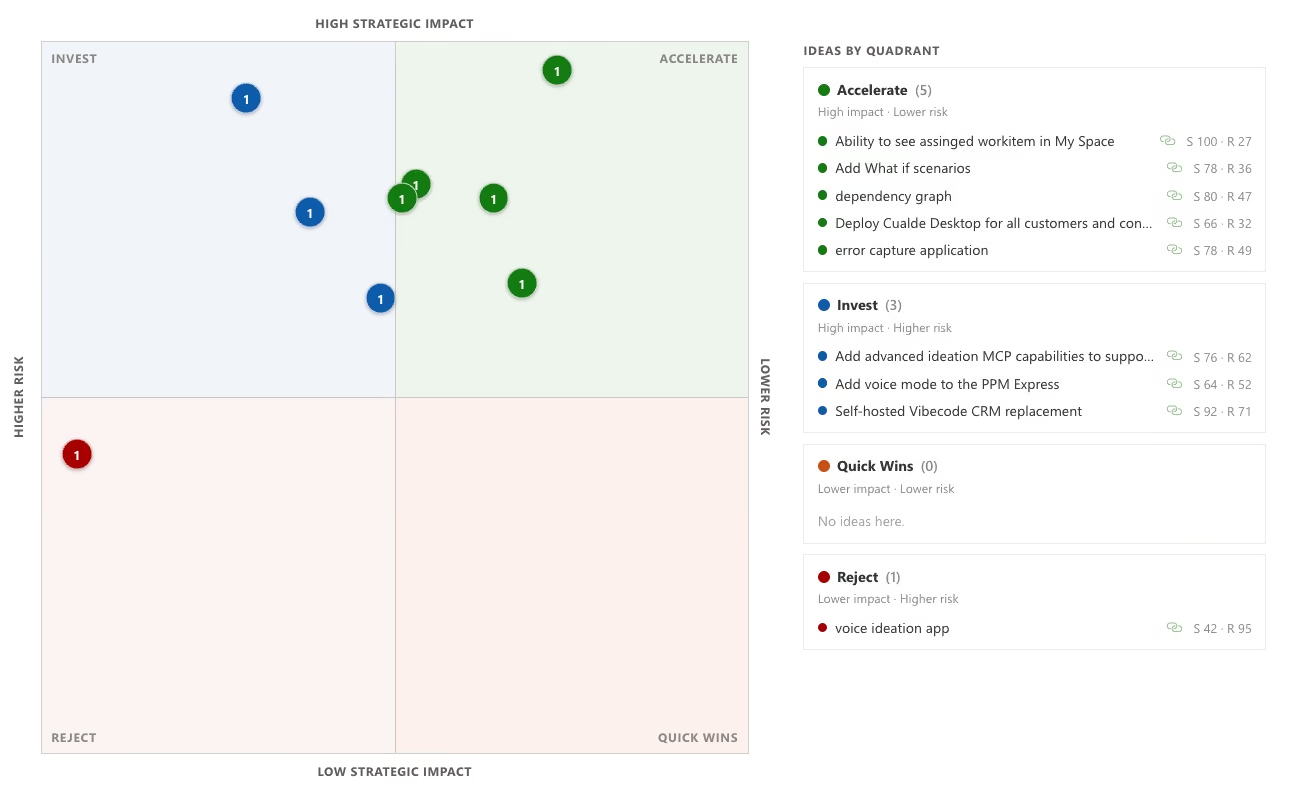
Capture requests and score them against published strategic and risk criteria, with budget, forecast, benefits and impact next to each initiative. Mandatory work stays identifiable as mandatory, and the cost and capacity consequences of protecting it stay visible rather than absorbed silently.
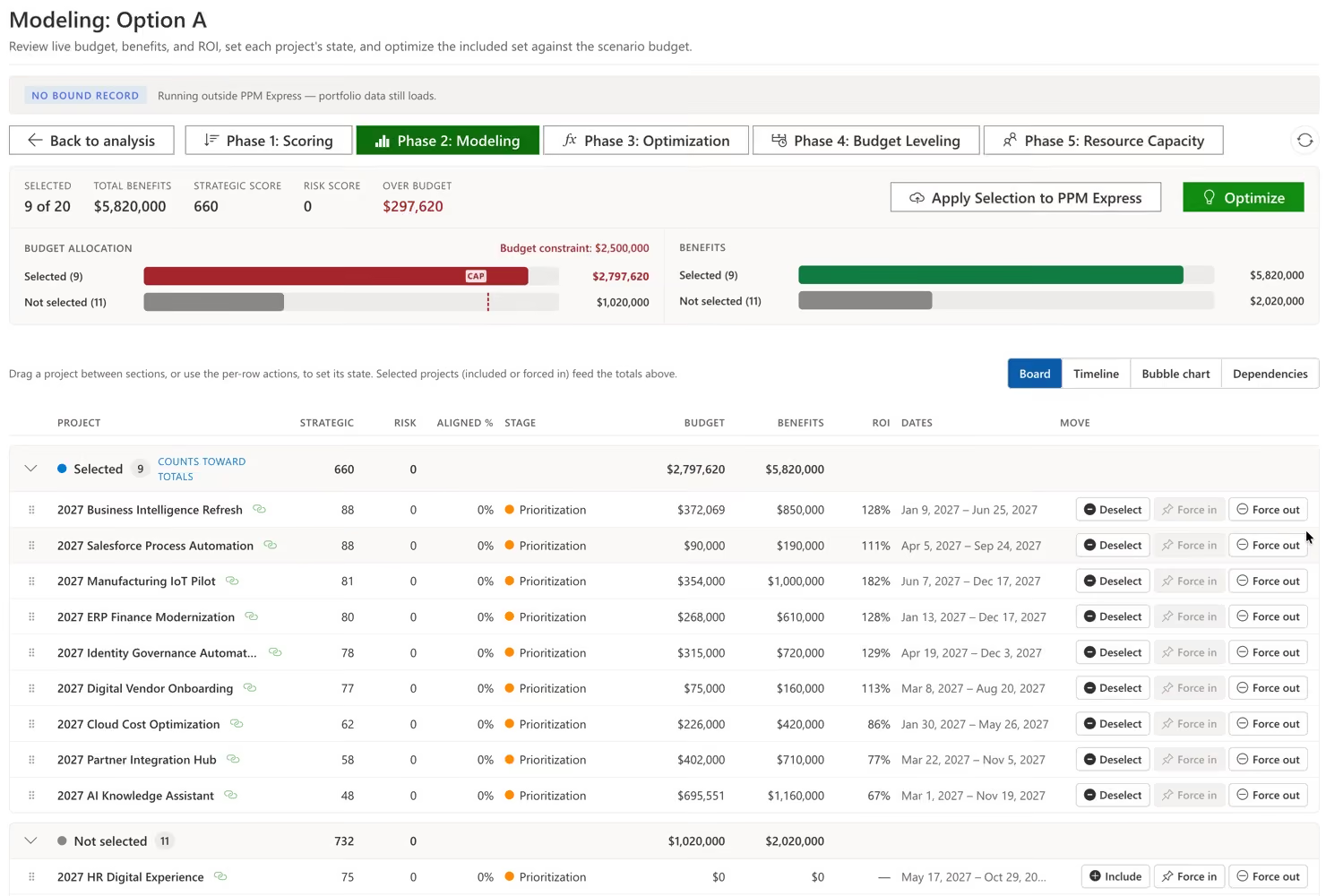
Build competing funding scenarios against one ceiling, then check the survivors against real availability in hours or % FTE. Over-allocation appears before the portfolio is approved, not after four programs discover they all depend on the same security team.
Enterprise PPM platforms cover broadly the same ground. Where they differ most is what it costs to give your whole organization access to it.
| PPM Express | Planview | Planisware | Meisterplan | ServiceNow SPM | |
|---|---|---|---|---|---|
| Portfolio and programme hierarchy | Yes | Yes | Yes | Yes | Yes |
| Weighted scoring and prioritization | Yes | Yes | Yes | Yes | Yes |
| What-if funding scenarios | Yes | Yes | Yes | Yes | Yes |
| Resource capacity planning | Yes | Yes | Yes | Yes | Yes |
| Stage-gate intake and approvals | Yes | Yes | Yes | Yes | Yes |
| Budgets, forecasts and benefit realization | Yes | Yes | Yes | Yes | Yes |
| Dashboards and portfolio reporting | Yes | Yes | Yes | Yes | Yes |
| Regulatory change programme portfolios | Yes | Yes | Limited | Limited | Yes |
| Audit-ready decision history with retained baselines | Yes | Yes | Yes | Limited | Yes |
| Microsoft Project, Planner and Project for the Web | Native two-way | Yes | Limited | Limited | Limited |
| Jira and Azure DevOps | Native two-way | Yes | Limited | Limited | Yes |
| Power BI reporting pack | 200+ reports | Limited | Limited | Limited | Limited |
| Unlimited users included | Yes | No, per seat | No, per seat | No, per seat | No, per seat |
| Typical annual cost | $8,000 to $25,000 flat | $100,000+ | $100,000+ | Mid five figures | $100,000+ with platform |
Planview is the broadest suite in the category and the strongest analyst position. If you need enterprise architecture, value stream management and PPM from one vendor, it covers more ground than we do, with the longest implementation and the highest cost to match.
Planisware is genuinely excellent at R&D and new product development pipeline modelling. For a bank or credit union portfolio of regulatory change, core modernization, risk and digital channel work, that depth is largely unused and still paid for.
Meisterplan is fast to deploy and very good at lean capacity and scenario planning. If contention over shared engineers and risk specialists is your single problem, it will solve it quickly. It is deliberately lighter on financials, benefit realization and gated intake, so institutions with examiner and audit evidence requirements tend to outgrow it.
ServiceNow SPM is a strong choice if you already run ServiceNow for ITSM, because the platform and data are already there. If not, you are buying the platform to get the portfolio module, and the procurement, cost and implementation footprint follow.
PPM Express covers the same core portfolio capabilities on one flat annual subscription with unlimited users. We are not the deepest R&D pipeline tool or the broadest enterprise suite. We are the portfolio layer for banks and credit unions that run on Microsoft and Jira and need a defensible decision record without a six-figure licence.
A regional bank ran its compliance program, a core modernization and a digital roadmap as three separate queues that met only when the budget was added up. Moving them into one PPM Express portfolio, scored on the same model and tested against the same shared teams, changed what the executive committee saw and what it cost to say yes.
Mandatory work scored on the same model as everything else, so the approach with the smallest capacity footprint won.
Strategic initiatives sequenced against real free capacity instead of slipping quietly every quarter.
Regulatory, core and digital work reviewed together, with the trade-off on screen rather than escalated.
“We finally have one place where the executive committee can see the regulatory work, the core program and the digital roadmap against the same people, and decide what moves.”
— Head of Enterprise PMO, regional bank
The question is rarely whether regulatory, resilience, modernization and customer initiatives matter. It is which combination fits the budget and the delivery capacity without creating unmanaged risk somewhere else. Build comparable scenarios, keep the mandatory commitments visible inside them, and choose with the full trade-off on screen.
Most bank evaluations stall on the same things: a tool that costs work in dollars but not in people, per-seat pricing that keeps the business out of the system, and a third-party risk review that starts after the decision instead of before it. The guide covers the five questions that separate a platform that works in a bank from one that works in a demo, an eighteen-requirement comparison against Planview, Clarity, ServiceNow SPM, Planner and Smartsheet, a cost example at 250 and 1,000 users, and a third-party risk checklist you can hand to vendor management on day one.
Security & Trust
Enterprise-grade security is built into our platform. We offer US and EU data residency, full GDPR compliance, and custom DPAs to meet strict regulatory requirements.
Need app availability in your region/country to meet data residency requirements? We can provide.
Microsoft 365 and Okta SSO ensure secure identity management, while centralized user management, advanced permissions, detailed audit logs, and strict data isolation protect sensitive enterprise data.
Bring your security reviewers to the same call.
Book Enterprise Demo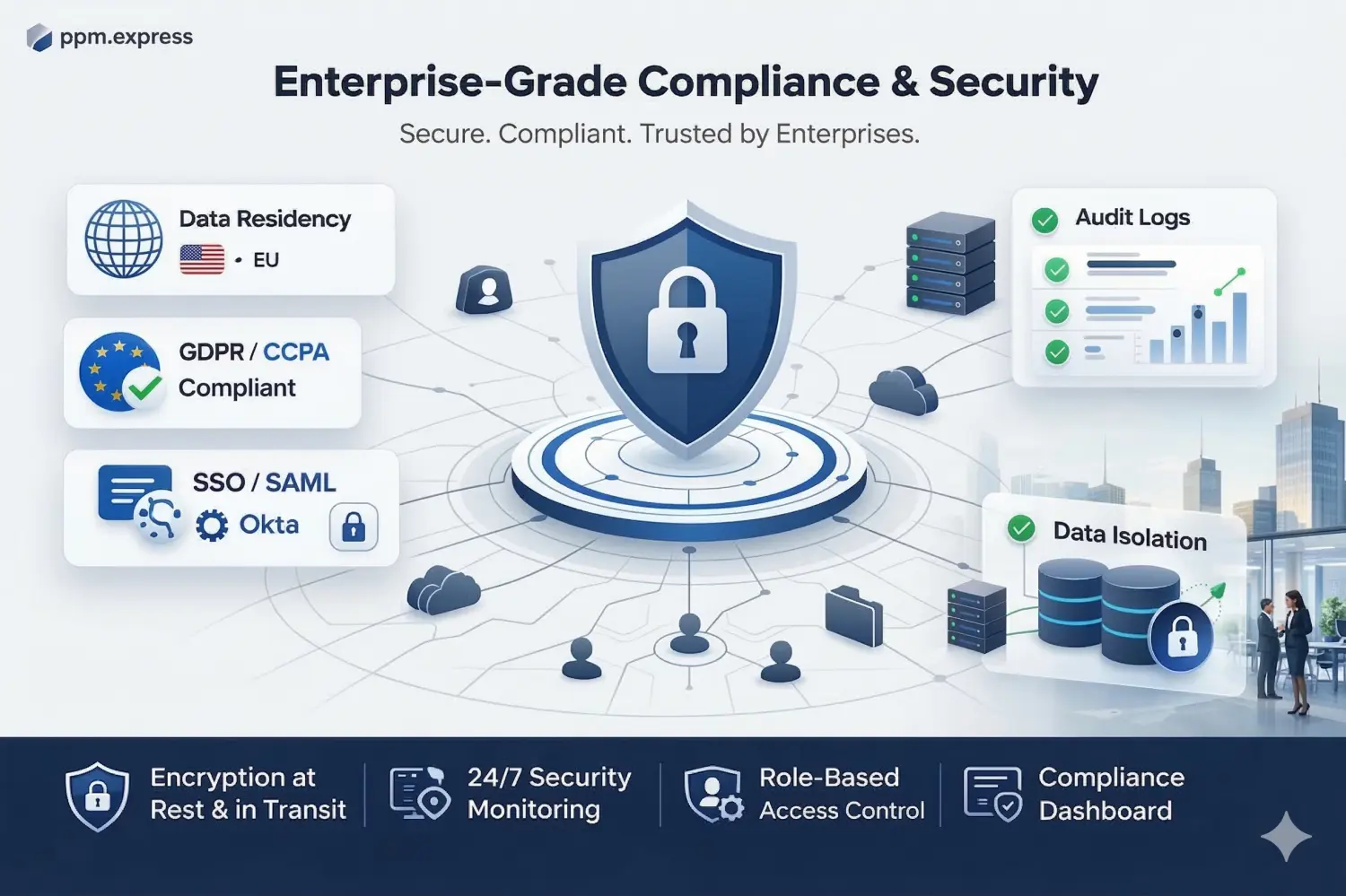


What our clients say
250+
Customers
use our software daily
100 hours
Saved every year
on monitoring state and statuses of projects, per PM
100K+
Projects
tracked on the PPM Express platform
Unlimited
Users
on every paid plan, so visibility is never rationed
Data residency
US & EU Data Residency
Encrypted in transit and at rest, with SSO, audit logs and tenant isolation. No customer data used to train AI models.
Reporting
200+ ready-to-use reports
Power BI reports built on live portfolio data, so stakeholders get self-service dashboards instead of a request queue.
Pricing
One flat annual subscription
$25,000/year for large enterprises, $8,000/year for SMB. No per-seat penalty.

Streamline Project Portfolio Management and Visibility at Scale
Integrations


Capture new project request, streamline evaluation and prioritization
Product

Structured Approach for prioritizing and aligning portfolios with strategic priorities and resource constraints
Product
Last updated 3 September 2026
Banking portfolio management, answered.
Most of the review is answered by where the data lives and who controls access. Each bank has its own isolated tenant on Microsoft Azure, in the US or the EU, and sign-in runs through the bank's own Entra ID or Okta with the conditional access and MFA policies already in force. Data is encrypted in transit and at rest with FIPS 140-2 algorithms, backups are geo-replicated, and audit logs cover the portfolio of record. PPM Express does not hold its own SOC 2 or ISO 27001 certificate; the Azure data centers do, and the bank security page documents the shared-responsibility split, the subprocessors, the DPA and the mapping to the interagency third-party risk guidance, FFIEC, GLBA and NYDFS Part 500. Vendor management teams typically complete their questionnaire from that page and one call.
The same as for a hundred. The Ultra plan is a flat $25,000 a year with unlimited users, viewers and guests, so every program manager, business sponsor, risk owner and executive can be in the system without a licensing conversation. At list prices, a per-seat PPM suite at $30 per user per month costs $360,000 a year for the same thousand people. The cost calculator lets you run your own numbers against any vendor at one, three and five years.
The trial is thirty days on the full Enterprise plan with unlimited users. Purchases carry a thirty-day full-refund window, and banks switching from another platform can use the Switch terms: implementation guaranteed in fifteen business days, deferred billing for up to twelve months while the incumbent is retired, and a year-one exit refund. Your data can be exported at any time.
Run-the-bank is the cost of keeping the bank operating: existing systems, operations, support, licenses. Change-the-bank is investment in doing something different, whether that's new products, regulatory change, modernization or efficiency work. The distinction matters because both come from the same pot and the boundary gets fought over. A lot of what sits in run is really deferred change, and reclassifying it honestly is often the first useful thing a portfolio review does.
The agreed set of change initiatives a division or the whole bank has committed to deliver in a period, with funding, sequencing and ownership attached. It's different from a project list because it's a commitment: the book of work is what leadership said it would do and will be held to. The usual problem is that it mixes mandatory regulatory commitments with discretionary investment and treats both the same way.
Score both on the same model instead of exempting one of them. Mandatory work should rank high because its risk factor is genuinely severe, not because it skips assessment. Once regulatory change carries a score, the cost it imposes in displaced strategic investment becomes visible, and leadership can see exactly how much of this year's capacity the compliance agenda is consuming.
Yes. Projects run a configurable process of phases and stages with gates between them, and you choose which gates require approval. Named approvers review in the Approval Center and approve or reject with comments, and every approver has to sign off before a project advances. The decision history is retained, and a scoring model already being used on live work has to be cloned before anyone can change it.
They can. Alongside standard approvals handled inside PPM Express, there's an API-based option built for organizations already running an external approval or workflow platform. PPM Express sends the approval request out to your system, and your system calls back to approve or reject the stage transition. For banks with an established change-governance toolchain, that avoids standing up a second approval queue.
Run the scenario both ways. Pareto optimization shows the options where you can't improve strategic value, benefits, risk or cost without conceding something elsewhere, so the executive committee sees the actual frontier rather than one recommended plan. The aim isn't to underfund mandatory work. It's to stop the crowding-out from happening silently and then being discovered in December.
The model that was applied, the factor weights in force at the time, the scenarios compared, the one selected, and the numbers as they stood at that moment. Figures are baselined at the point of decision and the decision history is kept. Because a model scoring live change has to be cloned before it can be altered, the basis of a past decision can't be edited after the fact.
When numbers change upstream after you've built an analysis, PPM Express shows you exactly what moved and asks whether to take it, rather than absorbing the change quietly. A re-plan then starts from a known delta instead of another data-gathering round. On a multi-year program where technical standards and regulator clarifications arrive in installments, that difference compounds.
Each person's capacity comes from their work week and calendar exceptions, and allocation shows against it in hours, percent or FTE, with overallocation flagged. Books of work usually break on a specific group of people rather than on budget: the change specialists, data engineers or SMEs written into a dozen initiatives at once. That shows up as soon as the plans sit in one view.
Yes. Project Online and Project for the Web connect directly, and for the Microsoft Project Desktop client there's PPM Express Project Publisher, an add-in your planners use to publish schedules up from inside Project. Desktop 2016, 2019 and 2021 are supported. Plans come across up to 2,000 tasks and ten levels of hierarchy.
Every initiative carries budget, forecast, benefits and impact, baselined at approval, so the current position can be set against what was funded. Because the portfolio reads live from the delivery tools, the committee sees the position as it stands rather than a reconciliation put together the week before. That week-before reconciliation is normally where the credibility-damaging discrepancies come from.
Data residency in the US or the EU, one isolated tenant per bank, Entra ID or Okta single sign-on with your own conditional access and MFA, FIPS 140-2 encryption in transit and at rest, geo-replicated backups, audit logs on the portfolio of record, and a DPA on request. Prioritization models in active use are protected from silent edits, which tends to be the specific control an audit function asks about. The full control set, the shared-responsibility split with Azure and the regulatory mapping are on the bank security page.
No. Horizon scanning, regulatory interpretation and obligation mapping are a separate discipline with their own tooling. PPM Express handles what comes next: turning agreed obligations into funded, sequenced, staffed initiatives, and evidencing how those calls were made. The two work together, and conflating them is a common reason people end up disappointed with one or the other.
.svg)


