
For the transformation office
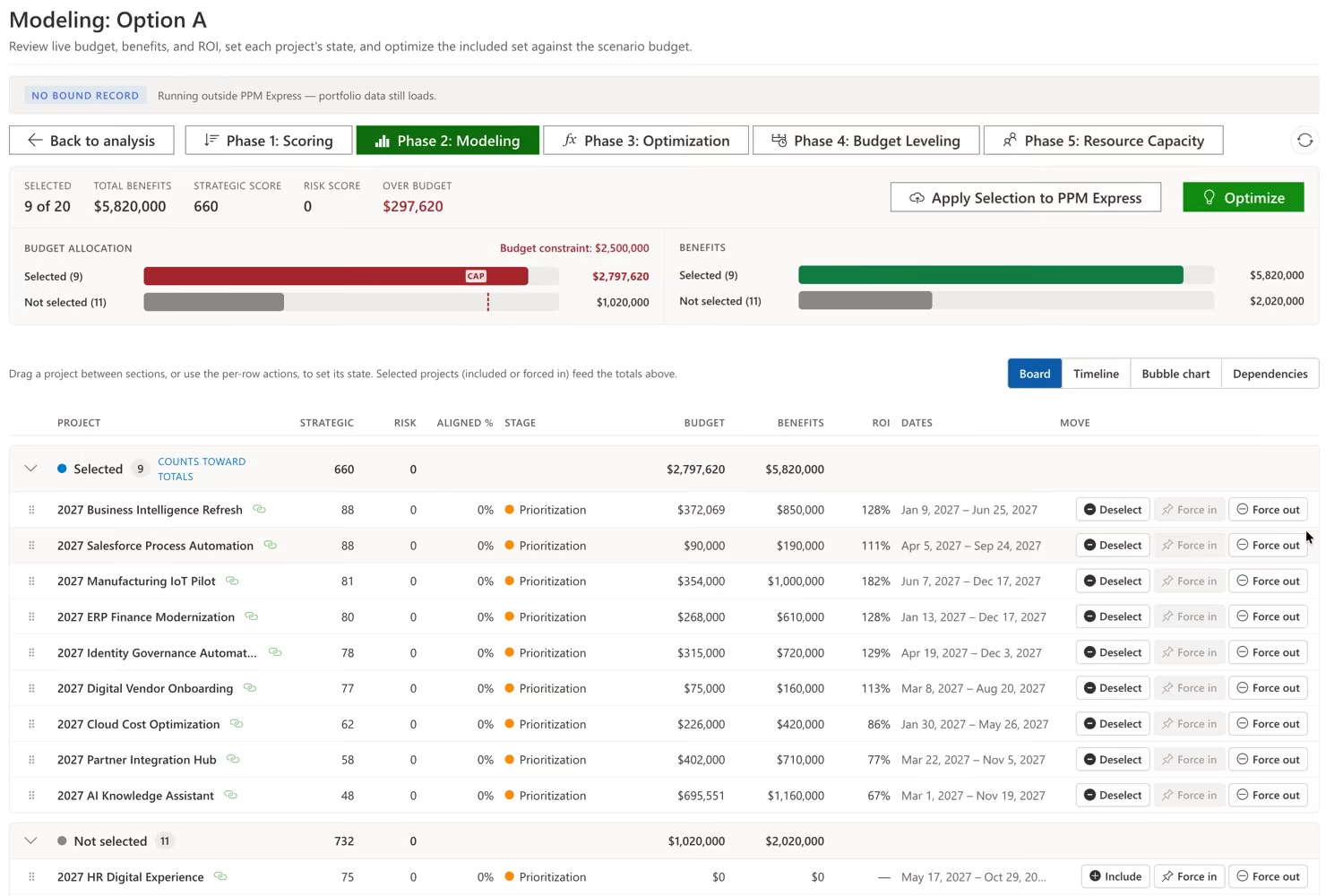
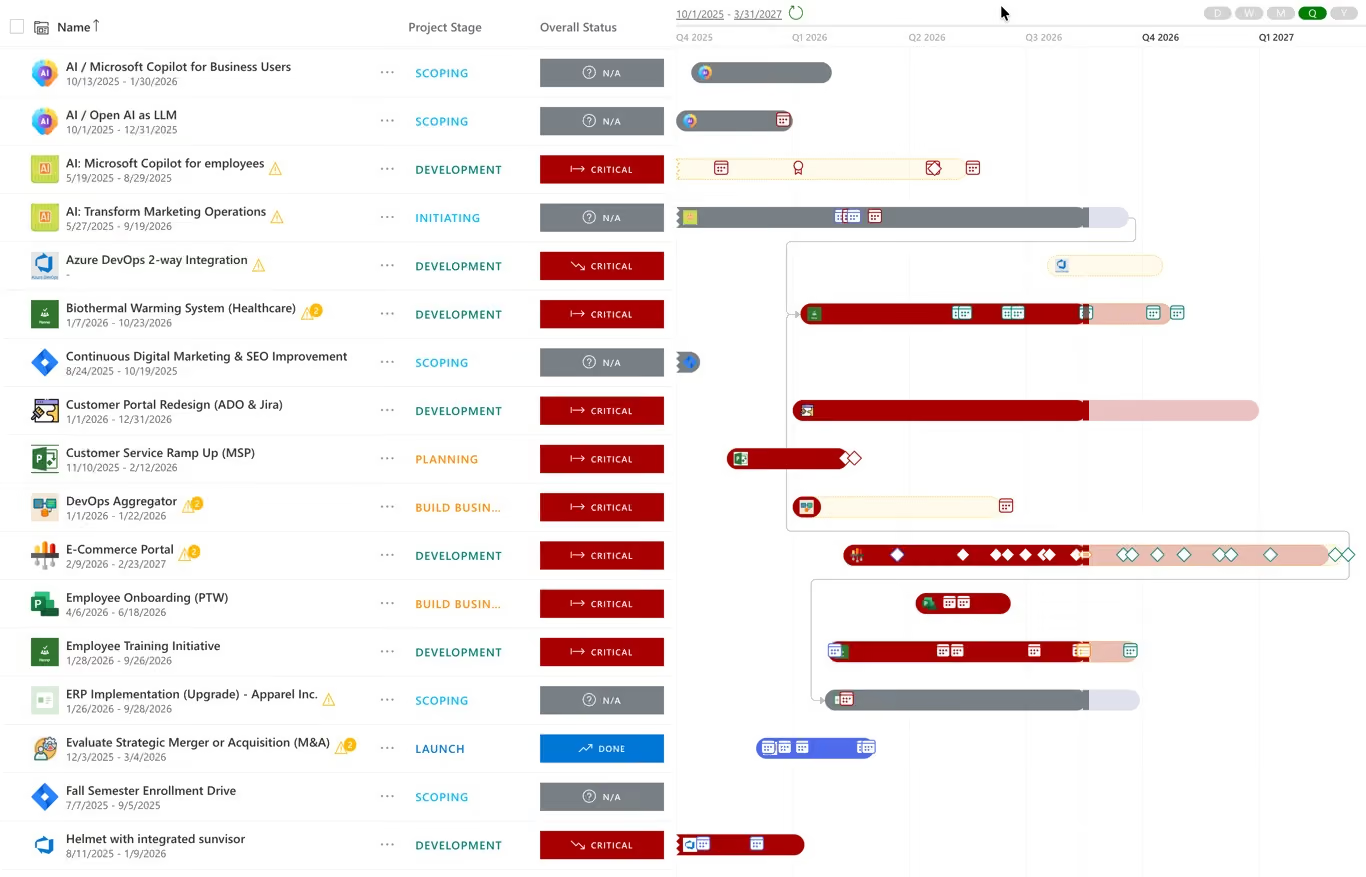
Whatever the delivery teams use — Jira, Azure DevOps, Microsoft Project, Planner, Smartsheet, Monday.com — the transformation view is assembled from live data rather than a monthly collection exercise that is stale before it is read.
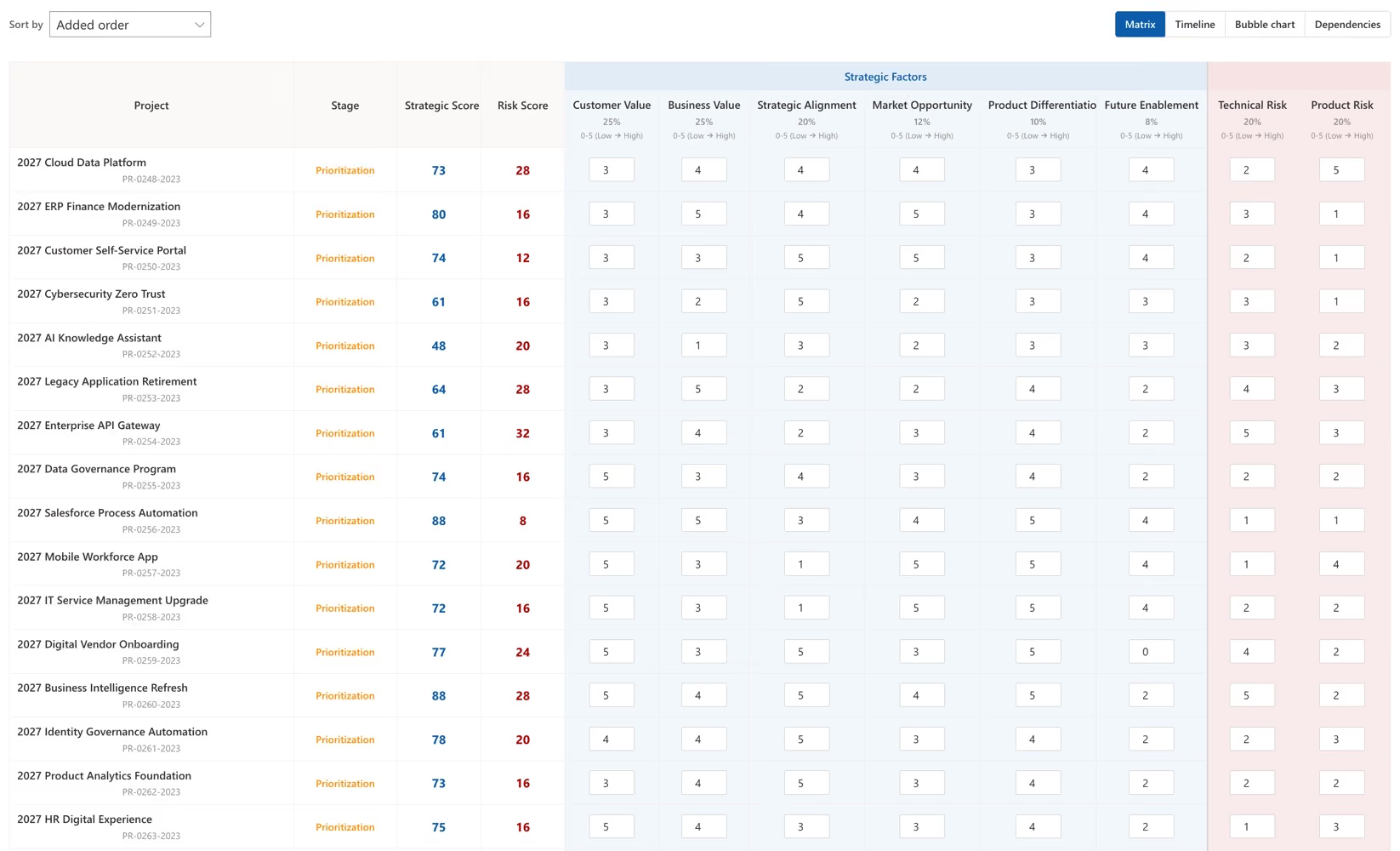
Weighted strategic and risk factors with published value ranges, so a score means the same thing across workstreams that are nothing alike. When you stop a program, the reasoning is on record, and the same criteria were demonstrably applied to the ones you kept.
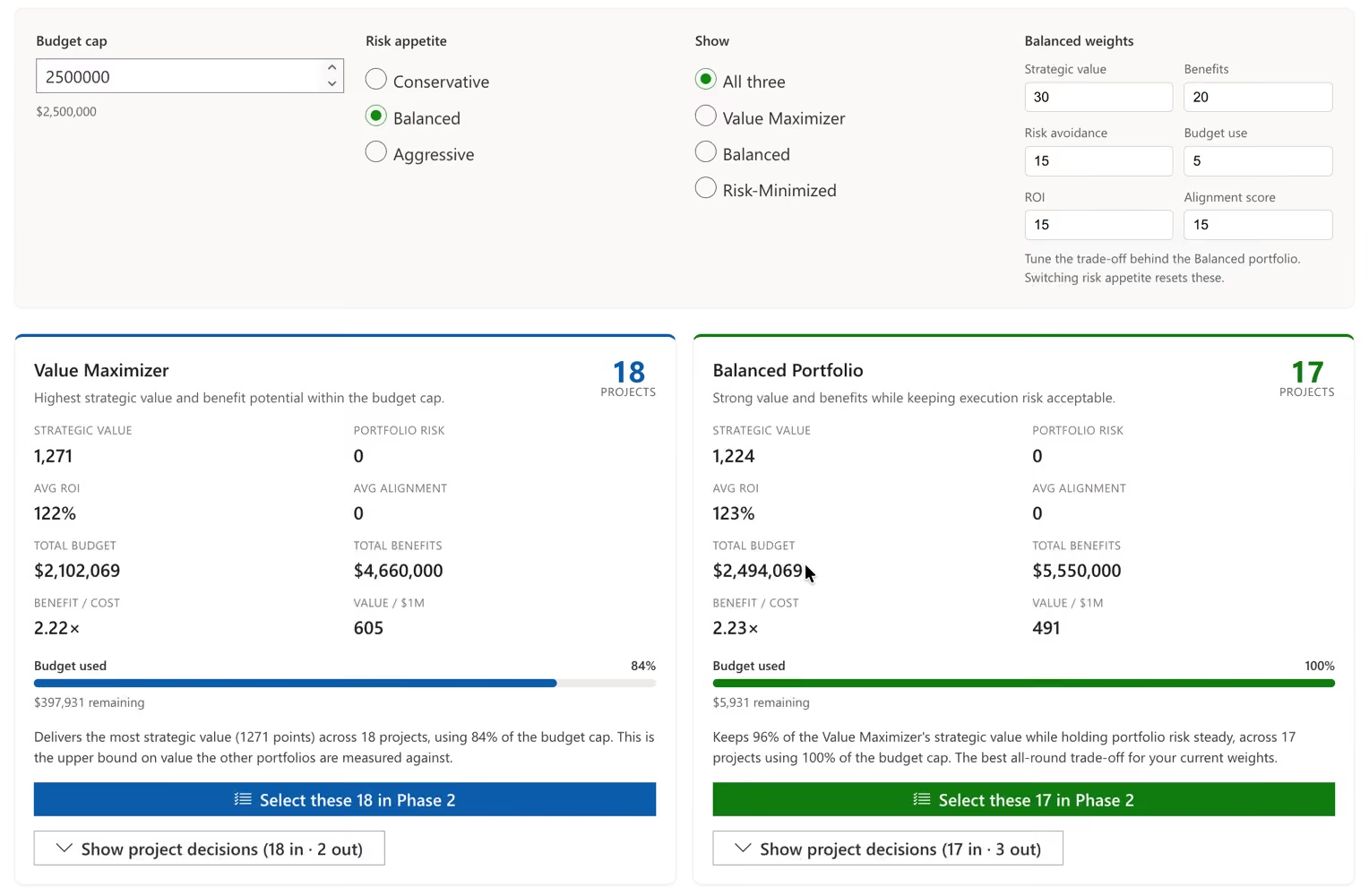
Build competing scenarios against one ceiling, see the Pareto-optimal set of trade-offs, check the survivors against people's free capacity, then publish the decision onto every project with the numbers baselined at the moment you made it.
Enterprise PPM platforms cover broadly the same ground. Where they differ most is what it costs to give your whole organization access to it.
| PPM Express | Planview | Planisware | Meisterplan | ServiceNow SPM | |
|---|---|---|---|---|---|
| Portfolio and programme hierarchy | Yes | Yes | Yes | Yes | Yes |
| Weighted scoring and prioritization | Yes | Yes | Yes | Yes | Yes |
| What-if funding scenarios | Yes | Yes | Yes | Yes | Yes |
| Resource capacity planning | Yes | Yes | Yes | Yes | Yes |
| Stage-gate intake and approvals | Yes | Yes | Yes | Limited | Yes |
| Transformation and run-the-business portfolio split | Yes | Yes | Limited | Limited | Yes |
| Benefit realization tracked against the original case | Yes | Yes | Yes | Limited | Yes |
| Strategy and OKR linkage to funded work | Yes | Yes | Limited | Limited | Yes |
| Dashboards and portfolio reporting | Yes | Yes | Yes | Yes | Yes |
| Microsoft Project, Planner and Project for the Web | Native two-way | Yes | Limited | Limited | Limited |
| Jira and Azure DevOps | Native two-way | Yes | Limited | Limited | Yes |
| Power BI reporting pack | 200+ reports | Limited | Limited | Limited | Limited |
| Unlimited users included | Yes | No, per seat | No, per seat | No, per seat | No, per seat |
| Typical annual cost | $8,000 to $25,000 flat | $100,000+ | $100,000+ | Mid five figures | $100,000+ with platform |
Planview is the broadest suite in the category and the strongest analyst position. For a large multi-year transformation it covers more ground than we do, including enterprise architecture and value stream management. It also carries the longest implementation and the highest cost, which is a difficult thing to justify inside a programme already under budget scrutiny.
Planisware is genuinely excellent at R&D and new product development pipeline modelling. For a transformation portfolio of technology, process and operating model work, that depth is largely unused and still paid for.
Meisterplan is fast to deploy and very good at lean capacity and scenario planning. If the transformation is competing with business-as-usual for the same people, it will show you that quickly. It is deliberately lighter on financials and benefit realization, which is where transformation programmes are eventually judged.
ServiceNow SPM is a strong choice if you already run ServiceNow for ITSM, because the platform and data are already there. If not, you are buying the platform to get the portfolio module, and that becomes another transformation project of its own.
PPM Express covers the same core portfolio capabilities on one flat annual subscription with unlimited users. We are not the deepest R&D pipeline tool or the broadest enterprise suite. We are the portfolio layer that puts transformation and everything it displaces in the same view, so the true cost of the programme is visible.
Enterprise PPM platforms cover broadly the same ground. For a transformation portfolio the difference that matters is how well the platform holds the line from strategic objective to funded initiative to realised benefit, and what it costs to keep every stakeholder looking at it.
| PPM Express | Planview | Planisware | Meisterplan | ServiceNow SPM | |
|---|---|---|---|---|---|
| Weighted scoring and prioritization | Yes | Yes | Yes | Yes | Yes |
| What-if funding scenarios | Yes | Yes | Yes | Yes | Yes |
| Budgets, forecasts and benefit realization | Yes | Yes | Yes | Yes | Yes |
| Gated intake with configurable approval workflow | Yes | Yes | Yes | Limited | Yes |
| Portfolio and programme hierarchy | Yes | Yes | Yes | Yes | Yes |
| Resource capacity planning | Yes | Yes | Yes | Yes | Yes |
| Automated status reporting across every project | AI-drafted | Yes | Yes | Limited | Yes |
| Dashboards and portfolio reporting | Yes | Yes | Yes | Yes | Yes |
| Microsoft Project, Planner and Project for the Web | Native two-way | Yes | Limited | Limited | Limited |
| Jira and Azure DevOps | Native two-way | Yes | Limited | Limited | Yes |
| Portfolio AI over Copilot, Claude or ChatGPT | MCP server | Limited | Limited | No | Limited |
| Unlimited users included | Yes | No, per seat | No, per seat | No, per seat | No, per seat |
| Typical annual cost | $8,000 to $25,000 flat | $100,000+ | $100,000+ | Mid five figures | $100,000+ with platform |
Planview is the broadest suite in the category and the strongest analyst position. If you need enterprise architecture, value stream management and PPM from one vendor, it covers more ground than we do, with the longest implementation and the highest cost to match. Per-seat licensing is also why transformation programmes tend to ration visibility to the seats they could justify.
Planisware is genuinely excellent at R&D and new product development pipeline modelling. For a transformation portfolio spanning technology, process and organizational change, that depth is largely unused and still paid for.
Meisterplan is fast to deploy and very good at lean capacity and scenario planning. If contention over scarce change capability is your single problem, it will solve it quickly. It is deliberately lighter on financials, benefit realization and gated intake, which is most of what a transformation office has to evidence.
ServiceNow SPM is a strong choice if you already run ServiceNow for ITSM, because the platform and data are already there. If not, you are buying the platform to get the portfolio module, and the procurement, cost and implementation footprint follow.
PPM Express covers the same core portfolio capabilities on one flat annual subscription with unlimited users. We are not the deepest R&D pipeline tool or the broadest enterprise suite. We are the portfolio layer for transformation offices that need a defensible record of what was funded, what changed and what it delivered, without a six-figure licence.
“If we take 15% out, what stops?” is the question every transformation office is asked and few can answer live. Build competing scenarios against one budget ceiling, see the trade-offs on screen, and select one, with the numbers baselined at the moment of decision and the full history kept for the conversation six months from now.
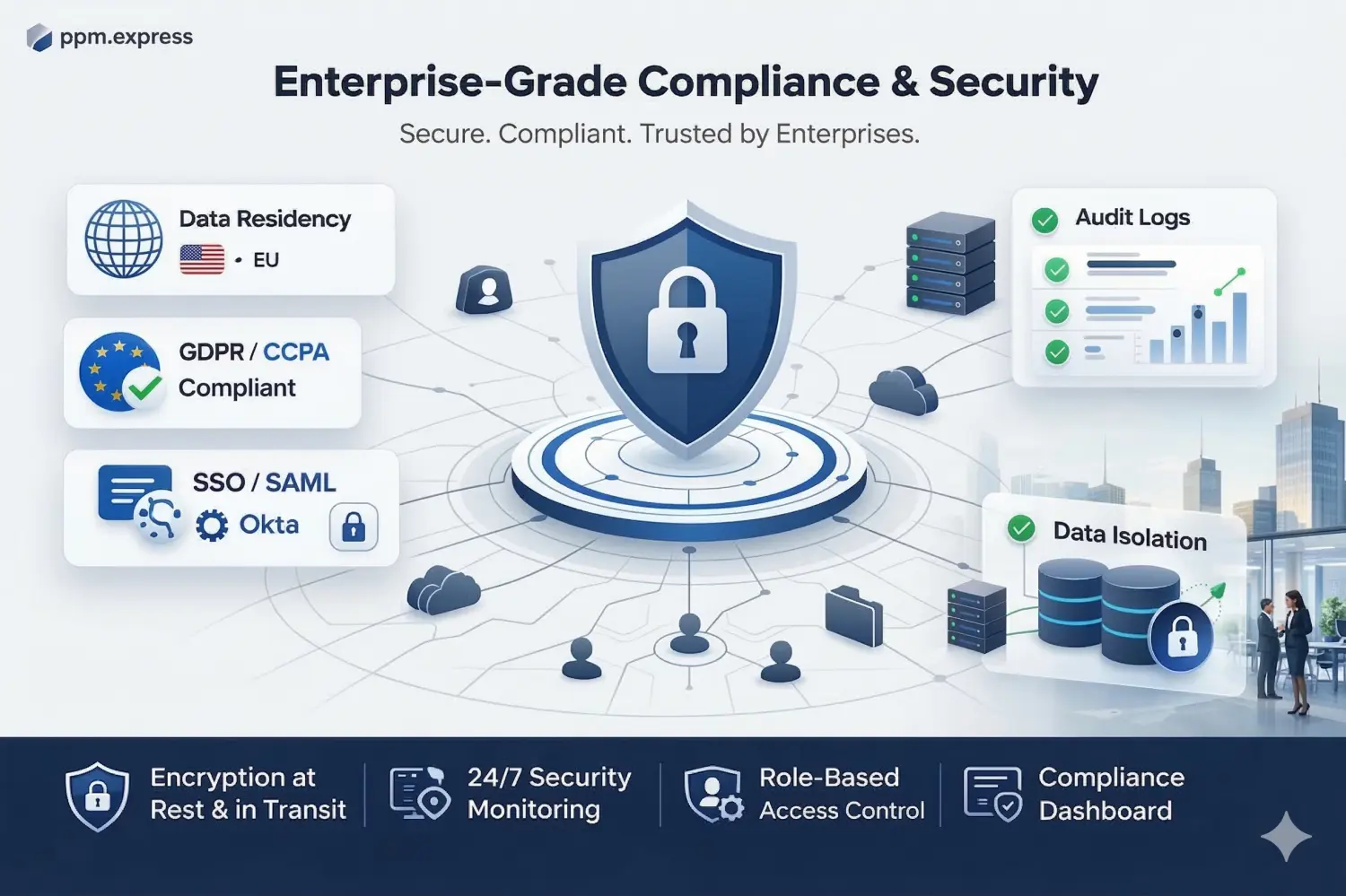

Security & Trust
Enterprise-grade security is built into our platform. We offer US and EU data residency, full GDPR compliance, and custom DPAs to meet strict regulatory requirements.
Need app availability in your region/country to meet data residency requirements? We can provide.
Microsoft 365 and Okta SSO ensure secure identity management, while centralized user management, advanced permissions, detailed audit logs, and strict data isolation protect sensitive enterprise data.
Bring your security reviewers to the same call.
Book Enterprise Demo

What our clients say
250+
Customers
use our software daily
100 hours
Saved every year
on monitoring state and statuses of projects, per PM
100K+
Projects
tracked on the PPM Express platform
Unlimited
Users
on every paid plan, so visibility is never rationed
Data residency
US & EU Data Residency
Encrypted in transit and at rest, with SSO, audit logs and tenant isolation. No customer data used to train AI models.
Reporting
200+ ready-to-use reports
Power BI reports built on live portfolio data, so stakeholders get self-service dashboards instead of a request queue.
Pricing
One flat annual subscription
$25,000/year for large enterprises, $8,000/year for SMB. No per-seat penalty.

Streamline Project Portfolio Management and Visibility at Scale
Integrations

Capture new project request, streamline evaluation and prioritization
Product

Structured Approach for prioritizing and aligning portfolios with strategic priorities and resource constraints
Product
Last updated 20 August 2026
Transformation Office portfolio management, answered.
A PMO assures delivery of a standing portfolio. A TMO exists to land one specific, time-bound change and then close down. Its distinguishing job is benefits: proving the value promised in the business case actually showed up, and recommending which workstreams continue, scale or stop. TMOs usually carry more authority and a much shorter life than the PMO they sit beside.
Defining the value a change is meant to deliver, giving it an owner, and tracking it through to the point where the business can evidence it. Three parts have to be in place: the benefit definition, a baseline to measure against, and someone accountable by name. Most transformation programs have the first one and neither of the other two.
It usually belongs in the portfolio platform rather than a separate tool, because a benefit only means anything next to the initiative delivering it and the money funding it. In PPM Express each workstream carries budget, forecast, benefits and impact, baselined at the moment of the funding decision. The promise and the outcome stay attached to each other instead of drifting into different decks.
Each workstream follows a process built from phases and stages, with gates in between. You decide which gates need approval. The workstream lead assigns approvers, who review in the Approval Center and approve or reject with comments. Unanimous approval advances the workstream. A single rejection holds it. If your organization already runs approvals through another system, gates can be routed there through the API instead.
Hold the benefit at the workstream that owns it rather than at the level where it gets reported. When three workstreams each claim a slice of the same headcount saving, all three claims sit against the same benefit and the overlap is obvious. Double-counting is almost always a side effect of benefits being added up in slides instead of tracked in one place.
Compare scenarios rather than defending workstreams one at a time. Pareto optimization shows the set of options where you can't improve strategic value, benefits, risk or cost without conceding something, so the board picks a point on that frontier. A workstream then stops because a better portfolio exists without it. Nobody has to lose an argument.
Usually the baseline was never fixed. If the "before" figure gets reconstructed afterward, any result can be made to look like progress, and your CFO knows it. PPM Express baselines numbers at the moment of the decision and keeps the decision history, so the comparison runs against what was actually approved rather than a figure assembled later to fit the story.
PPM Express works out capacity from each person's work week and calendar exceptions, then shows allocation against it in hours, percent or FTE, with overallocation color-coded. Transformations tend to fail in a specific way here: the same senior operators are written into six workstream plans, each of which looked reasonable on its own. Put those plans in one view and the double-booking is unmissable.
Portfolio position, movement since last time, decisions being requested, benefits against baseline. The week of prep exists because those four things live in four places. In PPM Express they're one live view, so the pack becomes a snapshot of the system rather than a rebuild of it. That also removes the awkward gap between what the pack says and what the delivery tools say.
Every selected scenario stamps its outcome onto each workstream, baselines the numbers at that moment, and keeps the decision history. Three months on, "this was never agreed" becomes a checkable claim. It's the difference between a governance forum that decides things and one that reopens the same argument each quarter with a slightly different set of attendees.
It does. Project Online and Project for the Web connect directly, and for the Microsoft Project Desktop client there's PPM Express Project Publisher, an add-in that publishes an open plan up into PPM Express. Desktop 2016, 2019 and 2021 are supported. Workstream leads keep their planning tool, and the TMO gets the portfolio view without asking anyone to rebuild a schedule.
Partly by asking less of people. Workstream leads stay in the tools they already use, whether that's Microsoft Project, Planner, Smartsheet, Monday.com, Jira or Azure DevOps, rather than keeping a parallel set of records for the TMO. Fatigue is often less about the change itself than about the reporting overhead that arrives with it.
Most are, in fact. TMOs typically get created once a program is already in difficulty. Because PPM Express connects to tools the workstreams are already using, you can assemble the current position without pausing delivery for a data-gathering exercise. The genuinely hard part is retrofitting baselines for workstreams that started without them, and that's a governance call rather than a software one.
.svg)


