
For small and mid-size organizations
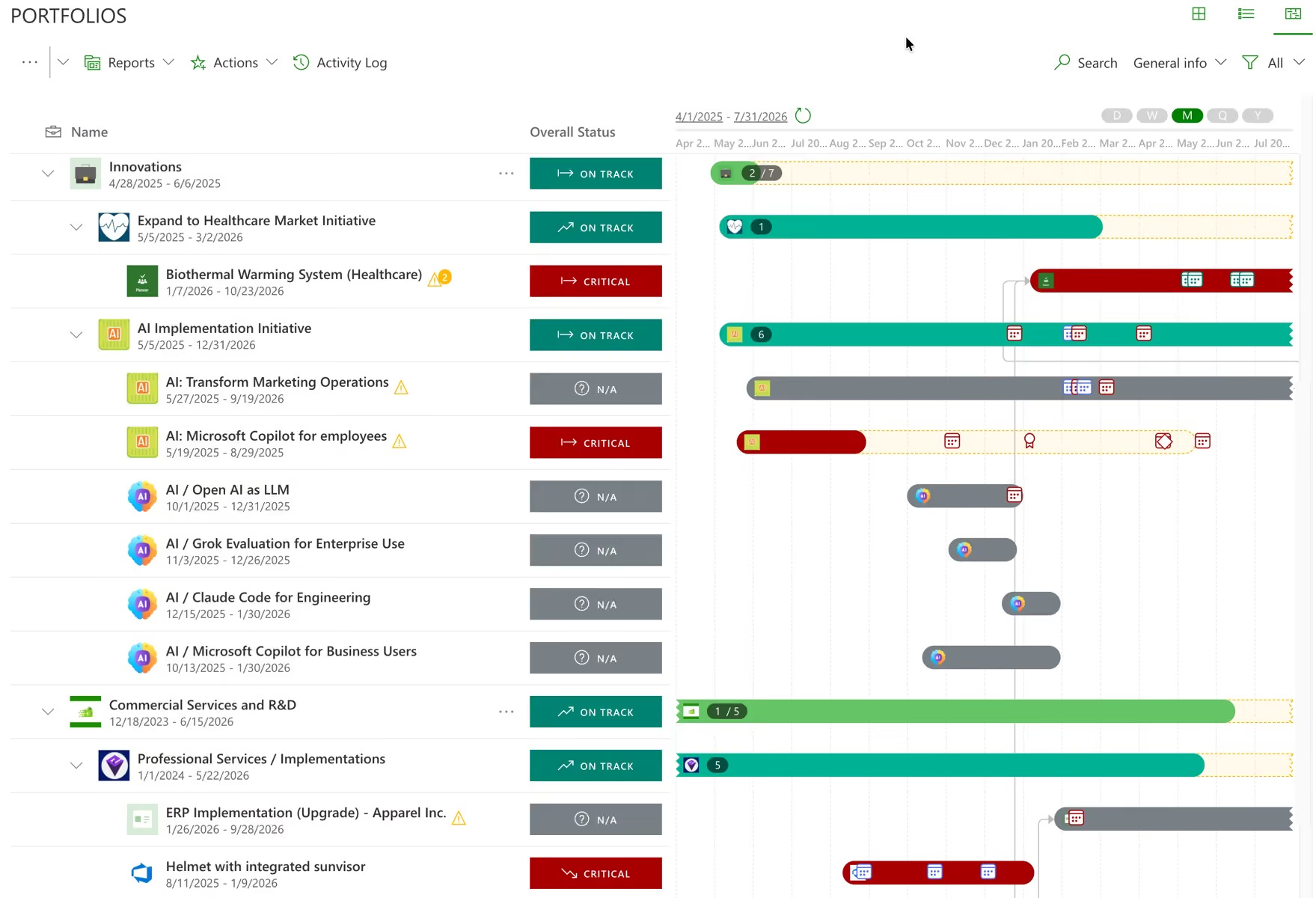
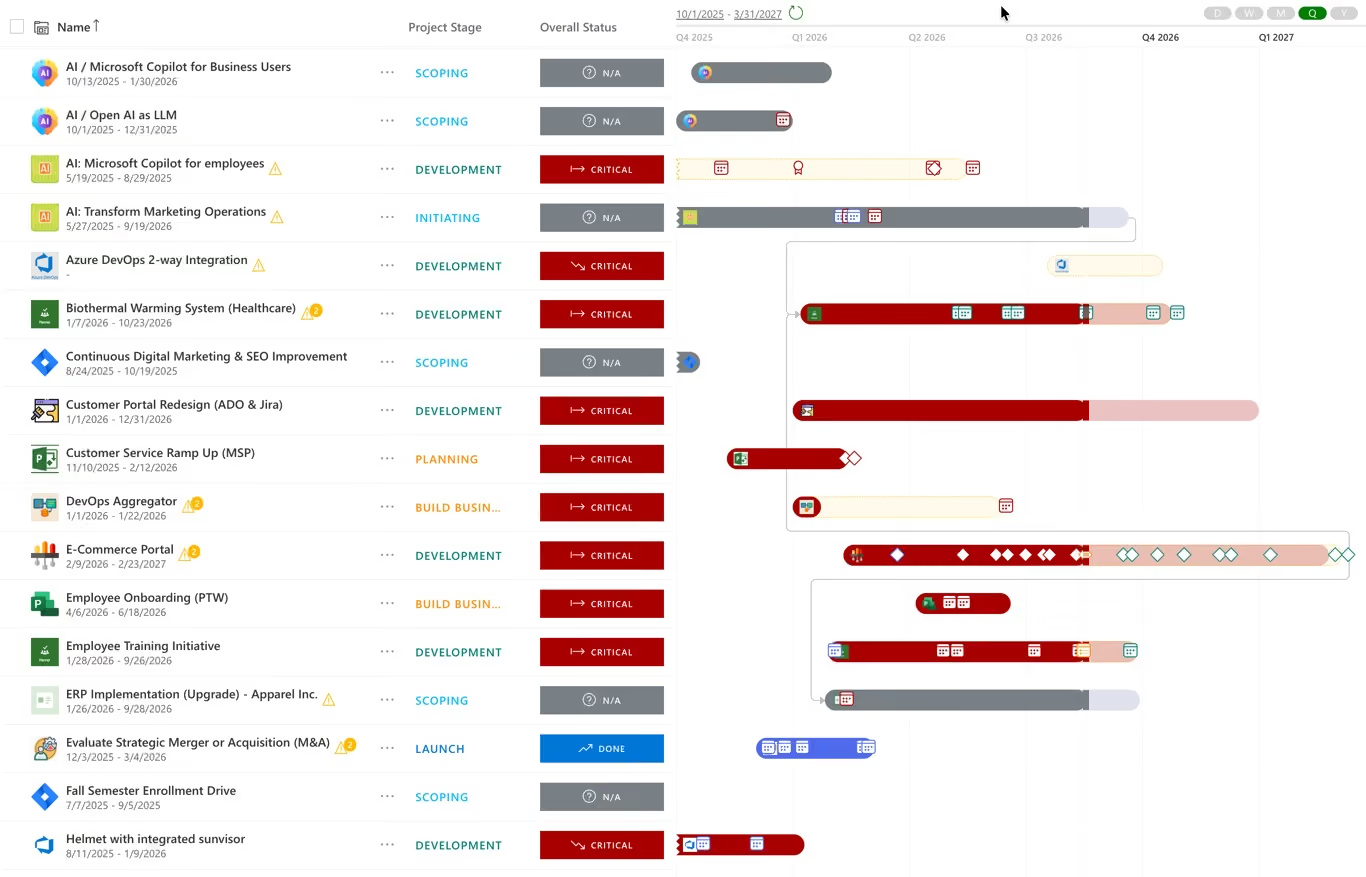
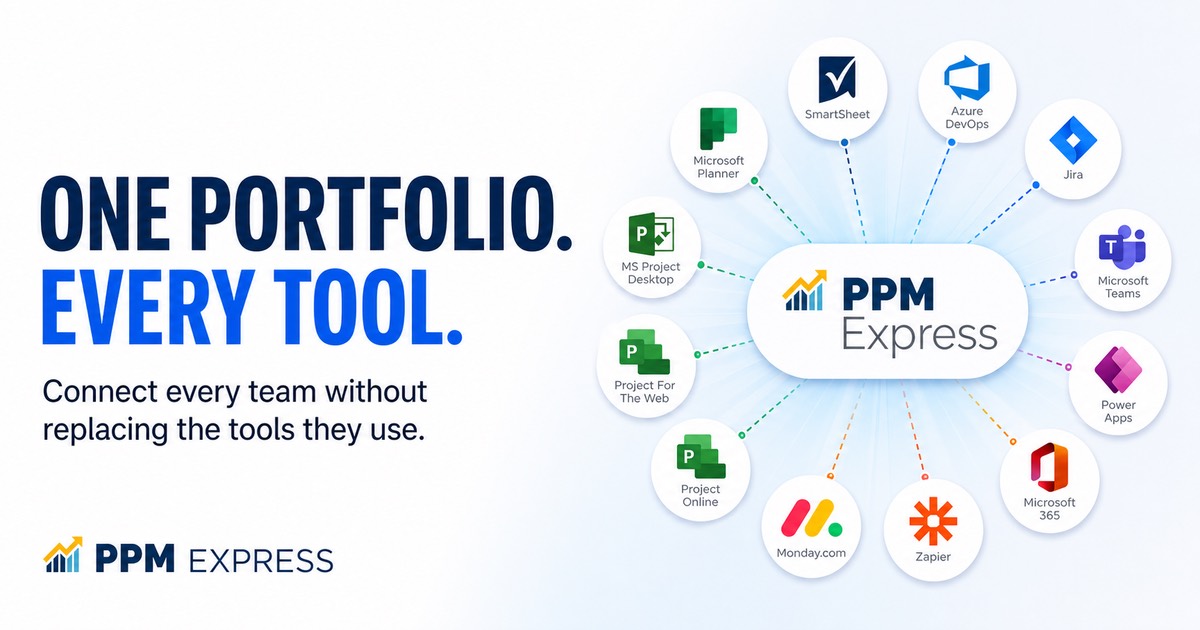
Two-way sync with Jira and Azure DevOps on Ultra; Microsoft Project, Planner, Project for the Web, Smartsheet and monday.com read into the portfolio. Nothing is migrated and nobody records their work twice — the portfolio fills from live project data.
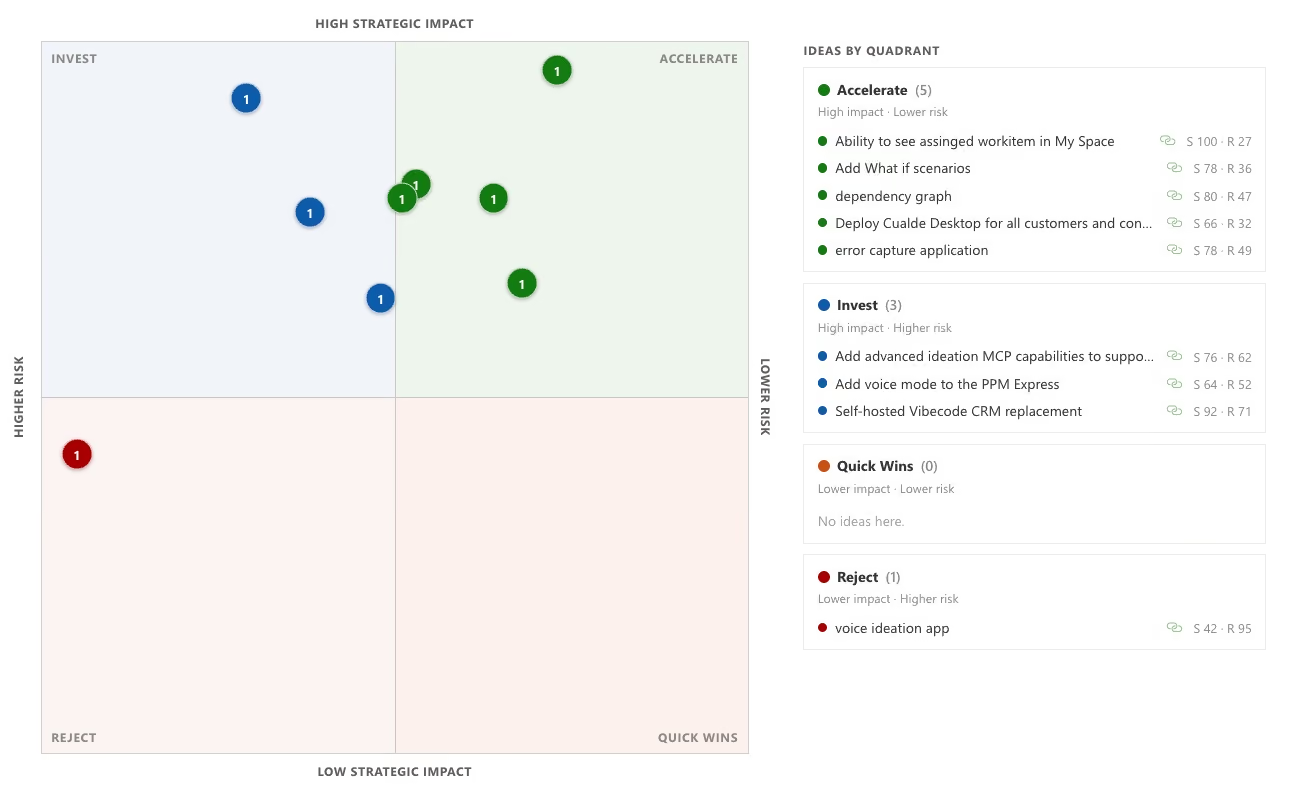
Requests arrive through a form instead of a corridor, get scored against criteria agreed in advance, and join a ranked queue. Weighted scoring, MoSCoW or ICE — whichever your organization will actually use.
AI-written status assembled from live data, 200+ Power BI reports, and a portfolio view leadership can open themselves. The monthly assembly job mostly disappears.
Four tools organizations of this size actually shortlist, on the same requirements. Where they differ most is how the bill behaves as you grow.
| PPM Express | Celoxis | Microsoft Project Plan 3 | Meisterplan | ServiceNow SPM | |
|---|---|---|---|---|---|
| Portfolio and programme hierarchy | Yes | Yes | Limited | Yes | Yes |
| Weighted scoring and prioritization | Yes | Yes | No | Yes | Yes |
| What-if funding scenarios | Yes | Limited | No | Yes | Yes |
| Resource capacity planning | Yes | Yes | Yes | Yes | Yes |
| Gated intake and approvals | Yes | Limited | No | Limited | Yes |
| Budgets, forecasts and benefit realization | Yes | Yes | Limited | Limited | Yes |
| Dashboards and portfolio reporting | Yes | Yes | Limited | Yes | Yes |
| Portfolio layer over tools teams already use | Yes | Limited | No | Limited | Limited |
| Microsoft Project, Planner and Project for the Web | Native two-way | Limited | Native | Limited | Limited |
| Jira and Azure DevOps | Native two-way | Limited | No | Limited | Yes |
| Power BI reporting pack | 200+ reports | Limited | Yes | Limited | Limited |
| Unlimited users included | Yes | No, per user | No, per user | No, per resource | No, per seat |
| Published rate | $8,000/year flat | $45 per user/month | $30 per user/month | From $600/month per 50 resources | Quoted, platform required |
| Modelled cost at 100 people | $8,000 | $54,000 | $36,000 | About $14,400 | Quoted |
| Cost as headcount grows | Unchanged | Rises per user | Rises per user | Rises per resource | Rises per seat |
Modelled figures are list rates applied to 100 people, billed annually, and exclude discounts, implementation and any platform licences bought separately. Vendor rates were taken from published pricing at the time of writing. Check current pricing with each vendor before deciding.
Celoxis is a capable all-round PPM product and a fair shortlist entry at this size, with genuine portfolio, financial and reporting depth. The difference is licensing shape rather than capability: at $45 per user per month the bill scales with every person you want to see the portfolio, which is usually the opposite of what a growing organization wants.
Microsoft Project Plan 3 is the cheapest way into scheduling if you are already a Microsoft estate, and it sits closer to the identity, compliance and Copilot layer you already have. It is a project scheduling tool rather than a portfolio governance layer, so weighted prioritization, gated intake and funding scenarios are Power Platform builds you would own yourself. Many organizations run Plan 3 and a portfolio layer together rather than choosing between them.
Meisterplan is the closest comparison on price at this size and genuinely strong at lean capacity and scenario planning. It charges per planned resource, so the cost tracks your resource pool rather than your headcount. It is deliberately lighter on financials, benefit realization and gated intake, which is where organizations tend to outgrow it rather than replace it.
ServiceNow SPM rarely makes sense at this size unless you already run ServiceNow, because you would be buying the platform in order to get the portfolio module.
PPM Express covers the same core portfolio capabilities on one flat annual subscription with unlimited users. We are not the cheapest scheduler and we are not the lightest capacity tool. We are enterprise portfolio capability at $8,000 a year, with the price unchanged as you grow.
A smaller organization does not need less portfolio management — it needs the same answers with far less overhead to get them. Four capabilities cover most of what a growing organization actually asks of a portfolio, and all four are included in the $8,000 plan.
Security & Trust
Enterprise-grade security is built into our platform. We offer US and EU data residency, full GDPR compliance, and custom DPAs to meet strict regulatory requirements.
Need app availability in your region/country to meet data residency requirements? We can provide.
Microsoft 365 and Okta SSO ensure secure identity management, while centralized user management, advanced permissions, detailed audit logs, and strict data isolation protect sensitive enterprise data.
Bring your security reviewers to the same call.
Book Enterprise Demo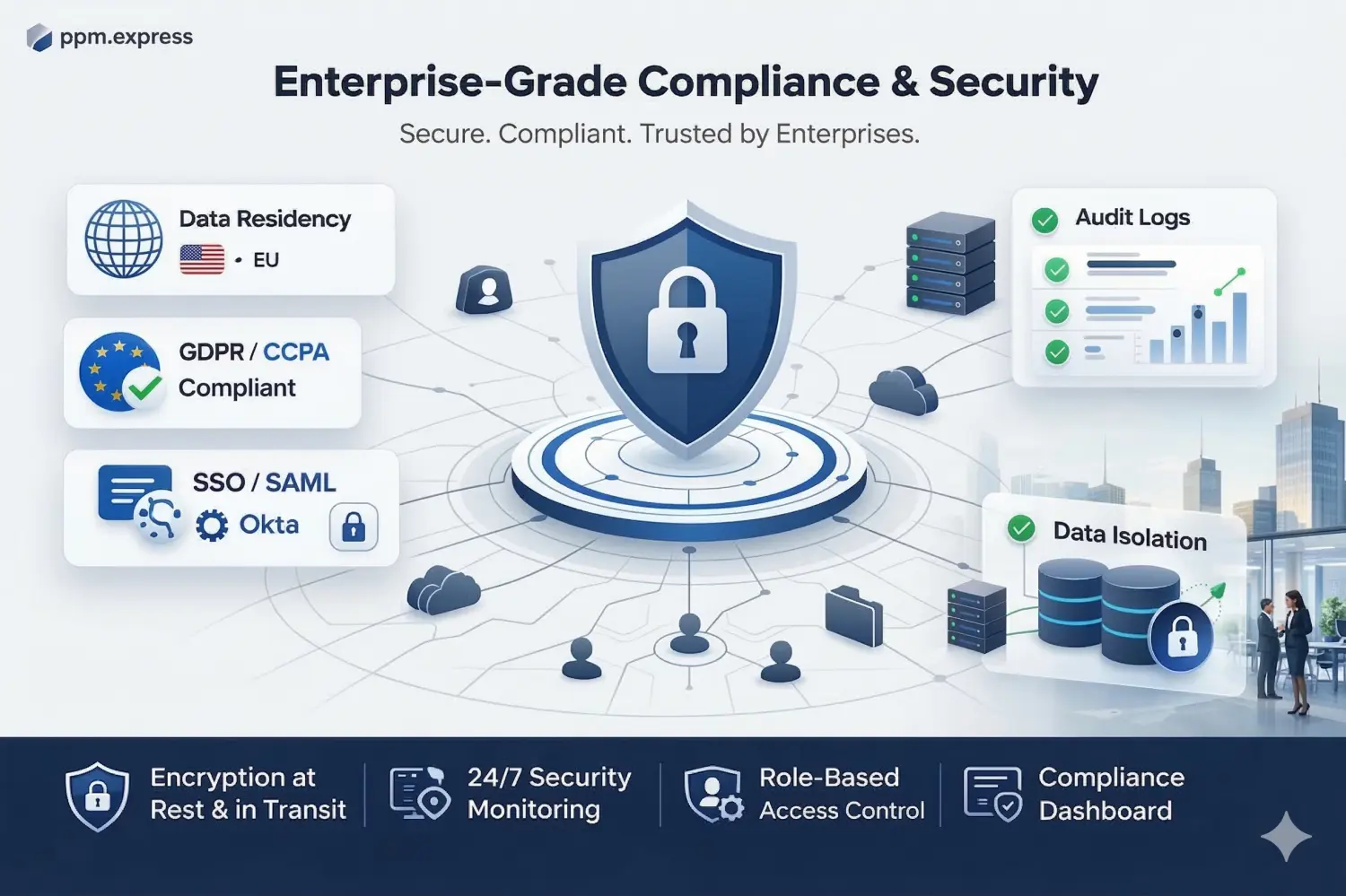


What our clients say
250+
Customers
use our software daily
100 hours
Saved every year
on monitoring state and statuses of projects, per PM
100K+
Projects
tracked on the PPM Express platform
Unlimited
Users
on every paid plan, so visibility is never rationed
Data residency
US & EU Data Residency
Encrypted in transit and at rest, with SSO, audit logs and tenant isolation. No customer data used to train AI models.
Reporting
200+ ready-to-use reports
Power BI reports built on live portfolio data, so stakeholders get self-service dashboards instead of a request queue.
Pricing
One flat annual subscription
$25,000/year for large enterprises, $8,000/year for SMB. No per-seat penalty.

Every project from Jira, Azure DevOps, Planner and the rest, in one view that maintains itself.
Integrations


Capture new requests, score them on agreed criteria, and convert what is approved into a funded project.
Product

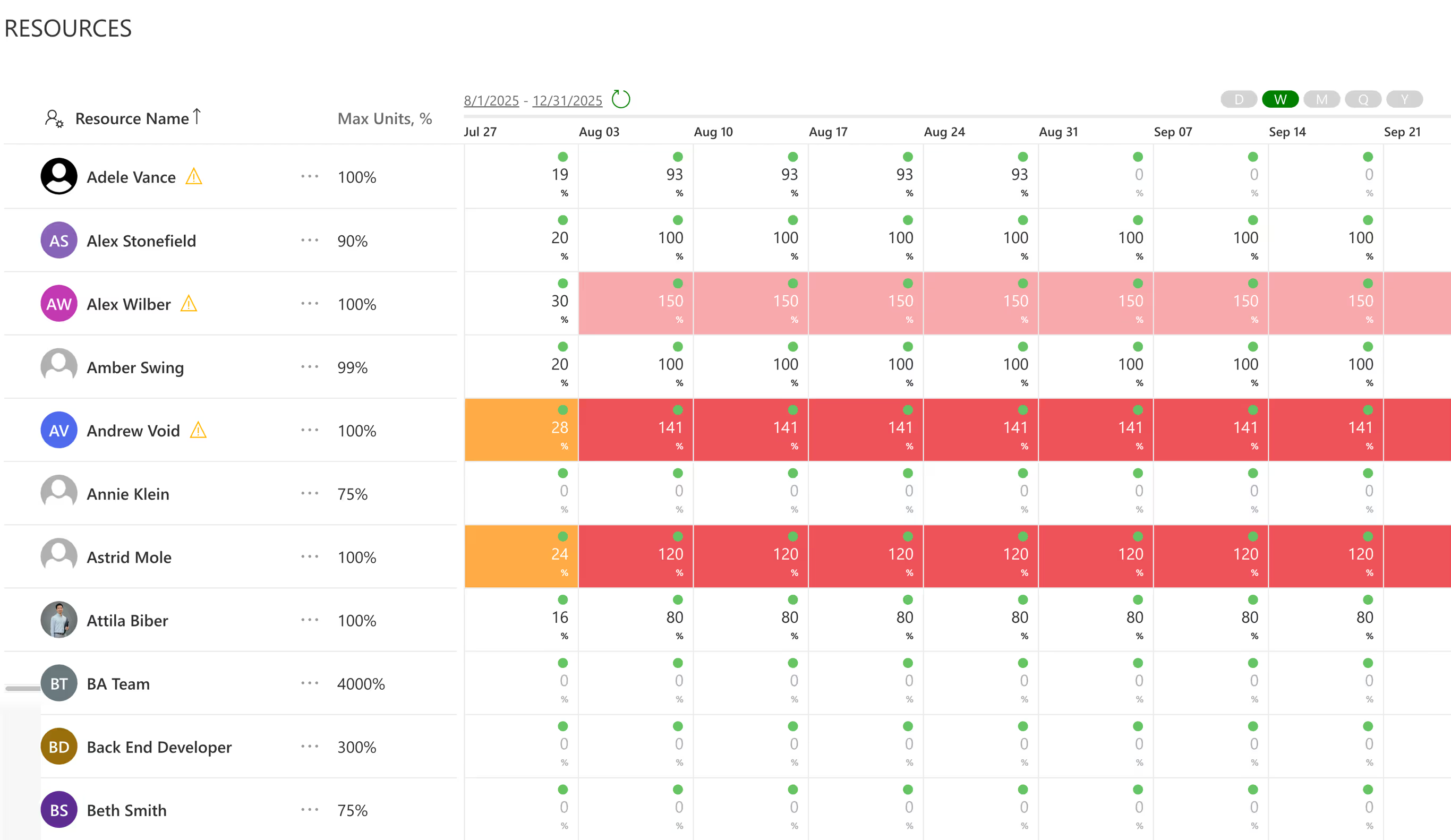
Plan by role and skill against real availability, so over-allocation surfaces before you commit.
Product
Last updated 30 August 2026
Portfolio management for small and mid-size organizations, answered.
PPM Express Enterprise is $8,000 per year, billed annually, with unlimited users and guests. That is the whole price — there is no per-seat component, so it does not change when you hire, and adding executives or external stakeholders as viewers costs nothing. There is a thirty-day trial, and a full refund within thirty days of purchase if it is not right.
No. Project, program and portfolio management, resource planning and utilization with unlimited resources, financials and benefit realization, innovation and ideation, roadmaps, OKRs, unlimited time tracking, the 200+ Power BI report pack, AI project status reports and all integrations are included on Enterprise. Ultra, at $25,000 a year, is aimed at large enterprises and public companies that need the additional security, support and governance options rather than different core functionality.
A meaningful share of our customers are organizations of this size. The threshold is not headcount, it is whether you run enough projects across enough tools that no single person can hold the picture in their head — and whether more work is being asked for than the team can absorb. If both are true, the portfolio problem is real regardless of how many people you employ.
Yes, and it is a common starting point. In smaller organizations the portfolio is usually run by an operations lead, a head of delivery or the COO alongside another job. PPM Express is built so the portfolio maintains itself from the delivery tools rather than requiring someone to keep it current, which is precisely what makes it workable without dedicated PMO headcount.
None of those can answer a portfolio question. Each holds the truth about its own projects, in its own structure, and the only way to compare across them is for a person to rebuild the picture by hand every month. PPM Express sits above them and reads from them. Your teams keep working exactly where they work now and nothing is recorded twice.
There is no data migration to run. Because PPM Express connects to tools you already use, the portfolio fills from live project data as soon as the integrations are connected — usually within the trial. Configuring scoring models, portfolio structure and reports is where the time goes, and that is measured in days rather than the multi-month implementations this category is known for.
Most portfolio rollouts fail because delivery teams are asked to record their work twice — once in their own tool, once in the portfolio system. Predictably they stop, and the portfolio goes stale. PPM Express reads from the delivery tools instead, so the only people who change how they work are the ones running the portfolio, and they are the ones who wanted it.
Put a front door on it. Requests and ideas are submitted through a form that captures the context needed to judge them, scored against criteria agreed in advance — weighted scoring, MoSCoW or ICE — and reviewed at a gate. What is approved converts into a project with the business case still attached, so the reasoning survives into delivery.
Check capacity before you approve, not after. PPM Express derives availability from each person’s work week, calendar and calendar exceptions, then plans by role and skill across every project. Over-allocation is shown at the point of commitment, so “can we take this on as well?” gets a real answer instead of an optimistic one.
Yes, and because guests are unlimited there is no reason not to give them access. Budgets, forecasts, benefits, dates and resource plans are live in PPM Express, with AI-written status reports and more than 200 Power BI reports. Leadership opens the portfolio rather than waiting for someone to assemble a view of it.
Nothing you have to renegotiate. The price does not move with headcount, and the same product runs portfolios of hundreds of projects at much larger organizations, so there is no starter tier to outgrow or migration to a different edition. If you later need the additional security and support options, moving to Ultra credits the unused remainder of what you have already paid.
Data residency is available in the US and the EU, with full GDPR compliance and custom DPAs where your legal team needs them. Sign-in runs through Microsoft 365 or Okta SSO, with centralized user management, advanced permissions, audit logs and strict tenant isolation. None of that is reserved for the larger plan.
Data residency is available in the US and the EU, with full GDPR compliance and custom DPAs where your legal team needs them. Microsoft 365 and Okta SSO handle identity, so joiners and leavers follow the directory you already run. Each customer's data is strictly isolated, and detailed audit logs record what changed and who changed it.
.svg)


