
PPM SOFTWARE for Insurance Companies
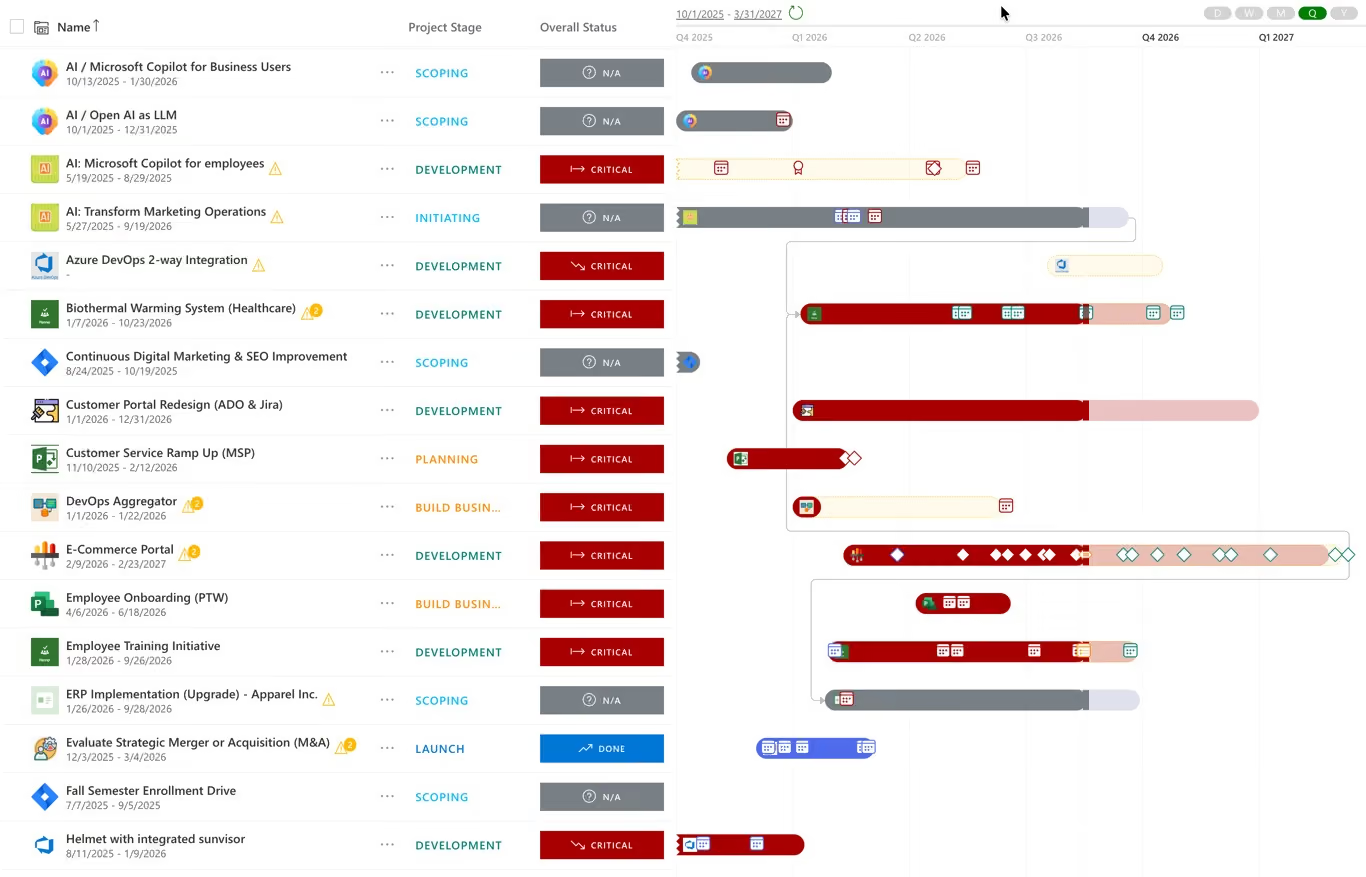
Roll up work from Azure DevOps, Jira, Microsoft Project, Planner, Project for the Web, Smartsheet and Monday.com across product, claims, policy, data, operations and technology. Teams keep their delivery tools; portfolio leaders get one current view without anyone maintaining a second reporting plan.
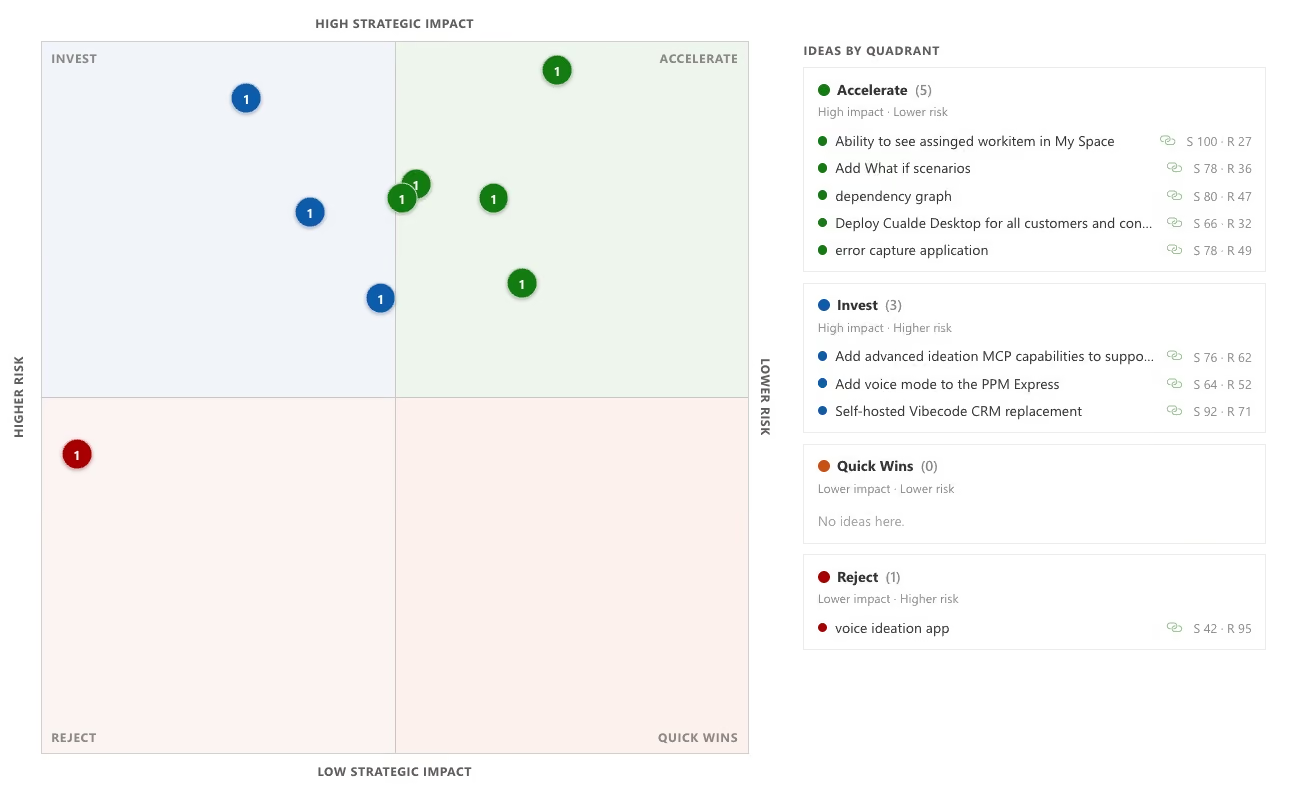
Score proposals against weighted strategic and risk criteria with published value ranges, keeping budget, forecast, benefits and impact in view. A required change, a claims improvement and a product opportunity stay different kinds of work, but the basis for sequencing them stops being implicit.
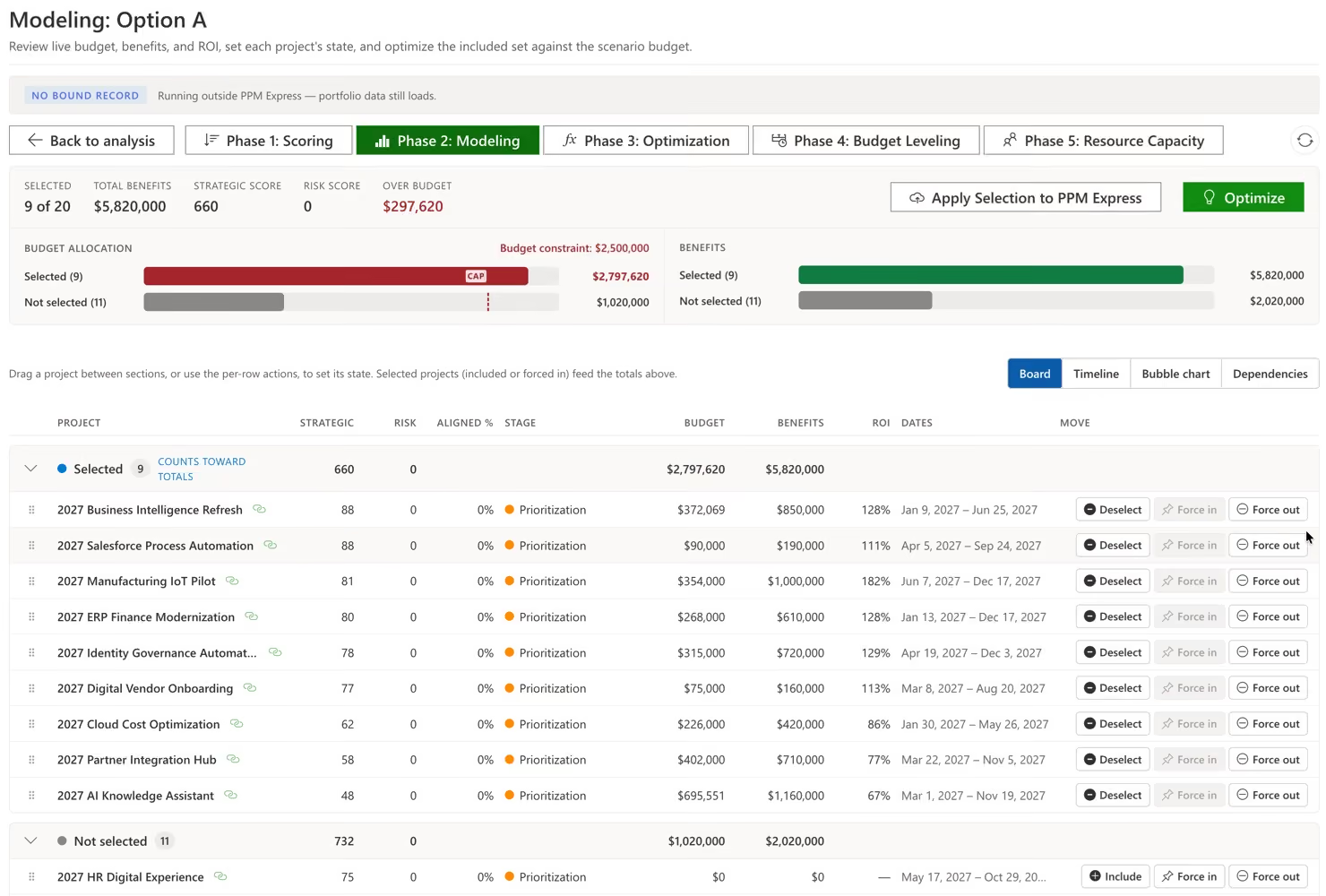
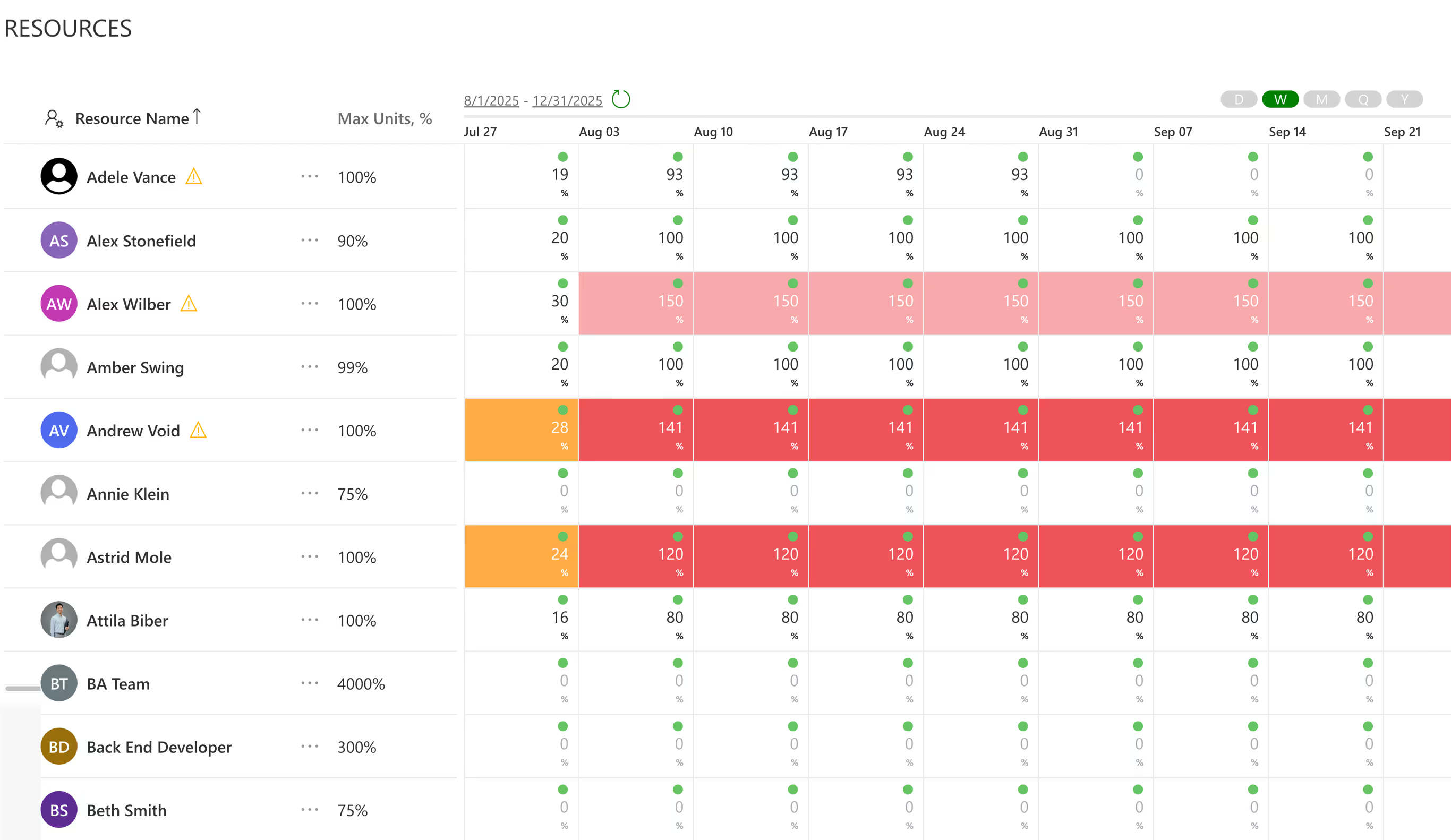
Model funding scenarios against one ceiling and check the selected work against availability in hours or % FTE. Where several roadmaps depend on the same architecture, data or security capacity, you see the collision while it is still a proposal.
Enterprise PPM platforms cover broadly the same ground. Where they differ most is what it costs to give your whole organization access to it.
| PPM Express | Planview | Planisware | Meisterplan | ServiceNow SPM | |
|---|---|---|---|---|---|
| Portfolio and programme hierarchy | Yes | Yes | Yes | Yes | Yes |
| Weighted scoring and prioritization | Yes | Yes | Yes | Yes | Yes |
| What-if funding scenarios | Yes | Yes | Yes | Yes | Yes |
| Resource capacity planning | Yes | Yes | Yes | Yes | Yes |
| Stage-gate intake and approvals | Yes | Yes | Yes | Yes | Yes |
| Budgets, forecasts and benefit realization | Yes | Yes | Yes | Yes | Yes |
| Dashboards and portfolio reporting | Yes | Yes | Yes | Yes | Yes |
| Multi-line-of-business portfolio (P&C, life, specialty) | Yes | Yes | Yes | Limited | Yes |
| Regulatory commitment tracking with deadline baselines | Yes | Yes | Yes | Limited | Yes |
| Microsoft Project, Planner and Project for the Web | Native two-way | Yes | Limited | Limited | Limited |
| Jira and Azure DevOps | Native two-way | Yes | Limited | Limited | Yes |
| Power BI reporting pack | 200+ reports | Limited | Limited | Limited | Limited |
| Unlimited users included | Yes | No, per seat | No, per seat | No, per seat | No, per seat |
| Typical annual cost | $8,000 to $25,000 flat | $100,000+ | $100,000+ | Mid five figures | $100,000+ with platform |
Planview is the broadest suite in the category and the strongest analyst position. If you need enterprise architecture, value stream management and PPM from one vendor, it covers more ground than we do, with the longest implementation and the highest cost to match. Per-seat licensing also means the executives who most need portfolio visibility are usually the ones left out.
Planisware is genuinely excellent at R&D and new product development pipeline modelling, with depth we do not attempt to match. For a carrier portfolio of regulatory, claims, policy-platform and distribution work, that depth is largely unused and still paid for.
Meisterplan is fast to deploy and very good at lean capacity and scenario planning. If contention over shared architects and actuaries is your single problem, it will solve it quickly. It is deliberately lighter on financials, benefit realization and gated intake, so carriers with regulatory evidence requirements tend to outgrow it.
ServiceNow SPM is a strong choice if the carrier already runs ServiceNow for ITSM, because the platform and data are already there. If not, you are buying the platform to get the portfolio module, and the cost and implementation footprint follow.
PPM Express covers the same core portfolio capabilities on one flat annual subscription with unlimited users. We are not the deepest R&D pipeline tool or the broadest enterprise suite. We are the portfolio layer for carriers that run on Microsoft and Jira and need a defensible decision record without a six-figure licence.
A required policy change, a claims initiative, a product launch and a platform upgrade can all be urgent and still compete for the same people. Score each one against explicit criteria, compare the funding scenarios that are actually viable, and test the result against shared capacity before four separate roadmaps become one impossible delivery plan.
Security & Trust
Enterprise-grade security is built into our platform. We offer US and EU data residency, full GDPR compliance, and custom DPAs to meet strict regulatory requirements.
Need app availability in your region/country to meet data residency requirements? We can provide.
Microsoft 365 and Okta SSO ensure secure identity management, while centralized user management, advanced permissions, detailed audit logs, and strict data isolation protect sensitive enterprise data.
Bring your security reviewers to the same call.
Book Enterprise Demo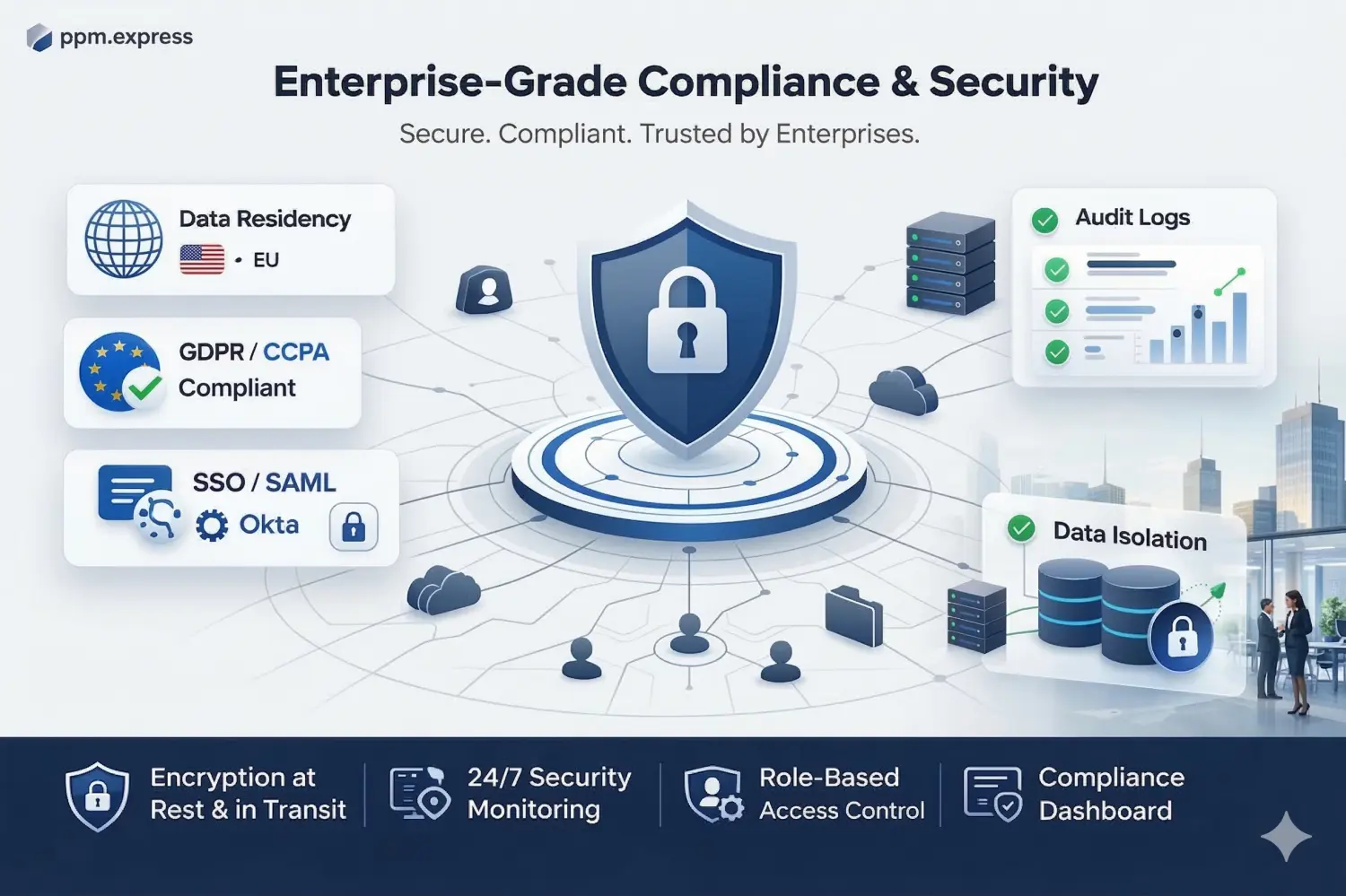


What our clients say
250+
Customers
use our software daily
100 hours
Saved every year
on monitoring state and statuses of projects, per PM
100K+
Projects
tracked on the PPM Express platform
Unlimited
Users
on every paid plan, so visibility is never rationed
Data residency
US & EU Data Residency
Encrypted in transit and at rest, with SSO, audit logs and tenant isolation. No customer data used to train AI models.
Reporting
200+ ready-to-use reports
Power BI reports built on live portfolio data, so stakeholders get self-service dashboards instead of a request queue.
Pricing
One flat annual subscription
$25,000/year for large enterprises, $8,000/year for SMB. No per-seat penalty.

Streamline Project Portfolio Management and Visibility at Scale
Integrations


Capture new project request, streamline evaluation and prioritization
Product

Structured Approach for prioritizing and aligning portfolios with strategic priorities and resource constraints
Product
Last updated 20 August 2026
Insurance portfolio management, answered.
Managing every change initiative across the carrier as one funded portfolio rather than as separate line-of-business roadmaps. That covers core system work, product launches, regulatory change, distribution and digital projects. Carriers need it for a structural reason: lines of business plan independently but draw on the same actuarial, IT and underwriting specialists, so independent roadmaps produce a collision nobody planned for.
One scoring model with published value ranges, applied to every line. Each line will argue its context is unique and each is partly right, which is exactly why the weighted strategic and risk factors need to be agreed at group level rather than negotiated line by line. The question then becomes which factors matter to the group, debated once, instead of which line pushes hardest, debated every quarter.
Run-the-business keeps policies administered, claims paid and regulators satisfied. Change-the-business is investment in doing those things differently: modernization, new products, new channels. For carriers the line blurs badly during a core system program, when a large share of "change" spend is really the cost of running two systems at once. Separating them honestly is usually what makes the modernization case credible.
The program runs a configurable process of phases and stages with gates between them, and you pick which gates need approval. Assigned approvers review in the Approval Center, and every one of them has to approve before the program moves on. Reviewers typically weigh business value, risk, schedule, budget, resources and what was actually delivered, which on a five-year program is the discipline that keeps each tranche honest.
Put it in the same portfolio as everything else, scored on the same model, drawing from the same capacity pool. Carriers often govern the core program separately because of its size, and that's precisely what hides its true cost: the product and distribution work that quietly never happened because the same people were committed to migration.
Fairness comes from the scale, not the ranking. When strategic and risk factors carry published value ranges, a 3 from specialty means what a 3 from personal lines means and the comparison holds. You can also run two frameworks side by side, a full weighted model and something lighter like MoSCoW, then look at where they disagree. That disagreement is often the most useful output.
Re-test the portfolio at each funding cycle instead of treating the original approval as settled. Baselines set at the initial decision stay available, so the board can see how far the current forecast has drifted from the case it approved. On a multi-year program that's the single most useful governance question, and the one least often asked.
Allocation shows against calculated capacity in hours, percent or FTE, with overallocation flagged before anyone commits. In practice this surfaces the shared actuarial, data and underwriting specialists who appear in several line-of-business roadmaps at once. Each roadmap looked entirely plausible on its own, which is why the clash never gets caught in a line-level review.
Yes. Resources can be filtered by role, department or skill, and utilization displays in hours, percent, FTE or chart view. Capacity is calculated from each person's work week and calendar exceptions, and actual hours from time tracking feed the same views. So you can look at your pricing actuaries as a group across every line rather than hunting for them roadmap by roadmap.
Yes. Project Online and Project for the Web connect directly. For plans built in the Microsoft Project Desktop client, PPM Express Project Publisher is an add-in that publishes an open schedule up into PPM Express. Desktop 2016, 2019 and 2021 are supported, and each published plan carries up to 2,000 tasks across ten levels of hierarchy.
Track them in the program's forecast rather than as a run-cost line somewhere else. Budget, forecast, benefits and impact sit against the initiative and are baselined at the funding decision, so the accumulating cost of the overlap stays attached to the program that created it. It then shows up in the same comparison as the benefits, which is the only place it can be judged fairly.
The retained decision history shows which scenario was selected, on which model, with which numbers at that moment. Models already scoring live change have to be cloned before they can be edited, so the basis of an earlier decision can't be quietly rewritten. Add detailed audit logs, US or EU data residency and custom DPAs, and that covers what carriers are normally asked for.
No, and waiting gets the order backwards. PPM Express connects to the tools teams already use, so the portfolio view assembles from current delivery activity whatever platform the underlying policies sit on. Portfolio visibility is a governance layer. It isn't an output of the target system, and treating it as one is how carriers end up flying blind for four years.
.svg)


