
Written for enterprise PMOs running a real evaluation. Eighteen requirements, the evidence behind each one, what each vendor publishes about price, and the places each product is the weaker choice.
Commercial disclosure: PPM Express produced and funded this comparison. Every assessment was drafted with AI from the vendors’ own published documentation, then reviewed and approved by PPM Express Analysts before publication. It evaluates publicly documented product capabilities against a defined requirement set; it is not independent analyst research or a benchmark test of both systems on the same dataset.Read the method
Triskell is a serious enterprise PPM platform and the honest read is that it beats PPM Express on configurability and matches it on integration depth: its Jira and Azure DevOps connectors are documented as genuinely bidirectional, with named objects and mechanisms. Two things shape the evaluation. It publishes no product documentation at all, only marketing and integration pages, so several requirements can only be verified to feature-name level. And it documents no artificial intelligence capability and no price.
Primary trade-off: On configurability and object modelling, Triskell is the more flexible platform. Its Jira and Azure DevOps sync documentation is also more specific than most.
Primary trade-off: No AI capability is documented anywhere, no price is published, and there is no public product documentation, help centre or API reference to verify against.
The default scenario is an enterprise hybrid PMO with 250 modeled users, 75 to 250 active initiatives, several delivery systems in play, and a need for centralized portfolio, resource, financial and executive reporting.
Wants everyone in the portfolio, governance across the tools teams already use, resource and financial control, and a cost that does not move when headcount does.
Leads at the default 250-user benchmark because the $25,000 annual plan includes unlimited users and the price is knowable before you talk to anyone.
Covers the functional requirements well and its bidirectional connectors are strong. What costs it here is that participation economics cannot be assessed without a quote.
| Customer requirement | Priority | PPM Express | Triskell |
|---|---|---|---|
Connect strategy, objectives, and execution Map initiatives to strategy and track progress against objectives or key results. Strategy | Mandatory | ✓ MeetsIncluded in UltraStrategy and OKR modules are included in the evaluated Ultra plan.Sources [2] | ✓ MeetsTriskell platformObjectives and key results are a named capability, with cascading from corporate goals down to individual objectives, and balanced scorecards translating strategy into KPIs and initiatives. The evidence is feature-level rather than mechanical: check-in cadence, confidence scoring and key-result data types are not documented anywhere on the vendor's site.Sources [8], [9] |
Manage portfolio and project hierarchy with roll-ups Centralize initiatives and provide governed portfolio-level health, status, dates, risks, and decisions. Portfolio governance | Mandatory | ✓ MeetsIncluded in UltraUnlimited portfolio, program, and project management are included in the evaluated Ultra plan.Sources [2] | ◐ Partially meetsTriskell platformThe object model plainly holds projects, products, programs, ideas and initiatives, hierarchical task management is documented on the Gantt feature, and the agile page describes epics and features rolling up into portfolio views. What is never described is the aggregation itself: which measures roll up, whether roll-up is automatic or formula-driven, and how a multi-level portfolio consolidates cost, effort and status.Sources [10], [11], [12] |
Capture ideas and prioritize proposed work Collect requests, score them consistently, and move approved initiatives into delivery. Intake & prioritization | Important | ✓ MeetsIncluded in UltraInnovation and ideation plus standard prioritization frameworks are included in the evaluated Ultra plan.Sources [2], [3] | ◐ Partially meetsTriskell platformIntake is concrete: a requests repository to centralise project requests, an innovation management capability to capture and evaluate ideas, configurable scoring criteria, and workflows automating request routing and approval. A business case as a named object is not documented; the nearest published statement is an investment analysis feature that evaluates financial viability and potential ROI.Sources [13], [14] |
Compare advanced portfolio what-if scenarios Model competing investment mixes using strategy, budget, capacity, timing, targets, and dependencies. Portfolio modeling | Important | ◐ Partially meetsIn Ultra; depth worth checkingPrioritization, optimization, roadmaps and resource what-if reporting are all documented. If you model several competing investment mixes side by side, check that depth against your own decision process.Sources [3], [4] | ✓ MeetsTriskell platformWhat-if scenario analysis has its own feature page and documents simulation against two specific constraint types: resource demand, to identify constraints before they bite, and financial scenarios, to estimate project costs more precisely. Worth validating in a demo: the vendor does not document whether a chosen scenario can be promoted or committed to the live plan, or how two scenarios are compared side by side.Sources [15], [8], [13] |
Plan resource capacity and utilization Balance demand and capacity across roles, named resources, teams, projects, and time periods. Resources | Mandatory | ✓ MeetsIncluded in UltraThe evaluated plan supports hours, percent, and FTE planning, capacity, availability, and proposed and committed allocations.Sources [4] | ✓ MeetsTriskell platformCapacity balancing against organizational capacity, forecasting of resource needs from historical data and project requirements, identification of under- and over-utilized resources, role-based planning to expose skill gaps, and top-down allocation are all documented, with Gantt-based allocation over time. Heatmap views and the named-versus-generic resource distinction are not described.Sources [16], [11] |
Manage budgets, forecasts, actuals, benefits, and ROI Provide portfolio and project financial control and connect spend to expected value. Financials & benefits | Mandatory | ✓ MeetsIncluded in UltraBuilt-in financials support budgets, forecasts, actuals, benefits, fiscal and non-fiscal values, and estimated ROI.Sources [5] | ◐ Partially meetsTriskell platformBudgeting and forecasting, automated budget projections, real-time expense monitoring with variance detection, capital and operational expenditure tracking, ROI through investment analysis, chargeback and ERP reconciliation, and multi-currency tracking are documented. Benefits realization is not: there is no benefit object and no baselined-against-realized benefit tracking anywhere on the vendor's site.Sources [14], [17], [11] |
Support waterfall, agile, and hybrid delivery Allow teams to use native schedules or external delivery tools without losing portfolio governance. Delivery | Mandatory | ✓ MeetsIncluded in UltraNative task scheduling supports traditional, sprint, and task-list approaches; external schedules can be linked.Sources [1], [2] | ✓ MeetsTriskell platformOne of the better-evidenced areas. The Gantt documents all four dependency types with lag, hierarchical tasks, multiple resource assignment modes and automatic progress. Kanban and Scrum boards are named features, the vendor is a SAFe partner platform modelling lean portfolio management guardrails and investment themes, and hybrid is stated explicitly as aggregating agile and waterfall work in one place.Sources [12], [11], [10] |
Track time and effort against work Capture actual effort for projects and tasks and use it in reporting and resource analysis. Time | Important | ✓ MeetsIncluded in UltraUnlimited time tracking, advanced approvals, and custom fields are included in the evaluated Ultra plan.Sources [2] | ◐ Partially meetsTriskell platformTimesheets are a documented platform feature covering time booking on any item, actuals collection feeding resource usage and cost, several parameters controlling timesheet settings, and programmatic access through the API for creating timesheets and updating timephased data. The approval half is missing: no submission, approval or rejection cycle, no approver role and no period locking is documented.Sources [18], [11], [19] |
Generate and distribute AI-assisted status reports Create standardized executive reports with AI narratives and scheduled PDF or email delivery. Executive reporting & AI | Mandatory | ✓ MeetsIncluded in UltraProject Story supports AI summaries, configurable single- and multi-page reports, scheduled PDF email, and unlimited recipients in the evaluated plan.Sources [6] | ◐ Partially meetsTriskell platformConventional reporting is solid. Configurable dashboards, scorecards, reports and a dynamic datamart are documented, with Excel export, automated report generation, scheduled distribution to stakeholders, and performance alerts on critical events or thresholds. The AI half of this requirement is absent: no AI-drafted status narrative or automated executive summary is documented.Sources [11], [20] |
Use AI for portfolio and project decision support Ask portfolio questions, identify risk, generate plans, summarize health, and automate routine management work. AI | Important | ✓ MeetsIncluded in UltraPPM Insights, status prediction, project digest, task and risk AI, schedule generation, and advanced AI agents are included in the evaluated plan.Sources [1], [2] | ? Not verifiedTriskell platformNo artificial intelligence capability is documented as a product feature anywhere on the vendor's site: not on the homepage, any solution page, the feature library, the role pages or the news and events page, and not as an announced roadmap item either. Triskell publishes blog content about AI in project management, which is commentary rather than documentation of product behaviour.Sources [21], [8], [20] |
Consolidate delivery data from multiple work systems Roll up work from Jira, Azure DevOps, Planner, Project, Smartsheet, monday.com, and other systems into a portfolio view. Integrations | Mandatory | ✓ MeetsIncluded in Ultra, with setup conditionsStandard integrations plus two-way Jira and Azure DevOps are covered by this plan. Confirm setup and the conditions on each connected system.Sources [1], [2], [7] | ✓ MeetsTriskell platformFifteen named connectors each with a dedicated page: Jira, Azure DevOps, Microsoft Project, Microsoft Teams, Microsoft Dynamics, SharePoint, Power BI, single sign-on, Salesforce, SAP, PeopleSoft, Oracle, Google Drive, Adobe Workfront, BMC Helix and Businessmap, with a REST API for anything else. Microsoft Planner, Project for the Web and ServiceNow are not among them.Sources [22], [19] |
Synchronize Jira and Azure DevOps work in both directions Create or update connected tasks and work items while preserving team execution in the source system. Bidirectional integration | Mandatory | ✓ MeetsIncluded in UltraTwo-way Azure DevOps and Jira synchronization is included in the evaluated Ultra plan and uses vendor-assisted setup.Sources [7] | ✓ MeetsTriskell platformJira is documented as fully bidirectional and configurable, with a mapper and actions defining which fields sync inbound and which are pushed back, and automatically created business rules and webhooks keeping both platforms in step in real time. Azure DevOps is equally explicit, naming epics, features, user stories, tasks and bugs, and stating that a lifecycle change propagates in both directions. Microsoft Project is framed as reading what project managers produce, with no stated write-back.Sources [23], [24], [25] |
Provide API, Power BI, and workflow automation Enable enterprise reporting, data export, integration, and repeatable process automation. Data & automation | Important | ✓ MeetsIncluded in UltraREST API, Power Automate and Zapier connectors, built-in dashboards, and Power BI report packs are included in the evaluated plan.Sources [1], [2] | ✓ MeetsTriskell platformA REST-based API with stateful and stateless authentication and API key support, covering data import, user creation and search, list values, Gantt and task data, timesheets and timephased data. Reporting covers configurable dashboards, scorecards and a dynamic datamart with a dedicated Power BI connector, and workflows can model any process for any item in the portfolio. No public API reference or rate limits are published.Sources [19], [11], [22], [12] |
Configure the platform without custom software development Allow PMO administrators to adapt fields, views, templates, rules, and workflows as practices mature. Administration | Important | ✓ MeetsIncluded in Ultra, configured by the PMOTemplates, custom fields, views, filters, layouts and modules are all administrator-managed.Sources [1] | ✓ MeetsAdapt / PlatformThis is the product's central claim and it is supported at entity level rather than by adjectives. Customers define attributes and use them to build and connect business items, attaching a workflow, custom attributes and custom roles to any item type including contracts, risks, deliverables and anything else they create. Configuration depth is tiered by package: low on Ready, medium on Adapt, and no-code and fully customer-specific on Platform.Sources [10], [12], [26] |
Support enterprise permissions, audit, and controlled environments Provide access controls, auditability, protected work, sandboxes, and environment options where required. Security & governance | Important | ✓ MeetsIncluded in UltraThe evaluated plan includes private projects, audit, advanced permissions, multiple tenants or sandboxes, dedicated hosting, and premium support options.Sources [2] | ✓ MeetsTriskell platformISO 27001 and SOC 2 Type II are claimed, with the SOC 2 Type II certification separately announced by the vendor in January 2026. Single sign-on requires a SAML 2.0 identity provider, with Microsoft Entra ID, Okta and Google Workspace named, and multi-factor authentication and conditional access inherited from the provider. Encryption uses SSL and AWS key management. SCIM provisioning and data residency are not documented.Sources [27], [28], [26] |
Allow broad participation without per-seat price growth Give employees, executives, team members, and viewers access without annual cost increasing for every additional user. Commercial model | Mandatory | ✓ MeetsFlat annual plan, UltraUltra is $25,000 per year with unlimited users. Enterprise is listed in the pricing reference table but is not used in the comparison calculations.Sources [1], [2] | ? Not verifiedTriskell platformTriskell publishes no price of any kind. There is no pricing page, no per-user rate, no minimum seat count and no tier pricing; its own comparison pages describe the model only as customised pricing with no long-term commitments. No free, viewer, read-only, requester or team-member participation tier is documented. Ready, Adapt and Platform are implementation packages, not published licence tiers.Sources [26], [29], [30] |
Run professional services delivery and profitability Manage client delivery, billable utilization, time, costs, charges, and profitability as an integrated operating model. Professional services | Optional | ◐ Partially meetsComponents included in UltraTime, resource planning, task costs, charges and profitability are all there. A complete native PSA operating model is not documented as one.Sources [1], [5] | ? Not verifiedTriskell platformNeither the financial management solution page nor the financial controllers role page mentions billable rates, bill-rate versus cost-rate cards, revenue, margin, profitability or invoicing. The financial model documented is internal cost control: budget, actuals, capital and operational expenditure, variance, chargeback and ERP reconciliation. There is no professional services automation page on the site.Sources [14], [17], [18] |
Map enterprise architecture and business capabilities Visualize initiatives, dependencies, capabilities, outcomes, and architecture relationships across the enterprise. Enterprise architecture | Optional | ◐ Partially meetsRoadmaps and strategy visualization in UltraRoadmaps and strategy visualization are available. A dedicated enterprise architecture model is not.Sources [1], [2] | ? Not verifiedTriskell platformThe only statement in this territory is a single line on the IT portfolio management page about a complete view of application performance across the IT ecosystem. There is no application inventory, no technology or capability model, no lifecycle or rationalization assessment and no service catalogue. The configurable object model would let a customer build such objects, which is a different claim from the vendor documenting the capability.Sources [31], [12] |
How the score works: Meets = 1, Partially meets = 0.5, Does not meet = 0. Mandatory requirements weigh more than Important ones, and Important more than Optional. Read the table. The percentage is a summary of it, not the result.
Triskell's proposition is that you model your own operating system: define the objects, the attributes, the workflows. That is genuinely powerful and it is also a project. PPM Express ships an opinionated portfolio model the PMO configures. Which is right depends on whether your process is a competitive advantage or just a process.
Triskell publishes no product documentation, help centre or API reference. Everything on its site is marketing, solution and integration pages. That is not a criticism of the product, but it does mean a diligence team cannot check claims the way it can with a vendor that publishes docs — so put more weight on the proof of concept.
PPM Express is $25,000 a year, on the website, at any headcount. Triskell publishes nothing and describes its model as customised pricing. Expect the first four weeks of an evaluation to be spent getting to a number rather than testing the product.
A comparison that only lists strengths is a brochure. Check each of these against your own operating model, the integrations you actually need, and how much implementation capacity you have.
Packaged enterprise PPM. One price, no seat count.
A configurable enterprise PPM platform, sold as a quoted subscription.
The short version: Triskell if your operating model is unusual enough to need custom objects and workflows, and a quoted agreement is acceptable. PPM Express if you want packaged portfolio governance, AI status reporting and a price you can budget today.
Every figure here is an annual cost at 250 users. Ultra is the plan being compared; PPM Express Enterprise appears as a price reference only. Triskell publishes no pricing page, no per-user rate, no minimum seat count and no tier prices; its own comparison pages describe the model as customised pricing with no long-term commitments. There is no estimated figure on the Triskell side of this table. Triskell publishes no price, and putting a number in its column would be inventing one.
Pricing was verified from each vendor’s public website on August 29, 2026.
Default summary scenario: 250 users. Official pricing sources: PPM Express [32] and Triskell [26].
Calculation assumption: there is none, on the Triskell side. Triskell does not publish a price for any edition at any user count, so this page states that rather than modelling a figure. Third-party “starting from” prices circulate for most products in this category; they are not vendor sources and none is used here. Triskell offers a 14-day free trial and sells through three implementation packages — Ready, Adapt and Platform — which differ by configuration depth and implementation time rather than by published price. PPM Express Ultra is $25,000 per year with unlimited users, published on the pricing page. Taxes, discounts, implementation, migration, integrations, support and professional services are excluded on both sides.
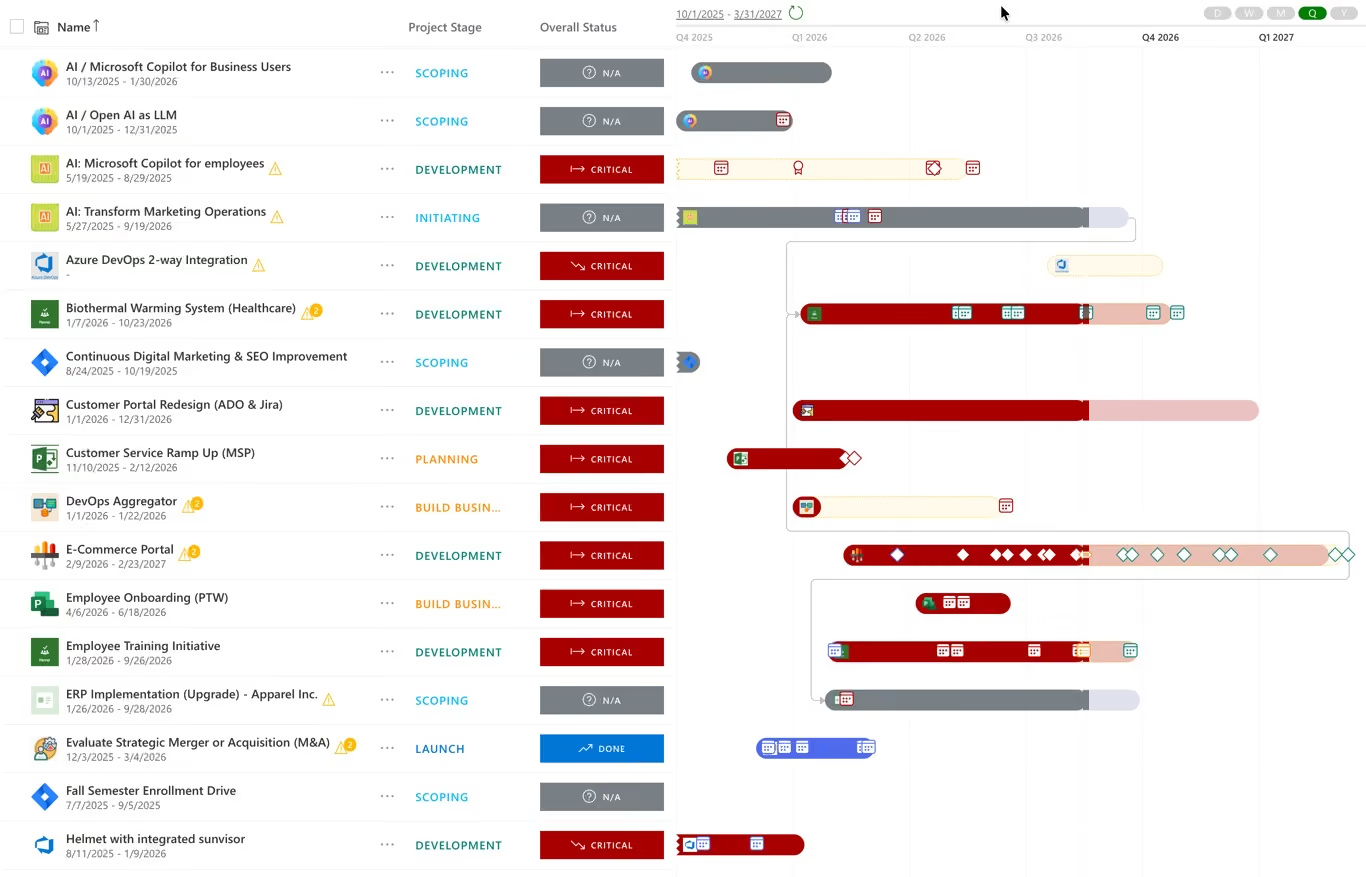
Illustrative product image from the PPM Express website. Product interfaces change over time.
Explore PPM ExpressThis is not a bake-off. Nobody loaded the same dataset into both products. What it does check is whether each vendor publicly documents a capability that meets the requirement, and what edition, integration or service you need to get it.
The full method is published. The eighteen requirements, the weightings, the three buyer scenarios, the evidence rules and the limitations are all set out on the comparison methodology page.
Requirement coverage, integrations, AI and what each vendor publishes about price.
They overlap on most of the requirement list and differ on philosophy. Triskell asks you to model your operating system in a configurable platform. PPM Express ships a packaged portfolio model that sits over the delivery tools teams already use. Both are credible; the question is whether configurability or time-to-value is the constraint you are buying against.
Triskell publishes no price. There is no pricing page, no per-user rate and no tier pricing anywhere on its site, and its own comparison pages call the model customised pricing. Third-party starting-from figures circulate but they are not vendor sources and none is used here. PPM Express Ultra is $25,000 a year with unlimited users.
None are documented. We checked the homepage, every solution page, the feature library, the role pages and the news and events page, and found no AI, machine learning, copilot or predictive capability described as a product feature, and no announced roadmap item either. Triskell publishes blog articles about AI in project management, which is commentary rather than product documentation.
Yes, and Triskell's documentation on this is specific. Its Jira integration is described as fully bidirectional with a field mapper and automatically created business rules and webhooks, and its Azure DevOps integration names epics, features, user stories, tasks and bugs syncing in both directions. PPM Express includes two-way Jira and Azure DevOps synchronization in the evaluated plan. Microsoft Planner is not a Triskell connector.
Triskell, clearly. Its object model lets customers define attributes and build their own business items, attaching workflows and custom roles to any item type. That is its central claim and the site supports it at entity level. The cost is implementation effort and a longer path to first value.
There is no way to say. PPM Express publishes $25,000 a year with unlimited users; Triskell publishes nothing. This page states that rather than modelling a figure, because putting an invented number in a competitor's column is how comparison pages lose their credibility.
Where funding, scoring, gates and benefits live. Strategic portfolio management
The constraint most portfolios actually fail on. Resource capacity planning and utilization
Test a funding mix before you commit to it. Portfolio what-if scenario planning
All material feature and pricing statements are based on public vendor sources accessed on or before August 29, 2026. Product packaging and functionality may change.
.svg)


