What-if Scenario Planner

Strategic Portfolio what-if planning for alignment, capacity and funding decisions

A five-phase framework for portfolio funding decisions — scoring, modeling, optimization, spend profile and capacity — built on your live PPM Express portfolio.

Build competing scenarios against one budget ceiling, see the genuine trade-offs, and publish the chosen portfolio back onto every project.

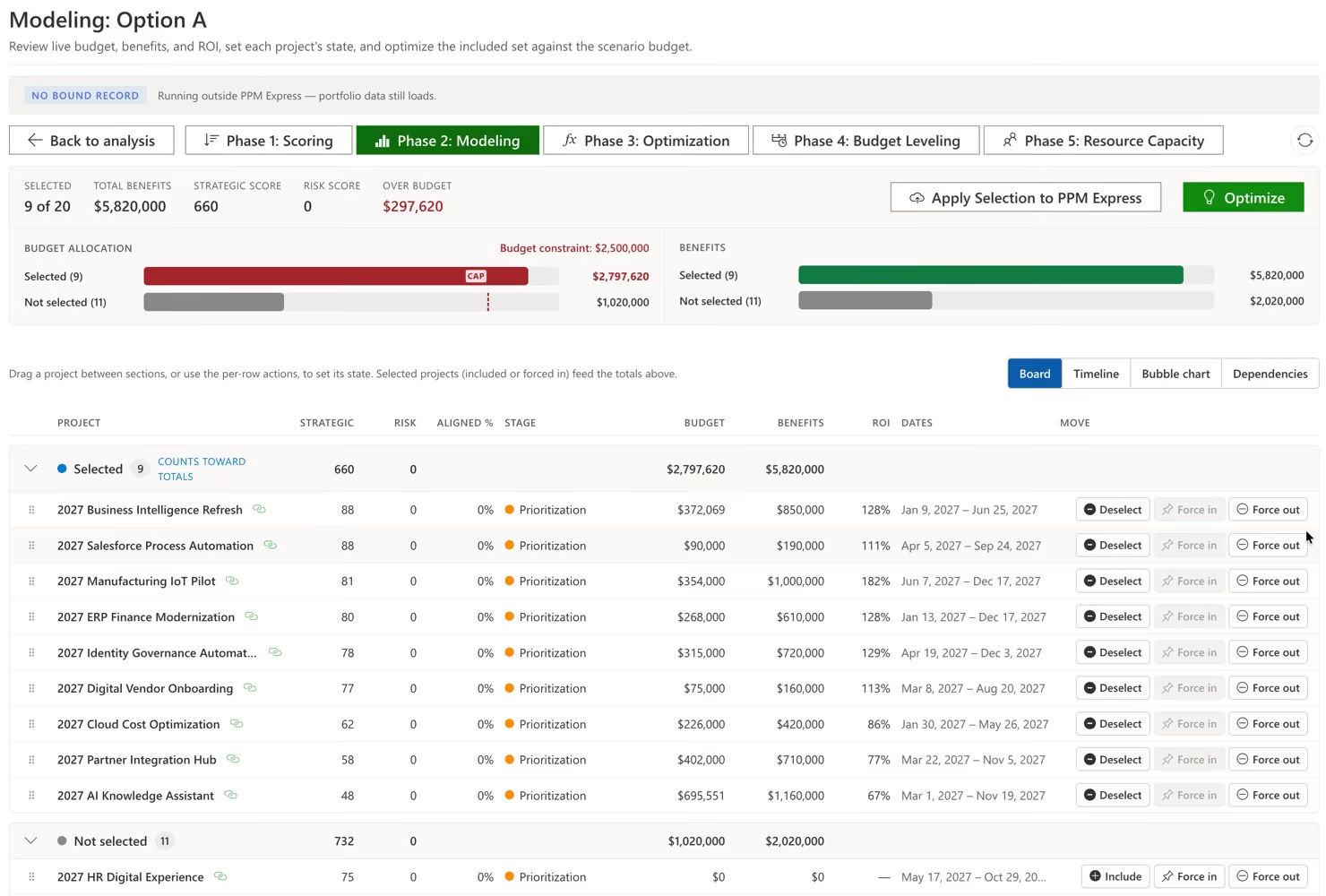
PPM Express what-if scenario planner comparing funding scenarios against available resource capacity

"What if the budget lands 15% lower?" shouldn't take three weeks to answer

Every funding cycle turns on a handful of questions with real answers that nobody can produce quickly. What comes out if the envelope shrinks? Which twenty of these forty projects should we fund? Can the people we actually have deliver the set we just approved?


Answering any of them means an analyst, an exported copy of the portfolio, a spreadsheet nobody else can audit, and a week you don't have. So the decision gets made on instinct and justified afterwards, or deferred to the next committee, by which time the question has changed.


When you can't test alternatives, you approve what you're asked to approve. Nothing looks unreasonable in isolation, and the portfolio ends up over-committed with no single decision to blame.

The framework

Five questions, in the order they need answering

1. How does each project rate against our criteria?

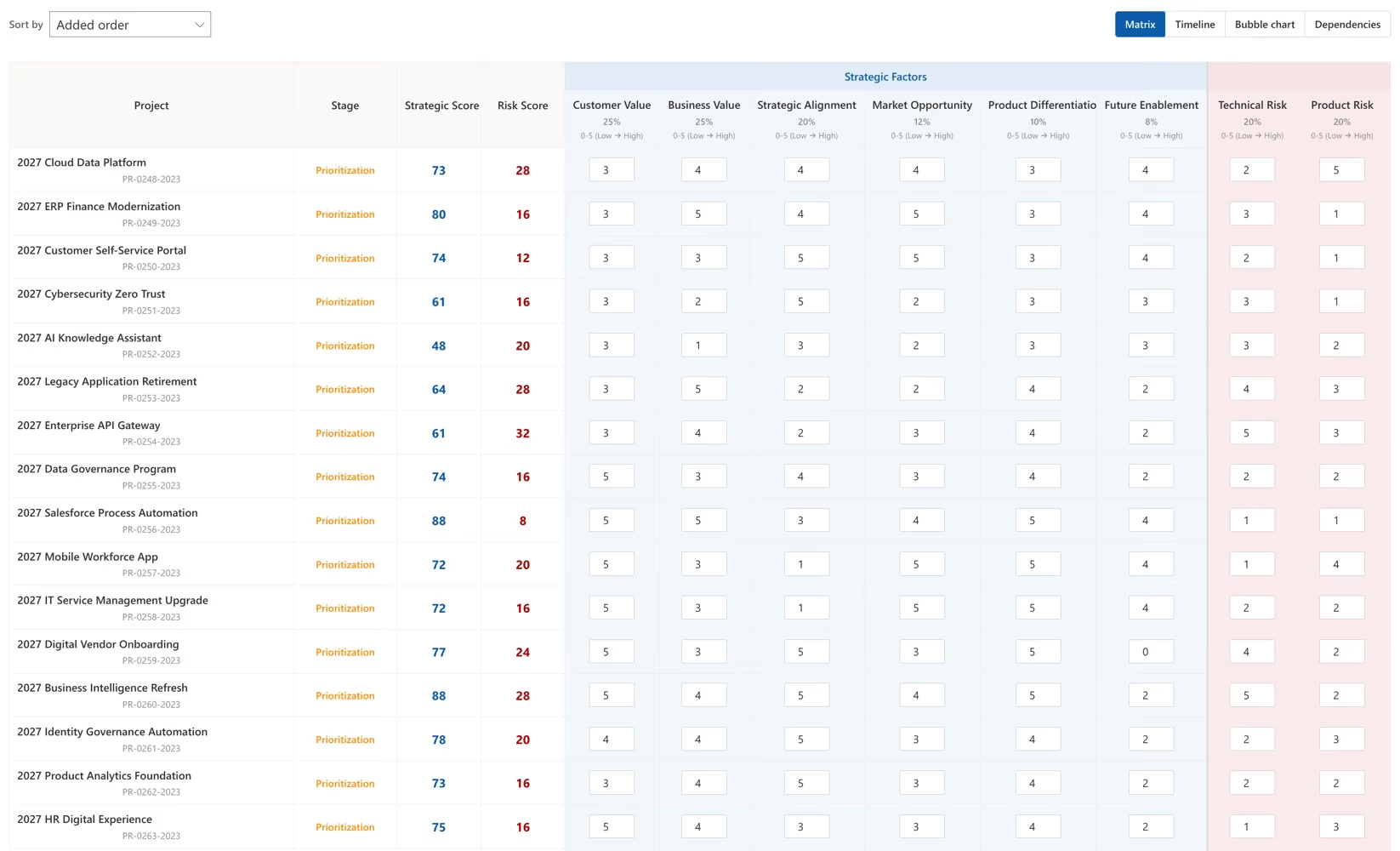
Score the pool against the analysis's model: weighted strategic factors and risk factors, each with a published value range so a 3 means the same thing to everyone.

Out come a Strategic Score and a Risk Score on a 0–100 scale, with weights visible wherever scoring happens.

2. Which projects are in, out, or non-negotiable?

Give budget, benefits and ROI per project, each set to included, excluded, or forced in, because in every real organization some things genuinely are non-negotiable, and a model that can't express that gets abandoned. A dependency graph shows what depends on what, so a scenario can't quietly select a project whose prerequisite was cut. The running total lands against your ceiling as you work.

3. What are the best trade-offs mathematically available to us?

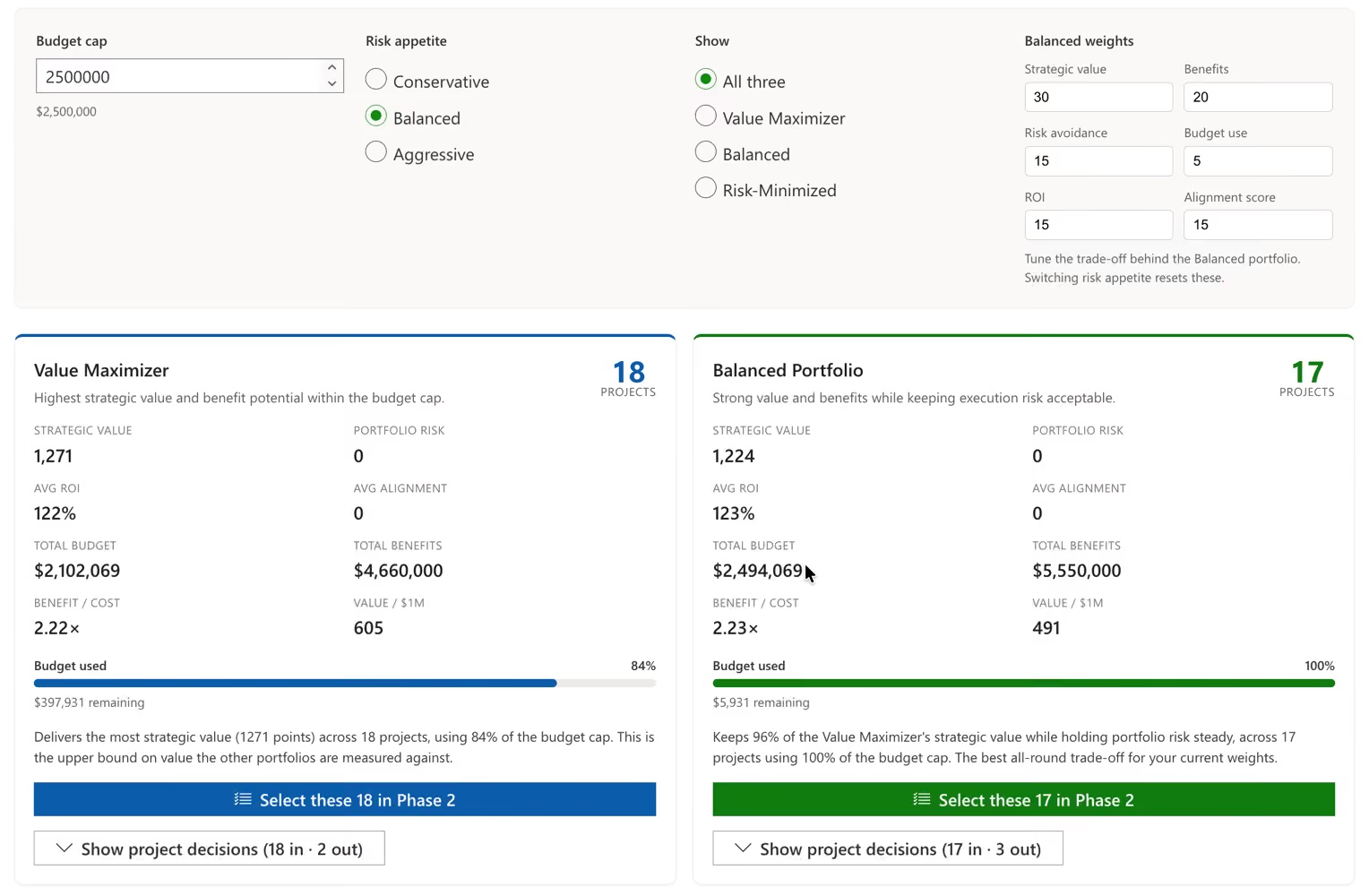
This is the phase that changes the meeting. Scenario Planner generates Pareto-optimal portfolios: the set of options where you cannot improve one measure without giving up another. Instead of arguing toward a single answer, the committee is handed the genuine frontier of trade-offs between strategic value, benefits, risk and budget, and chooses the point that matches its appetite. Most portfolio debates are disagreements about appetite dressed up as disagreements about facts — showing the frontier separates the two.

4. Where and how does the cash actually land?

Each project's forecast spend by month or quarter, plus the scenario's total spend over time. A committee that approved an annual number often hasn't seen that 60% of it falls in two quarters.

5. Can our people actually deliver this?

Each person's scenario workload against their free capacity — total capacity minus work already committed outside this scenario — grouped by role or project, with anything over 100% flagged. Most capacity checks measure against total capacity, which makes every plan look deliverable and is optimistic by exactly the amount of work nobody counted. Drag a project along the timeline to see what a delay would do, with the original position ghosted behind it: a genuine what-if that changes nothing upstream.
Project ranking table in PPM Express showing weighted scores and the funding cut-off line

Resource Capacity Planning and Utilization

Integrations

Six months later, "what did we commit to?" has a precise answer

Scenario Selection

Compare scenarios side by side

Not just totals, the project-by-project difference with rationale attached.

Select exactly one

Because a portfolio has one plan. Draft analyses and draft scenarios can't be selected at all, so nothing half-finished reaches the organization.

Manage in PPM Express

Every project in the pool is stamped with the analysis name, the scenario name, and Selected or Not Selected, visible to everyone in the system they already use.

Baseline at the moment of decision.

Selecting a scenario snapshots the numbers as they stood, so later variance is measured against what was agreed rather than what the plan says today.

Decision history retained.

Every selection is kept. The portfolio's decision trail is a feature, not an archaeology project.

Why What-If Scenario Planner?

The live portfolio, not a copy

Budgets, benefits, dates and resource plans live in PPM Express as they are now — nothing to export, nothing to reconcile.

Upstream changes are surfaced, never silent

If numbers change after you built the analysis, you're shown exactly what changed and asked whether to take it.

Models in use are protected.

A model already scoring live work must be cloned to change.

Your data stays yours

Isolated to your tenant, enforced with your verified sign-in.

Built for real portfolios

Financial data is cached and refreshed when a project actually changes, so large portfolios load in seconds.

What-if scenario planning framework

Integrations

Plan the portfolios you could fund. Choose the one you should.

Build competing funding scenarios on your live portfolio, see the genuine trade-offs, and publish the decision back onto every project.

Today those answers come from a spreadsheet one analyst owns: invisible to everyone else, stale the day after it's built, and impossible to defend when a sponsor asks why their project was cut.

Plan Portfolios

One question, several answers.

An analysis owns the budget ceiling, the scoring model and the candidate projects, so every scenario inside it is judged by the same rules, which is what makes comparing them mean something.

Value defined explicitly.

Weighted strategic and risk factors, each with a published value range, so a score means the same thing to everyone who enters one.

Plan Budgets

For each project, collect and track Budgets, Benefits and Impact

Select a Scenario

The genuine trade-off frontier.

Pareto optimization shows the options where you can't improve strategic value, benefits, risk or cost without giving something up, so the committee chooses a point on the frontier instead of arguing toward a number.

Over-allocation, called out

A person whose committed work exceeds capacity for a period shows red. Someone who is fine overall but breaches on a handful of dates shows amber, and that second case is the one that quietly sinks delivery dates.

Decisions that stick.

Select one scenario and every project is stamped with the outcome in PPM Express, with the numbers baselined at the moment of decision and the full decision history kept.
PPM Express what-if scenario planner comparing funding scenarios against available resource capacity
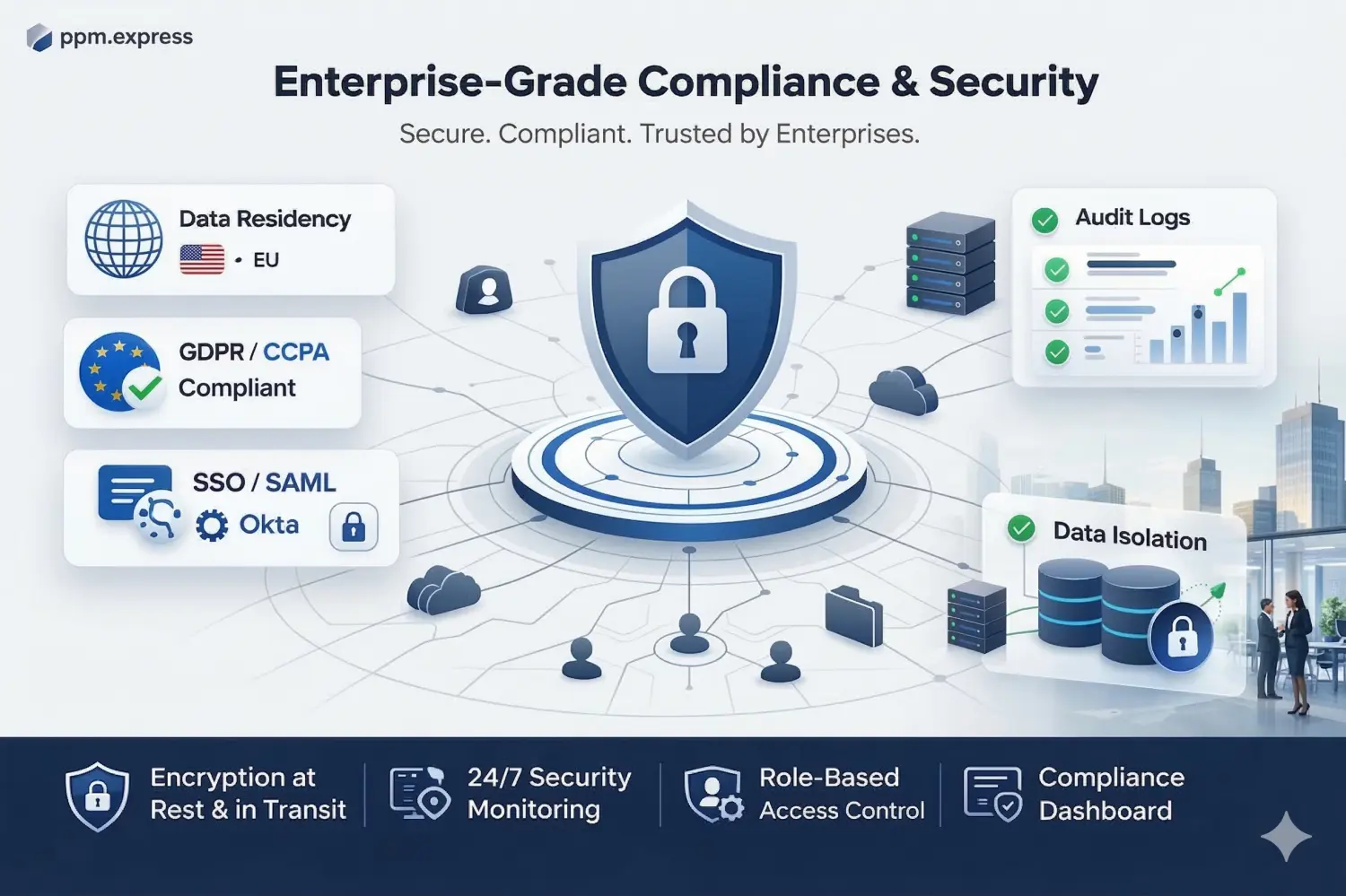
PPM Express security overview: EU and US data residency, GDPR and CCPA compliance, SSO and SAML with Okta, audit logs, data isolation, encryption at rest and in transit, and role-based access control

Security & Trust

Enterprise-grade. Without the enterprise runaround.

Enterprise-grade security is built into our platform. We offer US and EU data residency, full GDPR compliance, and custom DPAs to meet strict regulatory requirements.

Microsoft 365 and Okta SSO ensure secure identity management, while detailed audit logs and strict data isolation protect sensitive enterprise data.

Try PPM Express in Action
Arrow Right Icon

What enterprises ask before running portfolio scenarios

Frequently asked questions

Portfolio what-if scenario planning, answered.

What is portfolio what-if scenario planning?

Modelling alternative versions of the portfolio before committing to one. You change the inputs — add an initiative, defer another, move a date, cut a budget — and see what happens to cost, capacity, delivery dates and strategic coverage across everything else. The point is to have the argument while it is still cheap, rather than six months into delivery.

How is this different from modelling options in a spreadsheet?

A spreadsheet holds a snapshot that is already out of date when the meeting starts, and it has no connection to who is actually available. Scenarios in PPM Express are built from live portfolio data — current scores, budgets, allocations and delivery progress — so a scenario reflects the portfolio as it stands today, and re-running it next month costs nothing.

What can a scenario actually change?

Which initiatives are in and which are out, their sequence and dates, the budget assigned to each, and the people allocated to them. Non-negotiable items can be pinned so that every scenario carries them — which is usually where compliance obligations and contractual commitments belong.

Where does the data in a scenario come from?

The portfolio itself. Scores come from the weighted criteria you configured, costs and forecasts from the financial data on each initiative, progress from the delivery tools you have connected — Azure DevOps, Jira, Microsoft Project, Planner, Smartsheet or monday.com — and availability from the resource plan.

How is resource capacity handled inside a scenario?

The same way it is calculated everywhere else in PPM Express: from each person’s work week, calendar and calendar exceptions, with people allocated to initiatives in hours or percentage FTE. A scenario that over-commits a specialist shows it before the scenario is approved, rather than during the quarter it breaks.

What happens to the projects that do not make the cut?

They stay in the portfolio as deferred or unfunded, with their scores and business cases intact. That matters at the next planning round, because “what did we say no to, and why” then has an answer instead of a shrug.

Can we compare more than two scenarios at once?

Yes. Scenarios are compared side by side against the same objectives, the same money and the same people, so the trade-off between them is explicit rather than argued from memory.

Who should be in the room when scenarios are reviewed?

Whoever owns the money and whoever owns the people. Scenario reviews fail when the capacity constraint is represented by a number nobody in the room is accountable for. The output is a funding decision, so the people who can take it need to be present.

What happens once a scenario is approved?

It becomes the plan of record. Budgets, allocations and dates are published to the portfolio, the roadmap follows from it, and where a two-way connection is configured the agreed changes can reach the delivery tools rather than stopping at the steering committee.

How often should we re-run scenarios?

Quarterly re-ranking with monthly gate reviews is the pattern most enterprises settle on, plus an unscheduled run whenever something material moves — a budget cut, a reorganisation, an acquisition, a regulatory deadline. Re-running costs almost nothing, which is rather the point.

Do our delivery teams see anything while we are still modelling?

No. Modelling happens in the portfolio layer, and nothing is written to Azure DevOps, Jira or any other connected tool while a scenario is in draft. Teams see a change only once a scenario is approved and published, and only where you have configured a connection that writes back.

Learn More

Last updated 20 August 2026

What Our Clients Say
Taxpayer accountability demands complete transparency in government operations. PPM Express improved our project delivery timeliness by 30% and increased citizen satisfaction by 35%, while providing the budget visibility that elected officials and residents expect."
Henry Caldwell
Municipal Government
City Manager
Arrow right
Arrow right
With PPM Express our customers have a clear view of what is my next key date and my next milestone, and with active automated alerts on key dates approaching we make them more aware continuously looking at what’s next.
Marc de Graaf
Head of PMO
100 hours Saved
per PM per year
250 Customers
use our software daily
EU & US residency
encrypted in transit and at rest, with SSO, audit logs and tenant isolation. No customer data used to train AI models.
100K+ Projects
managed on PPM Express Platform