
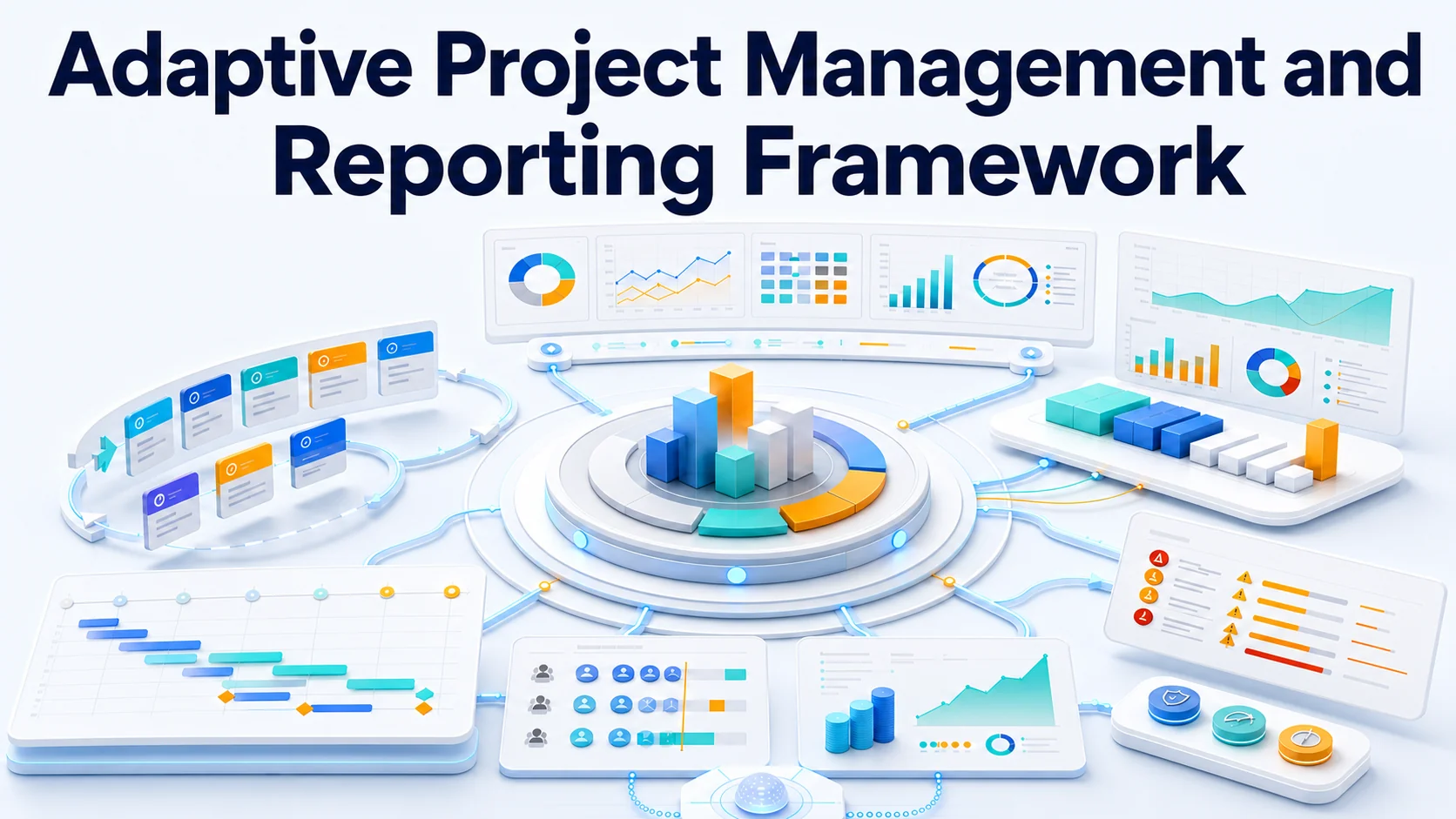

Enterprise project tracking used to revolve around schedule variance: what was planned, what happened, and whether the project was still on time.
That view is now too limited for most PMOs.
Look at a typical enterprise portfolio. Product teams may work in Jira or Azure DevOps. Infrastructure programs may rely on predictive schedules. Business teams may use Planner or monday.com, while transformation initiatives are still coordinated in spreadsheets. Leadership still expects one clear answer: are we putting the right money and people into the right work, and are we getting the outcomes we expected?
Adaptive Project Management and Reporting (APMR) is the market category now attached to that problem.
What is Adaptive Project Management and Reporting (APMR)?
APMR is a category of technology used by PMOs and other portfolio functions to support project and product delivery across waterfall, adaptive and hybrid ways of working. Gartner defines the market around optimizing delivery, managing complex resource allocation, tracking progress through reporting and dashboards, adapting to changing governance models, and balancing inbound demand against finite time, people and budget.
That is the market definition. What follows is one practical architecture for meeting it: standardize portfolio governance at the enterprise level, and let teams keep the delivery systems that already fit their work. The label is new. The management problem is not.
What changed from traditional project tracking
Traditional project tracking assumes that the important information lives inside the project plan. That works reasonably well when one project manager owns one schedule, one team and one delivery method. It breaks down quickly at portfolio scale.
A PMO does not only need to know whether a milestone is late. It needs to know whether the delayed initiative is still strategically important, whether another initiative should be accelerated instead, whether the same scarce resources are committed somewhere else, whether the forecast still fits the approved funding envelope, whether benefits are still achievable, whether the delivery team is using waterfall, Scrum, Kanban or a mixed model, whether the underlying work is happening in Jira, Azure DevOps, Microsoft Project, Planner, Smartsheet or monday.com, and whether executives can see the answer without waiting for somebody to rebuild a PowerPoint deck.
That is a broader scope than task management or schedule tracking. It combines multimethod project and product delivery with demand, resource allocation, prioritization, value tracking, reporting and integration with the other systems the enterprise already runs. Those are the capabilities the analyst definition of APMR centres on, and enterprise buyers increasingly evaluate them as one set rather than one at a time.
Project status has stopped being the end product. It is now an input into portfolio decisions.
Why enterprise delivery has become multimethod
Hybrid project management is often described as mixing Agile ceremonies with a waterfall plan. That definition is too narrow for enterprise PPM. At portfolio level, hybrid normally means something more structural, with different layers of work running on genuinely different models:
- Product and software delivery runs on Scrum, Kanban or continuous delivery, typically in Jira or Azure DevOps.
- Infrastructure and engineering runs on predictive, milestone-driven schedules, typically in Microsoft Project or native schedules.
- Business transformation runs on a hybrid of phase gates and iterative work, spanning a PPM platform and team tools.
- Departmental work runs on lightweight task management in Planner, monday.com or Smartsheet.
- Portfolio governance runs on adaptive funding, prioritization, resource and value decisions in the PPM layer above all of it.
An enterprise can therefore have a predictive program made up of Agile teams, an Agile product portfolio with fixed regulatory milestones, or a transformation portfolio where different projects use entirely different execution systems. Trying to eliminate that diversity usually creates resistance without creating better governance.
Standardize the management layer. Federate the execution layer. Teams should be able to work in the tools and methods that fit their work. The PMO should still receive standardized information about commitments, dates, risk, cost, capacity, value and outcomes.
The four-layer operating model
Layer 1: Execution
The execution layer is where the work gets done. For a predictive project, execution may be a WBS with dependencies, milestones, baselines and named resources. For an Agile team, it may be epics, features, stories, sprints and velocity. For a business function, it may be a lightweight task board.
The mistake many enterprises make is trying to use the execution layer as the enterprise portfolio layer. Jira is excellent at software delivery. A detailed Microsoft Project schedule is excellent at schedule modeling. Neither automatically becomes a complete enterprise investment-management system simply because a PMO can export data from it.
Layer 2: Project and program orchestration
This layer normalizes the things executives and PMOs need to compare across methodologies: health and RAG status, key dates and milestones, risks and issues, cross-project dependencies, budget and forecast, benefits, resource demand, decisions and approvals, governance stage, and strategic alignment.
This layer makes hybrid delivery manageable. The underlying work can differ, but the governance data must be comparable.
Layer 3: Portfolio decision management
At this level, the organization decides which initiatives should enter the portfolio, which should be delayed or stopped, where limited people and money should go, what happens if the funding envelope changes, whether approved work is still aligned to strategy, and whether expected benefits still justify continued investment.
This layer requires prioritization, capacity planning, scenario analysis and outcome tracking. Dashboards alone will not do the job.
Layer 4: Intelligence and reporting
The reporting layer should not be a manual reconstruction of the other three. It should continuously convert current portfolio data into executive dashboards, standardized status reports, exception alerts, capacity views, financial and benefit reporting, portfolio health summaries, decision-ready scenarios and AI-generated insights.
There is a parallel shift happening in AI: it is moving from isolated features toward embedded, governed intelligence. For a PMO, AI becomes useful when it works with trusted portfolio data and defined controls. Producing a smoother status paragraph is not enough.
What hybrid project management should mean in practice
A mature hybrid model does not mean every project manager invents a methodology. It means the organization separates what must be standardized from what can remain flexible.
Standardize at the portfolio level. The enterprise should define common rules for project and initiative intake, strategic scoring, risk classification, stage-gate or lifecycle governance, financial categories, resource planning, health definitions, status reporting cadence, benefits measurement and portfolio review.
Allow flexibility at the delivery level. Teams can choose the delivery model that fits the work: predictive schedules, Agile backlogs, Kanban, rolling-wave planning, hybrid milestone and sprint models, or external work-management systems.
Normalize the interface between them. The key question is not which methodology is correct. It is what information every initiative must provide so the enterprise can govern it consistently:
- Commitment: what are we delivering and by when?
- Investment: what money and capacity are committed?
- Progress: what has actually happened?
- Risk: what threatens the expected outcome?
- Value: what benefit or strategic result are we expecting?
- Decision status: continue, change, pause, accelerate or stop?
Six failure modes this model is meant to eliminate
1. Hybrid delivery becomes fragmented reporting. One team reports story points. Another reports percent complete. A third reports milestone status. The PMO spends Thursday converting all three into one RAG report. The teams using different methods is not the problem; the absence of a common portfolio model above them is.
2. Resource planning happens after approval. The business case is approved first. Capacity is checked later. A steering committee approves four initiatives in the same quarter, each one individually reasonable, and only in February does anyone notice that all four depend on the same two integration architects. That is a portfolio full of projects that cannot be delivered together.
3. Integration is treated as a technical appendix. If project data must be exported manually, the PMO does not have a live portfolio. It has a reporting process. For hybrid environments, integration architecture is a core business requirement.
4. Governance is confused with bureaucracy. Adaptive governance should increase the frequency and quality of decisions, not add approval layers for their own sake. A stage gate is valuable when it answers a real investment question: is the business case still valid, is capacity available, is the risk acceptable, should funding continue?
5. Reporting is backward-looking only. A traditional status pack describes what happened. An adaptive portfolio should also identify what is likely to happen next, which commitment is becoming unsafe, what resource bottleneck is forming, and which initiatives should be re-sequenced.
6. Strategy and execution are connected only in presentation slides. If strategic objectives live in one planning system and project execution lives somewhere else, alignment becomes a quarterly storytelling exercise. This model requires strategy to be expressed as structured portfolio data: objectives, scoring criteria, expected benefits, funding and measurable outcomes.
Eight questions to ask when evaluating a platform
Feature checklists are still useful, but they are easy to game. Most enterprise platforms can claim some version of resource management, reporting or Agile support. The better evaluation questions test whether those capabilities work together.
1. Can the platform support multiple methodologies without creating multiple portfolios? Ask the vendor to show a predictive project, an Agile project, a hybrid project and a lightweight work-management project inside the same portfolio view. Then ask whether health, risk, financials, resource demand and strategic alignment are comparable across all four.
2. Can teams keep their execution tools? For a large enterprise, replacing every delivery tool is usually the wrong success criterion. Ask which external systems can remain systems of execution, what data synchronizes, whether synchronization is one-way or two-way, whether one portfolio can contain projects from several tool ecosystems, and whether a single project can connect to more than one external source.
3. Is resource capacity part of the decision model? A resource heatmap after the portfolio has already been approved is not enough. The platform should help answer what happens to capacity if you approve, delay or accelerate an initiative.
4. Can governance adapt without custom development? Look for configurable stage gates, intake forms, scoring models, status definitions, custom fields, financial structures, reporting templates and role-based views.
5. Does reporting start from live operational data? If the answer involves exporting spreadsheets, copying slides or manually rewriting summaries, reporting has not been automated. Only parts of the old process have been digitized.
6. Can the portfolio be re-planned, not just monitored? A mature platform should support reducing a budget, adding a mandatory initiative, moving a program, protecting a scarce resource pool, maximizing strategic value within a funding ceiling, and comparing alternative portfolios.
7. Are financial value and benefits managed beyond project completion? Delivery completion is not the same as value realization. The platform should preserve the link between project investment and expected outcomes after go-live.
8. Is AI operating on governed data? The enterprise should know what data AI can access, how access is controlled, whether customer data is used for model training, where human approval remains required, and how AI-generated recommendations are reviewed.
A practical implementation model
This should not be implemented as a big-bang methodology transformation. A more durable approach is progressive.
Phase 1: Define the portfolio contract. Agree the minimum data every initiative must provide: owner, strategic objective, dates, health, funding, resource demand, risks, expected benefits and governance stage. Do this before configuring dashboards.
Phase 2: Connect the execution systems. Bring Jira, Azure DevOps, Microsoft Project, Planner, Smartsheet, monday.com and other relevant delivery systems into the portfolio model. Do not start by asking teams to abandon tools they already use effectively.
Phase 3: Establish common governance. Configure intake, lifecycle, stage gates, prioritization, status cadence, financial rules and capacity planning. The objective is comparability, not uniformity.
Phase 4: Move from reporting to portfolio decisions. Once the data is trusted, use it to drive quarterly re-prioritization, funding scenarios, capacity trade-offs, stop and start decisions, and benefits reviews.
Phase 5: Add embedded intelligence. Use AI to draft status reports, detect schedule and risk signals, flag resource overload, summarize portfolio changes and prepare decision material. Add it once the portfolio data underneath it is trusted, rather than as a substitute for doing that work.
Where PPM Express fits
PPM Express is designed primarily as the portfolio orchestration and governance layer above heterogeneous delivery tools. That architecture is relevant to enterprises that want stronger PMO control without forcing every team to migrate into one project execution product.
Predictive delivery can remain predictive. For schedule-driven work, PPM Express supports WBS-based planning, milestones, baselines, dependencies, lead and lag relationships and multiple resource assignments, which gives traditional projects a familiar predictive control model.
Agile delivery can remain in Jira or Azure DevOps. Software and product teams can continue managing epics, features, stories and sprint-oriented work in their existing platforms. PPM Express connects that execution data to the portfolio layer so the PMO can manage the initiative alongside traditionally scheduled projects. Neither tool needs to turn into the other; both need a common enterprise context.
Lightweight work can stay lightweight. Departments using Microsoft Planner, Smartsheet or monday.com do not need a heavyweight scheduling implementation to participate in portfolio reporting and governance.
One project can aggregate multiple delivery sources. A transformation program may have a predictive master schedule, an Azure DevOps engineering stream, a Planner workstream, and portfolio-level financials, risks and governance. The management model can be centralized even when execution is distributed.
Portfolio governance sits above methodology. PPM Express adds what execution systems rarely share consistently: strategic objectives and alignment, project and idea prioritization, process management and stage gates, portfolio and program structures, financial planning and benefits realization, resource capacity, risks and issues, and executive reporting.
Resource capacity crosses tool boundaries. The same person can be committed to an Agile product team, a waterfall implementation, operational work and a future project that has not started. Resource planning sits in the portfolio layer so capacity can be viewed against planned demand across initiatives, not only task assignments inside one system. The question that matters is whether you can actually staff the portfolio you are about to fund.
Prioritization and what-if planning make the portfolio adaptive. Weighted prioritization and scenario planning against strategic value, risk, budget, benefits and resource constraints move portfolio management from a fixed annual ranking toward a repeatable decision process.
Financials and benefits keep delivery connected to value. Projects can be managed with budgets, forecasts, actuals and benefit realization over time. A project can be technically green while becoming economically unattractive, and it can finish successfully while the promised benefit never materializes.
Reporting is continuous, not reconstructed. PPM Express provides portfolio dashboards, a large Power BI reporting pack, and Project Story for standardized AI-powered project status reporting, including structured reports from project data, AI-assisted narrative summaries, PDF export and scheduled delivery depending on the subscription plan.
AI sits on top of the governed portfolio. PPM Express AI covers three distinct mechanisms: project-level Insights AI, AI-generated project status reporting, and natural-language access to portfolio data through Microsoft 365 Copilot, Claude or ChatGPT over the PPM Express MCP server. Generation is triggered by a user action or a project synchronization rather than running in the background. Separately, AI agents on the PPM AI plan monitor schedules, budgets, risks and resource allocation continuously and propose corrections for a person to approve, rather than executing them. In every case the highest-value use emerges when AI operates on structured, governed portfolio data rather than on disconnected project extracts.
Who this model suits
The model is strongest when an enterprise has methodology diversity and tool diversity at the same time: a PMO managing both IT and business transformation; an enterprise where software delivery runs in Jira or Azure DevOps but executives need portfolio-level financial and resource visibility; a Microsoft-centric organization combining Microsoft Project, Planner and modern cloud delivery tools; a company that wants better PPM governance without a forced enterprise-wide tool replacement; or a PMO moving from periodic reporting toward continuous portfolio decision-making.
Projects do not need to look the same, but every one of them has to be governable, comparable and ready for a decision.
The operating principle for modern PMOs
The biggest mistake in hybrid project management is trying to solve methodology diversity by eliminating it. The answer lies in the operating architecture.
Let teams optimize execution. Standardize the enterprise decision layer.
That means one portfolio structure, one definition of strategic value, one view of funding, one capacity model, one governance framework and one reporting language, with multiple valid delivery methods underneath.
The PMO becomes less of a reporting factory and more of a portfolio decision function. And the technology stops asking every team to work the same way. Instead, it gives leadership a reliable way to govern all of that work as one enterprise portfolio.
If your portfolio spans Jira, Azure DevOps, Microsoft Project, Planner, Smartsheet, monday.com or a mix of delivery approaches, PPM Express is designed to create a governed portfolio layer above those systems. Start a trial or book a demo to see it against your own portfolio.
Sources and references
- Gartner, Adaptive Project Management and Reporting market definition, used here for category terminology and capability scope.
- Gartner, Magic Quadrant for Adaptive Project Management and Reporting, August 2026.
- PPM Express AI — Insights AI, AI status reporting, AI agents, and the published data path.
- PPM Express MCP server — natural-language portfolio access from Microsoft 365 Copilot, Claude and ChatGPT.
- PPM Express documentation — integrations, scheduling, financials and resource planning.
Gartner's APMR research is referenced in this article for market terminology and capability definitions only. PPM Express was not evaluated in the 2026 Gartner Magic Quadrant for Adaptive Project Management and Reporting. Gartner does not endorse any vendor, product or service depicted in its research publications.
.svg)


