
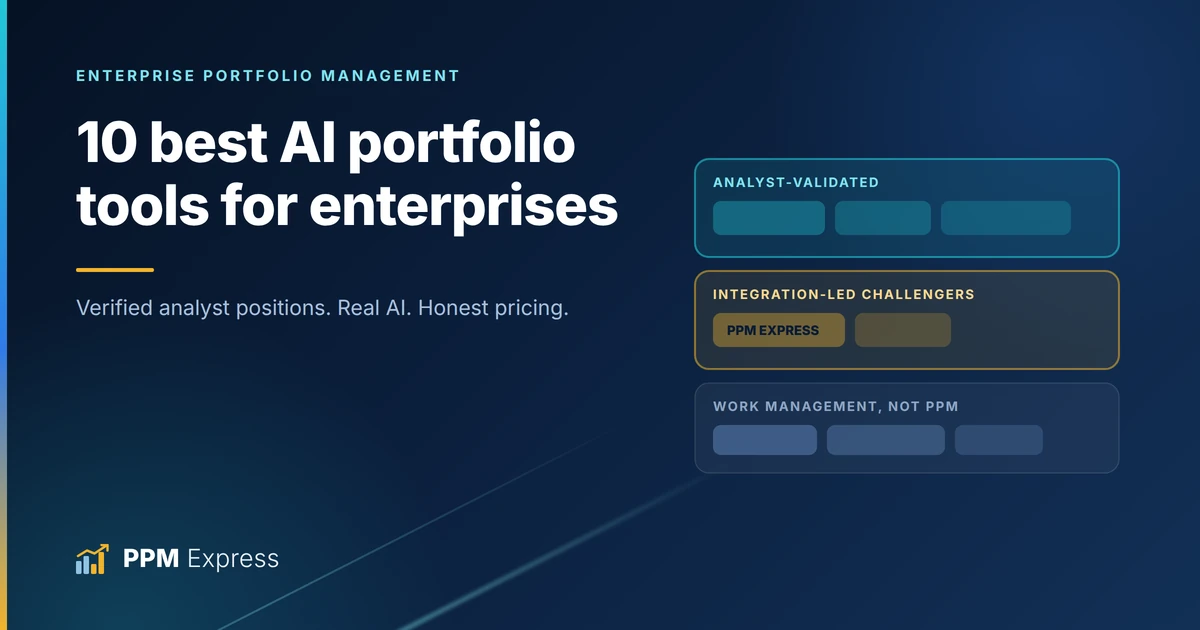

Portfolio management and work management are not the same purchase
Search for enterprise PPM software and you will get a hundred articles ranking monday.com, ClickUp, Asana and Notion. Those are good products. For the purposes of this comparison they are not enterprise portfolio management platforms, and their own documentation is the reason.
The distinction is not academic. A work management tool answers one question well: what is everyone doing, and is it on track. A portfolio platform answers a different set entirely — which initiatives get funded, against what criteria, inside which budget envelope, with which people, and whether the benefit that justified the spend ever actually arrived. Those are governance questions, and the machinery that answers them (investment categories, weighted scoring, stage gates, capacity modelling, benefits tracking) is either in the product or it is not.
Worth saying plainly: this is the definition we are using, not a universal market boundary. Gartner’s Adaptive Project Management and Reporting category is deliberately broader, covering multimethod delivery management alongside demand, resource management, prioritisation, value tracking, reporting and integration — and several vendors we set aside here are evaluated in that category or in adjacent ones. For this comparison we use a stricter governance test: prioritisation, funding, capacity, scenario planning, benefits, financial oversight and cross-tool portfolio visibility. Some work-management platforms provide selected portfolio capabilities but are measured here against that broader standard.
You can settle it yourself in ten minutes, without taking anyone’s word for it. Open each vendor’s own tier table and look for those five things. monday.com puts portfolio management behind Enterprise and documents no financial tracking, no scenario planning and no stage gates behind it. Smartsheet’s Control Center is a real portfolio construct, but it carries hard object limits and no benefits layer. Airtable has no portfolio governance at all, by design — you build it yourself. A CEO put it more bluntly than any vendor would, in a practitioner thread on whether Smartsheet could serve as a PPM system: “Smartsheet, Monday and Wrike are primarily Task management platforms.”
One warning before we start. “SPM” also stands for Sales Performance Management, and several search-optimised listicles cheerfully mix the two, ranking Anaplan and Varicent as portfolio tools. Check which market an article is actually describing before you trust its rankings.
How this comparison was researched
We reviewed vendor product documentation, release notes, published pricing pages, press releases, and analyst materials where they are publicly available. AI capabilities were counted only where we could identify a shipped or documented capability rather than a roadmap announcement, and we say which are generally available, in beta, or announced but not yet released. Where we could not verify a vendor claim from a first-party source, we say that too rather than treating absence of evidence as evidence of absence.
Last verified: September 2026. This market moves faster than any article can; confirm current capability and pricing directly with vendors before a purchase decision. Rankings, category boundaries and comparative judgments here are PPM Express editorial assessments against the criteria stated above — and PPM Express is a vendor in this market, appearing in its own list at number five.
The event driving this market: Project Online dies on 30 September
It is worth leading with this, because it is why so many organisations are shopping right now.
Microsoft Project Online retires on 30 September 2026. Licence sales ended in October 2025. Creation of new Project Web App sites was blocked on 1 April 2026. SharePoint 2013 workflows — which carried stage gates, approvals and change-request routing inside Project Online — stopped working on 2 April 2026, months before the platform itself. Separately, Project Server 2019 mainstream support ended on 9 January 2024, and extended support ended on 14 July 2026, so the on-premises product is now out of support entirely. For exactly what happens to PWA and the OData API after the retirement date, check Microsoft’s lifecycle documentation rather than any secondhand summary, this one included.
Microsoft’s own stated reason is that the legacy architecture could not support modern cloud and AI development. Its recommended destination, Planner Premium, is a capable team planner with a portfolio view — and Microsoft’s own documentation confirms it cannot connect Azure DevOps or Project Online projects, has no financial tracking, no budget management and no resource allocation in that Portfolios feature. Add one baseline where Project Online had eleven, no timesheet module, no stage-gate engine, and a ceiling of roughly 3,000 tasks per plan.
Microsoft has effectively left the enterprise portfolio tier. That displacement is the defining commercial dynamic of this category in 2026, and if you are affected, your timeline is measured in weeks.
What “AI PPM” actually means at enterprise scale
Be sceptical here. Every vendor in this market published an AI page in the last eighteen months; far fewer shipped documented, generally available capability.
Four things separate real from marketed:
Is it documented? Broadcom publishes versioned technical documentation for Clarity Vaia, gated behind an admin flag, naming which models you can configure. Several competitors publish a homepage claim and nothing else. That difference tells you a lot.
Does it act, and under whose authority? An agent that updates a record, advances a stage or reallocates capacity is a different governance object from one that writes a summary. Ask whose permissions it inherits. And note that more autonomy is not automatically better — plenty of enterprises restrict autonomous action deliberately, and controlled assistance with approvals and an audit trail is often the right answer rather than the lesser one.
Can external assistants reach it? A published MCP server has become the practical dividing line between vendors that expect you to use Claude, ChatGPT or Copilot and vendors that expect you to log into their UI. Broadcom, Planisware, Smartsheet, Adobe, Meisterplan and PPM Express all ship one today.
And the unfashionable one — what is it reading? An analysis over the whole portfolio and an analysis over the one tool the AI can see produce output of identical fluency. Coverage is a correctness property, not a reporting feature.
Four vendors commonly listed in “AI PPM” roundups — Triskell, North Highland’s UMT360, Bubble PPM and Celoxis — had no shipped AI capability we could verify from a first-party source during our research window in August and September 2026. All four are legitimate portfolio products, and any of them may have shipped something since. We left them off this particular list rather than rank an AI capability we could not confirm.
The 10 best AI project portfolio management tools for enterprises in 2026
1. Planview — the broadest platform in the category
If your selection process needs a choice that will survive scrutiny on paper, this is the one. Planview is a Leader in The Forrester Wave: Strategic Portfolio Management Tools, Q2 2026, where it took the highest Current Offering score of all thirteen vendors evaluated, with 5 out of 5 in twelve criteria. It is also the widest product line here by a distance, which is both the strength and the problem.
AI: Planview Anvi, launched October 2025, works in three layers — in-app risk detection, sentiment analysis and anomaly detection; conversational chat; and a custom agent studio with prebuilt templates and scheduled agent workflows. It runs on Snowflake and AWS Bedrock with Anthropic models. Forrester’s note on the Wave is worth quoting: “Agentic AI facilitates superior scenario comparisons and portfolio analyses.”
Integration: Planview Hub, the former Tasktop, gives bidirectional model-based sync across 60+ delivery tools including Jira, Azure DevOps, ServiceNow and Rally. Among the vendors and publicly documented connectors in this comparison, that is unusually deep integration architecture, and a genuine asset rather than a marketing claim.
The catch: seventeen products, several of them overlapping PPM tools acquired and renamed — Portfolios, PPM Pro, ProjectAdvantage, AdaptiveWork, ProjectPlace. Buyers get genuinely confused about which one they are being sold. Reviewers are consistent about the interface, and dated is the word that keeps coming up. No published pricing.
Best for: large enterprises that need one platform to survive procurement, audit and a formal selection process.
2. Broadcom Clarity — among the best-documented AI in the category
Clarity has been an enterprise portfolio mainstay for two decades, and under Broadcom it has kept shipping. What it has that most rivals do not is an AI capability you can read the technical documentation for before you buy.
AI: Clarity Vaia is among the most concretely documented AI stories here, and refreshingly narrow. Broadcom’s technical documentation specifies status report and roadmap summarisation, data generation and review, a natural-language help assistant, and configurable AI agents scoped to workspace, object or attribute. It is bring-your-own-LLM — an administrator enables an AI service flag and configures Google Gemini, OpenAI or Azure OpenAI, with direct Anthropic Claude support added in 16.4.2 in June 2026 alongside a prompt library and persistent chat history. That release also shipped a Clarity MCP Server, initially scoped to timesheets.
That is a real AI capability, versioned and admin-gated. It is also narrower than the marketing implies: summarisation, agents and one MCP surface, not autonomous portfolio decisioning.
The catch: the commercial relationship. Practitioner reports describe subscription costs roughly doubling previous maintenance fees after the Broadcom acquisition, with repeated complaints of “a lack of transparency from Broadcom in terms of licensing expenses.” One consultant reported around $500K in year one and $200K annually thereafter — a single practitioner account, not a benchmark. Implementation specialists are scarce and expensive. Clarity’s own product page names no Jira, Azure DevOps or Microsoft Project integration — that connectivity comes via ConnectALL or third parties.
Best for: large enterprises already invested in Broadcom’s ValueOps stack, with the procurement muscle to negotiate.
3. ServiceNow Strategic Portfolio Management — the platform play
ServiceNow is a Leader in The Forrester Wave: Strategic Portfolio Management Tools, Q2 2026, with the highest Strategy score of all thirteen vendors and top marks for Vision, Innovation and Roadmap.
Its real case is not portfolio depth. It is that the portfolio sits on the same platform as the ITSM, CMDB and change records the organisation already runs, so the data is already there and already governed. For a large ServiceNow shop that argument is hard to beat, and it has very little to do with feature comparison.
AI: Now Assist for SPM arrived in the Zurich release with feedback summarisation across epics and initiatives, draft demand generation from natural language, epic-to-story generation and analysis across investments and risks, plus agentic workflows. An AI Strategy View in AI Control Tower tracks AI-tagged goals across portfolios. Two caveats: the AI is licensed separately from SPM across three tiers, and Zurich introduced no separate Now Assist for PPM — the project module benefits only indirectly. ServiceNow’s documentation appears to be mid-rebrand on the AI naming, so confirm the exact scope and licensing of what you are buying.
The catch: G2 sits at 4.1 from 297 reviews. The recurring themes are a steep learning curve requiring significant technical expertise, an overwhelming interface, complex and time-consuming setup, and — most often — “the licensing is very expensive when scaling it to other departments.”
Best for: organisations already running ServiceNow for ITSM, where the data-gravity argument does the work.
4. Planisware — the R&D and pharma standard
Planisware is the incumbent in R&D-heavy industries, and the customer list is the argument. The company says it works with 18 of the top 20 pharmaceutical companies worldwide, and its Product Development and Innovation line accounted for 53% of 2025 revenue.
AI: Oscar, its agentic AI assistant, is deployed for existing customers at no separate subscription, with Planisware recommending version 7.1.5 or above to unlock the full range of capabilities — confirm your own version and entitlement before assuming access. It works as an orchestration agent coordinating specialised agents for forecasting, risk scoring and resource optimisation, with zero-code agent design where new agent logic is defined in plain language, role-based access control that honours existing Planisware security, and processing inside the customer’s own environment for data sovereignty. Planisware also ships an MCP server as of the 26Q2 release. Underneath the LLM layer sit older, harder capabilities most competitors lack: particle-swarm resource optimisation, Monte Carlo predictive modelling and machine-learning demand forecasting.
The catch: it is heavy. G2 sits at 3.9 from 27 reviews — a small sample — with page loads over a minute reported, an interface described as “old school,” and configuration flexibility that creates confusion. One reviewer called it “the Cadillac of PPM software,” which is both a compliment and a warning. Enterprise buyers rate it considerably higher than the small-sample public review sites do, which is usually a sign of a product that rewards a real implementation.
Best for: R&D-intensive enterprises — pharma, medical devices, complex product development — where stage-gated innovation portfolios are the whole job.
5. PPM Express — the integration-led challenger
Everything above assumes you will run portfolio governance in the vendor’s own system and connect delivery tools to it. PPM Express inverts that. Teams keep working wherever they already work; the portfolio layer sits above and aggregates.
Governance: objectives, investment categories and funding buckets; weighted scoring, MoSCoW and ICE-style prioritisation; what-if scenario planning with an optimiser that maximises value inside a budget; capacity planning by role and skill with over-allocation detection; budget, benefits and impact tracking; stage-gate approvals included in all plans; timesheet actuals feeding utilisation and cost; and 200+ ready-made Power BI reports.
AI — four separate mechanisms, worth distinguishing: Insights AI surfaces the portfolio signals that need a project manager’s attention — new risks, late milestones, resource overallocation — with generation triggered by a user action or a project synchronisation rather than running in the background. AI status reports are assembled from live project data. MCP access from Microsoft 365 Copilot, Anthropic Claude and OpenAI ChatGPT lets a portfolio lead interrogate the portfolio from whichever assistant they already use. And AI Agents, on the PPM AI plan, are the piece that monitors continuously — schedules, budgets, risks and resource allocation — proposing new risks, issues, action items and schedule changes that a project manager approves or rejects rather than executing them.
Integration — the reason it is on this list: two-way sync with Azure DevOps, Jira, Microsoft Project Desktop, Microsoft Planner, Project for the web, Project Online, monday.com and Smartsheet, with Jira and Azure DevOps included in every paid tier. Across the vendors and publicly documented connectors in this comparison, that is unusually broad bidirectional coverage, and it is what makes whole-portfolio AI analysis possible rather than aspirational. Connector scope changes frequently on every platform here, so confirm it during evaluation.
Pricing — and this is the differentiator: Enterprise at $8,000 a year and Ultra at $25,000 a year, both with unlimited users and guests. A PPM AI tier adds agents with implementation services. At 500 users, Ultra works out at $50 per user per year, against per-seat enterprise platforms in this category running into the hundreds. 30-day trial and a 30-day full refund.
The catch — stated plainly: PPM Express holds no analyst placement. If your selection process requires one, that is a real constraint and you should know it before the shortlist meeting rather than after. Buyers should also probe depth of financial management and benefits realisation against the specialists below, and note that AI agents and Copilot integration are provisioned on request rather than self-serve.
Best for: PMOs governing projects across several delivery tools, and organisations leaving Project Online that want to keep Azure DevOps and Jira exactly where they are.
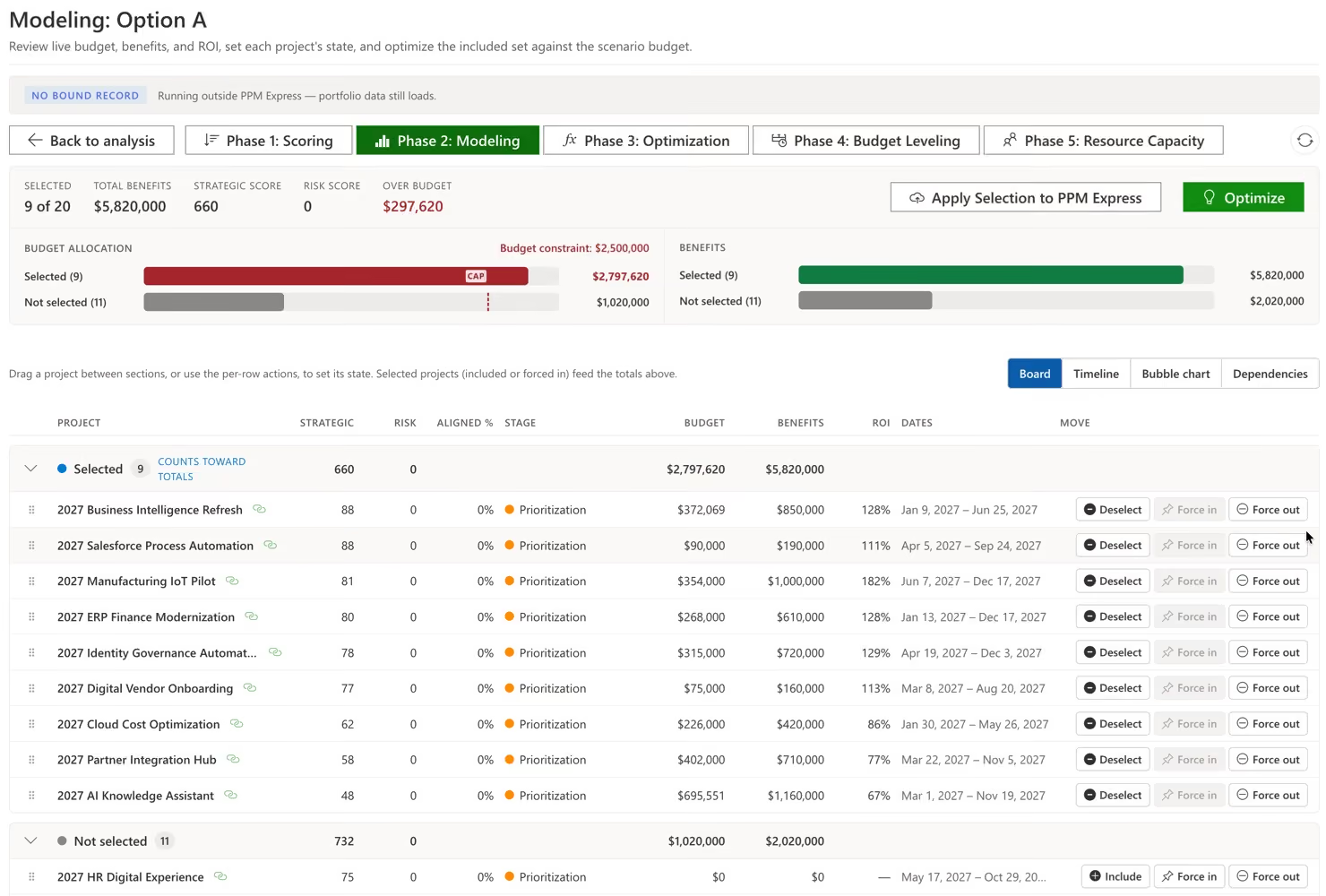
Alternative portfolio scenarios modelled against the money and the people actually available. More on what-if scenario planning and resource capacity planning.
6. Shibumi — the benefits realisation specialist
Shibumi is the specialist that the broad platforms get measured against whenever benefits are the point of the exercise. It is not trying to be a general PMO tool, and it is unusually well rated by the enterprises that run it.
Governance: the most complete published capability map in this research. Configurable intake; weighted scoring with ranked dashboards; unlimited scenarios evaluated against a baseline with automatic optimisation of a scenario against a chosen measure; supply-and-demand gap analysis; budget-at-risk alerts; and a deep benefits realisation engine — milestones carry financial and non-financial impacts, and benefit realisation auto-calculates on milestone completion with forecasting through execution. Stage gating is enforced by the workflow engine with mandatory-field checks.
AI: documented, which is more than several rivals manage. AI Analyze reached general availability on 18 February 2026 — query the initiative inventory for risks, milestones and dependencies and get summaries with recommendations. Alongside it sit an AI Agent Library of prebuilt agents and an Agent Factory for configuring your own, generating workplans from charter documents, performance gap analysis against benchmarks and workflow recommendations for approvals. Enablement is gated through your account team, and the underlying model provider is not disclosed.
The catch: it is a specialist. Its natural buyer is a transformation office running multi-billion-dollar value programmes, often alongside a Big Four or BPO partner — note the integrations with UiPath, Blue Prism and Automation Anywhere. It is not the IT PMO’s default. No published pricing.
Best for: enterprise transformation offices that have to prove benefits, not just track projects.
7. Bizzdesign — the enterprise-architecture-led option
Bizzdesign is a Leader in The Forrester Wave: Strategic Portfolio Management Tools, Q2 2026. Forrester singled out its strategy and modelling and capability-based planning, and called its AI capabilities “intuitive and practical” — noting that AI investment is a significant part of its innovation. Bizzdesign says it is the only vendor named a Leader in both this Wave and Forrester’s Enterprise Architecture Management Suites Wave, Q4 2024, which tells you exactly what it is: portfolio management run from an architecture model.
AI: Bizzdesign Unify launched on 16 April 2026 as an AI-native platform joining visual collaboration to live architecture and portfolio data. Named capabilities are conversational queries in plain language and AI co-worker agents that summarise designs, recommend improvements and surface insights on dependencies, constraints and business impact. Forrester’s evaluation noted external data connectivity through an MCP server on Alfabet. These are largely vendor-stated capabilities plus one analyst note; ask for a scoped demo of what is generally available today.
The catch: this is an enterprise-architecture-first product, and that is a bigger commitment than it looks. If your PMO does not already maintain an architecture model, you are buying a discipline as well as a tool.
Best for: organisations where IT portfolio decisions are genuinely architecture decisions — application rationalisation, technology risk, large-scale modernisation.
8. Cora Systems — the regulated-industry specialist
Cora is a Strong Performer in the Forrester Wave, Q2 2026. Its differentiator is compliance-grade project controls: Earned Value Management, subcontractor management and financial control, aimed at aerospace and defence, government contracting, engineering and life sciences.
AI — and Cora deserves credit for candour. Its Chief Product and Technology Officer described AI as “an active priority at Cora today” and framed the approach as building “the data architecture and integration framework that lets customers deploy their own AI use cases” rather than shipping confined application-specific features. In a category of maximalist claims, a vendor telling you its embedded AI is not yet mature is worth more than most product pages.
The catch: thin AI, by the vendor’s own account. Reviewers note “configuration and updates take effort, so it’s not something you can just set up and forget” and occasional reporting limits forcing exports. Jira integration is a named extension; no Azure DevOps or Microsoft Project integration is advertised. No published pricing.
Best for: A&D, government contracting and other EVM-regulated portfolios where compliance beats novelty.
9. OnePlan — the Microsoft ecosystem successor
If Project Online is your problem, this is among the most direct answers alongside PPM Express. OnePlan integrates with Project Online, Planner, Planner Premium, Teams, Azure DevOps, Jira, Smartsheet, monday.com, Asana, Wrike, Trello and ServiceNow — the widest Microsoft-ecosystem coverage we found in this comparison — and has been a repeated Microsoft Partner of the Year for Project and Portfolio Management.
It also publishes its pricing, which almost nobody at this tier does: Basic $10/user/month, Professional $30/user/month adding resource and financial planning plus Microsoft Project and Planner Premium integration, and Enterprise on request adding the Portfolio Modeler, what-if scenario planning, enterprise architecture, workflow automation and Power BI report packs.
AI: Sofia AI as an embedded assistant for portfolio and strategy, plus Insights AI from the Basic tier. Both are vendor claims — we found no independent verification, no documentation of GA scope and no third-party review evidence of what Sofia actually does. That is a gap in the public record rather than a judgement on the product; ask for a scoped demo.
The catch: read the tier table carefully — the real portfolio governance (modeller, scenarios, EA, workflow) is Enterprise-only, which is also the one tier with no published price. Review scores are a study in contrast depending on which capability is being rated. OnePlan claims a 2024 Forrester Wave Leader placement we could not verify from a public source.
Best for: Microsoft-centric PMOs migrating off Project Online who want published pricing and a familiar ecosystem.
10. Atlassian Strategy Collection — the one to watch, not to buy yet
Atlassian is a Strong Performer in the Forrester Wave, Q2 2026, with 5 out of 5 for Vision and Innovation, Security and Developer Extensibility. Forrester noted its “AI-powered model with a connected work graph” is “well in line with SPM’s expanded focus.”
Look closely at the scores, though: Current Offering 3.10 against Strategy 3.80. That gap is the signature of a vendor whose promise runs ahead of its product, and the release dates confirm it. Of the four headline capabilities announced at Team ’26 — Strategic Intelligence (Rovo agents reasoning over the Teamwork Graph across budget, goals, blockers and milestones), Funds, Strategic Planning and Human & AI Capital Management — exactly one, Funds, was generally available as of June 2026. Strategic Intelligence was in open beta, Strategic Planning rolling out through the rest of 2026, and Capital Management “coming soon.” Check current GA status before you evaluate; those dates will have moved.
Pricing — and it is the most striking published number we found. The Strategy Collection, which bundles Focus, Jira Align and Talent, lists at $77,400 per year for the 1–50 user tier, billed annually, with Jira Cloud Premium required as a minimum and no free trial. That is roughly $1,548 per user per year at the smallest tier — published openly, and at a level the Leaders in this category charge.
The catch: in 2026 you are largely buying a roadmap at a mature product’s price. If you are deep in Atlassian and planning a 2027 rollout, start the conversation. If you need portfolio governance working this quarter, look elsewhere.
Best for: large Atlassian-standardised organisations with an 18-month horizon.
Who is missing, and why
monday.com, Smartsheet, Wrike and Airtable are strong products that sit closer to delivery than to governance, which is what this comparison is measuring. Their portfolio features are largely monitoring views: monday’s portfolio management is Enterprise-only with no financial tracking, no scenario planning and no stage gates; Smartsheet’s Control Center is real but carries hard object limits and no benefits layer, and its Smart Agents were still marked coming soon as of August 2026; Airtable has no portfolio governance at all by design — you build it yourself. Several of them are evaluated by analysts in adjacent categories, and that is not a contradiction; it is a different definition doing different work.
Adobe Workfront is a genuine enterprise leader, of marketing and creative operations. Its AI Collaborators went GA on 13 August 2026 at no additional cost, one of the more generous agentic launches of the year. It is simply not an IT or engineering portfolio tool.
Triskell, North Highland’s UMT360, Bubble PPM and Celoxis are credible portfolio products whose AI capability we could not verify from first-party sources during our research window. Triskell rates well with the enterprises running it, though on a small sample, and was included for the first time in Gartner’s 2026 Magic Quadrant for Adaptive Project Management and Reporting; Celoxis has among the most transparent pricing in this market and 4.6 on G2 from 742 reviews. They belong on a PPM list. We could not place them on this one on the evidence available.
Meisterplan deserves a mention for honesty. It is deliberately narrow — portfolio-level capacity and scenario planning, sitting above whatever your teams use — and brands its AI “No-Nonsense AI”: instant status reports, connect your own agent via MCP, features “strictly opt-in only, and never trains public models.” In a category of maximalist claims, that reads well. Licensing is by resource rather than user.
Tempo is a strong Jira-native portfolio layer, with a genuinely novel AI Attribution feature that captures human time and AI activity together to measure what AI tools actually contribute. Tempo’s own guidance is that AI-driven portfolio management is “an emerging operating model rather than fully mature functionality” — a vendor advising caution, which is quotable.
Keto Software covers the SPM feature map on paper and holds Nordic industrial logos including KONE and Valmet, but raised only €8.4M in total, which is a procurement risk worth weighing.
What to ask before you sign
Is this a governance platform or a delivery tool? They are different purchases, and the marketing rarely distinguishes them. Ask to be shown investment categories, weighted scoring, stage gates, capacity modelling and benefits tracking working in the product, not described on a slide.
What is the AI reading? Ask for the coverage boundary in writing. Analysis over one connected tool and analysis over the whole portfolio are indistinguishable in the output.
Whose identity does the AI act under? An agent on a broad service account has removed the permission model you already built. One acting as the signed-in user has not.
Which AI features are GA today? Ask for a GA-versus-preview matrix by feature. Several vendors here announce a suite and ship it over eighteen months.
What is the real three-year cost? For per-seat platforms, model it at your actual headcount. Individual practitioner reports in this category include $500K in year one for Clarity, and $90K over three years plus $40K implementation for a mid-tier Planview product — anecdotes rather than benchmarks, but useful as a prompt for the question. Published flat-rate pricing at $8K–$25K a year changes that arithmetic considerably, and unlimited-user models change who you can afford to give access to — which turns out to matter more than the licence line.
What happens when Project Online switches off? If you are affected and have not started, that is the most urgent question on this page.
The summary
If your selection process leans on outside validation, Planview, Bizzdesign and ServiceNow are the Forrester Wave Leaders, with Cora and Atlassian as Strong Performers. Broadcom Clarity, Planisware and Shibumi rest their case on depth in their respective specialisms rather than on a badge, and in a real evaluation that tends to matter more.
If your problem is that your portfolio lives across Jira, Azure DevOps, Planner and Smartsheet and nobody can see all of it at once, the integration-led options — PPM Express and OnePlan — address that specific problem more directly and at a fraction of the cost, without a badge to point at in the steering committee.
And if you are still on Project Online, the deadline is 30 September. Whatever you choose, choose soon.
PPM Express gives enterprises one live portfolio built from Azure DevOps, Jira, Microsoft Project, Planner, Project Online, Smartsheet and monday.com — with scoring, scenario planning, capacity, stage gates and AI insights over all of it, for a flat annual fee with unlimited users. Compare it against the alternatives or start a 30-day trial.
Pricing, product capabilities and analyst placements cited here were last verified in September 2026 against vendor sites, press releases and public documentation. Where a vendor’s analyst standing is mentioned, it is the placement that vendor has itself announced publicly. Gartner and Forrester research is referenced for market terminology and vendor placements only; neither firm endorses any vendor, and PPM Express was not evaluated in the 2026 Gartner Magic Quadrant for Adaptive Project Management and Reporting. Confirm current details before purchase.
.svg)


