
PPM for Government and Public Sector Agencies
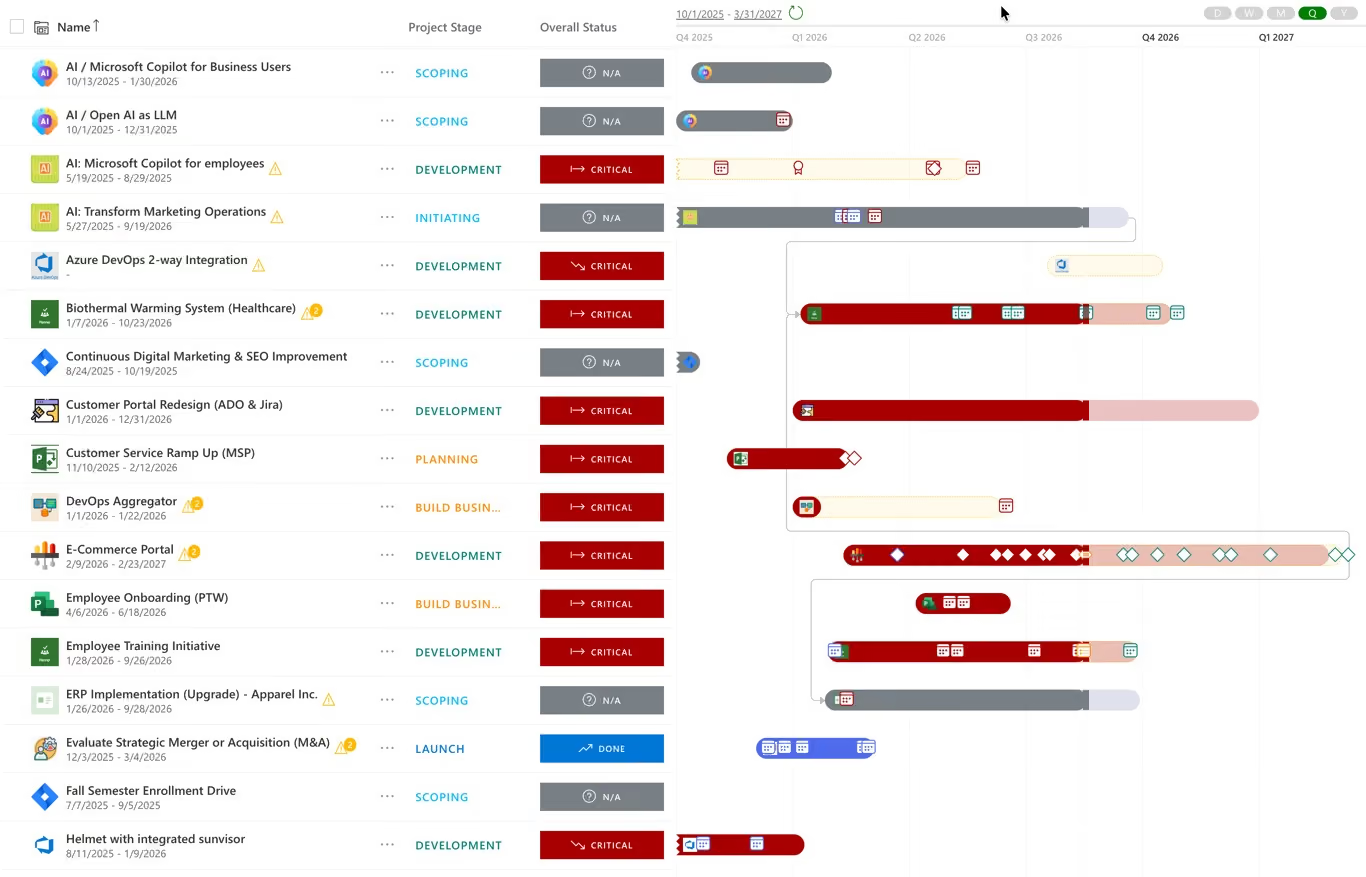
Roll up work from Azure DevOps, Jira, Microsoft Project, Planner, Project for the Web, Smartsheet and Monday.com, alongside capital and grant-funded programs entered directly. Divisions keep their delivery tools. Leadership gets one current view without a quarterly data call.
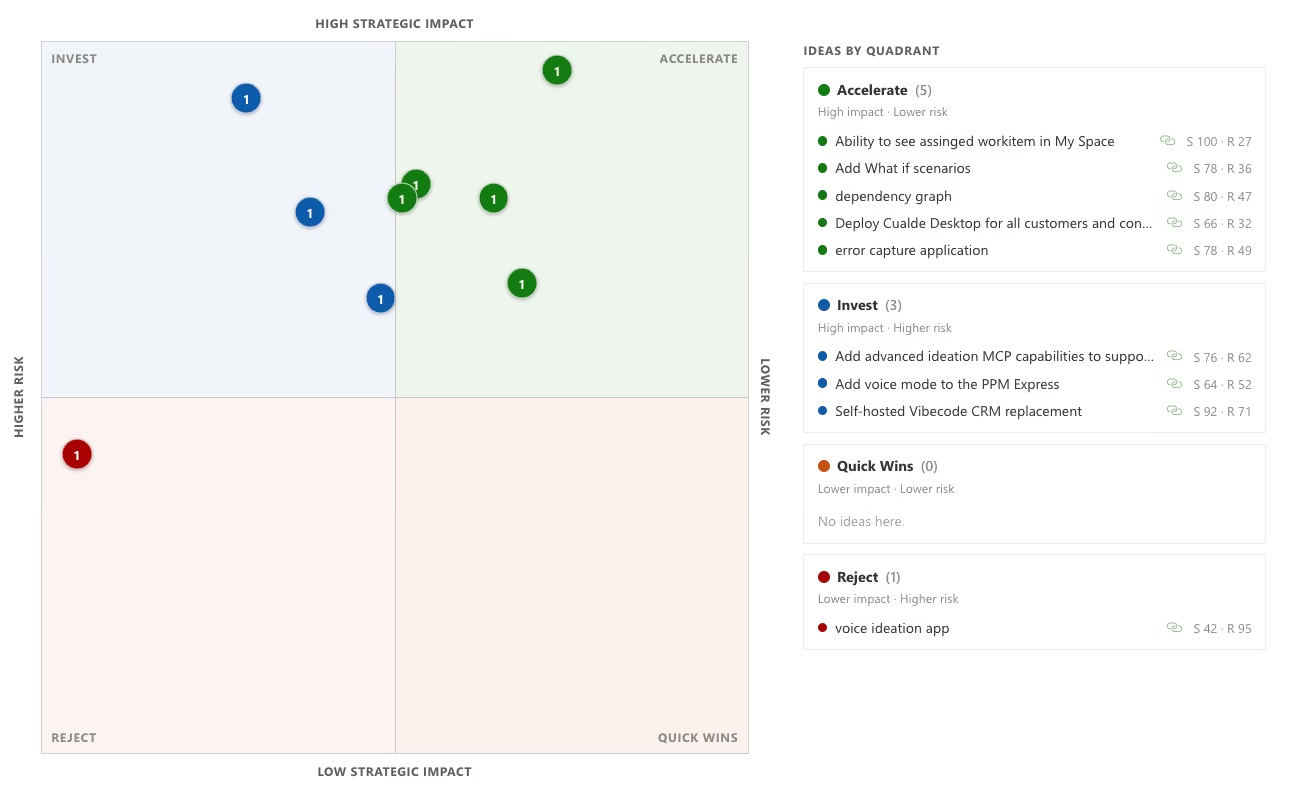
Weighted strategic and risk factors with published value ranges, kept alongside budget, forecast, benefits and impact. A mandated compliance program, a capital replacement and a service modernization stay different kinds of work, but the basis for sequencing them is written down before the requests arrive rather than argued after.
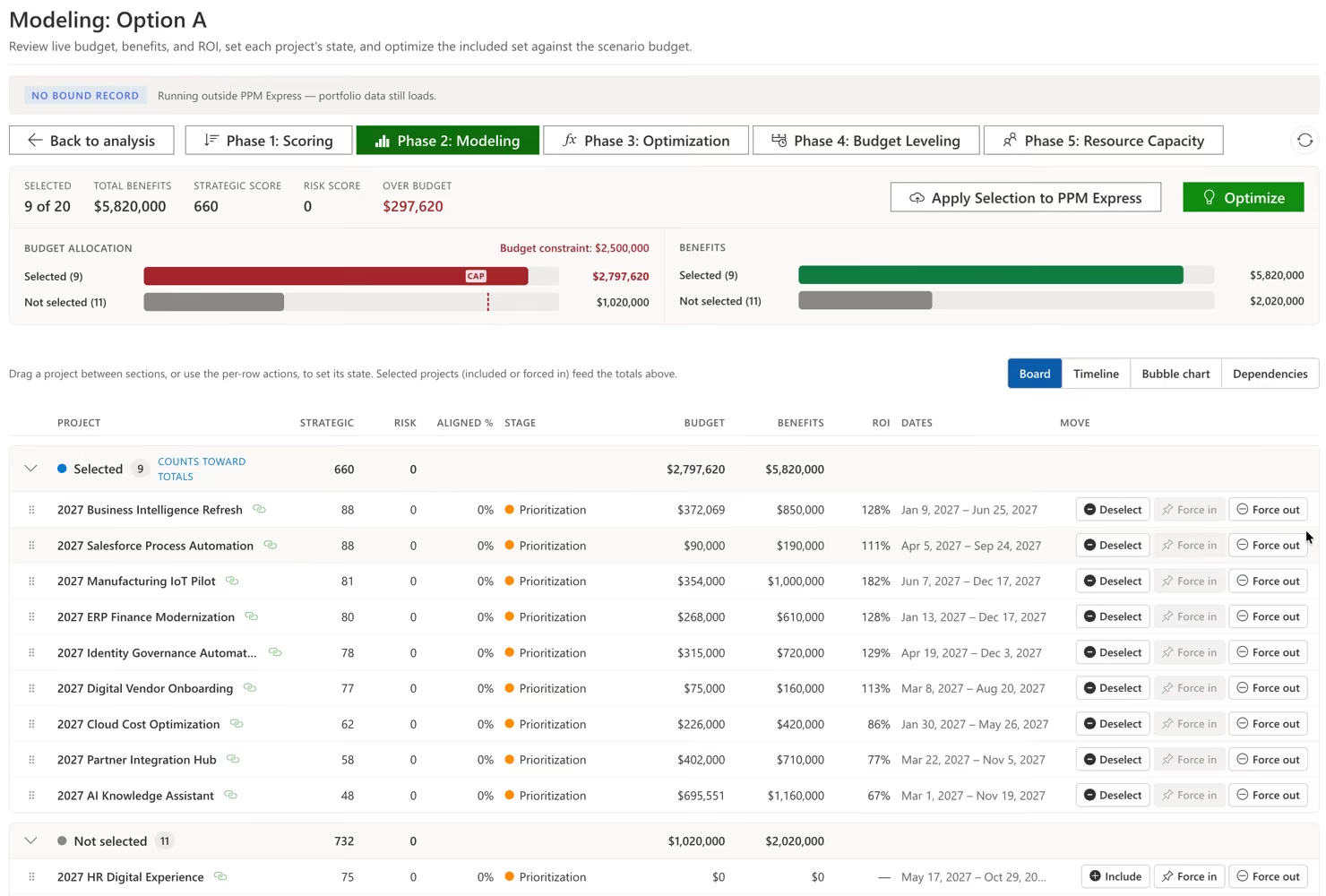
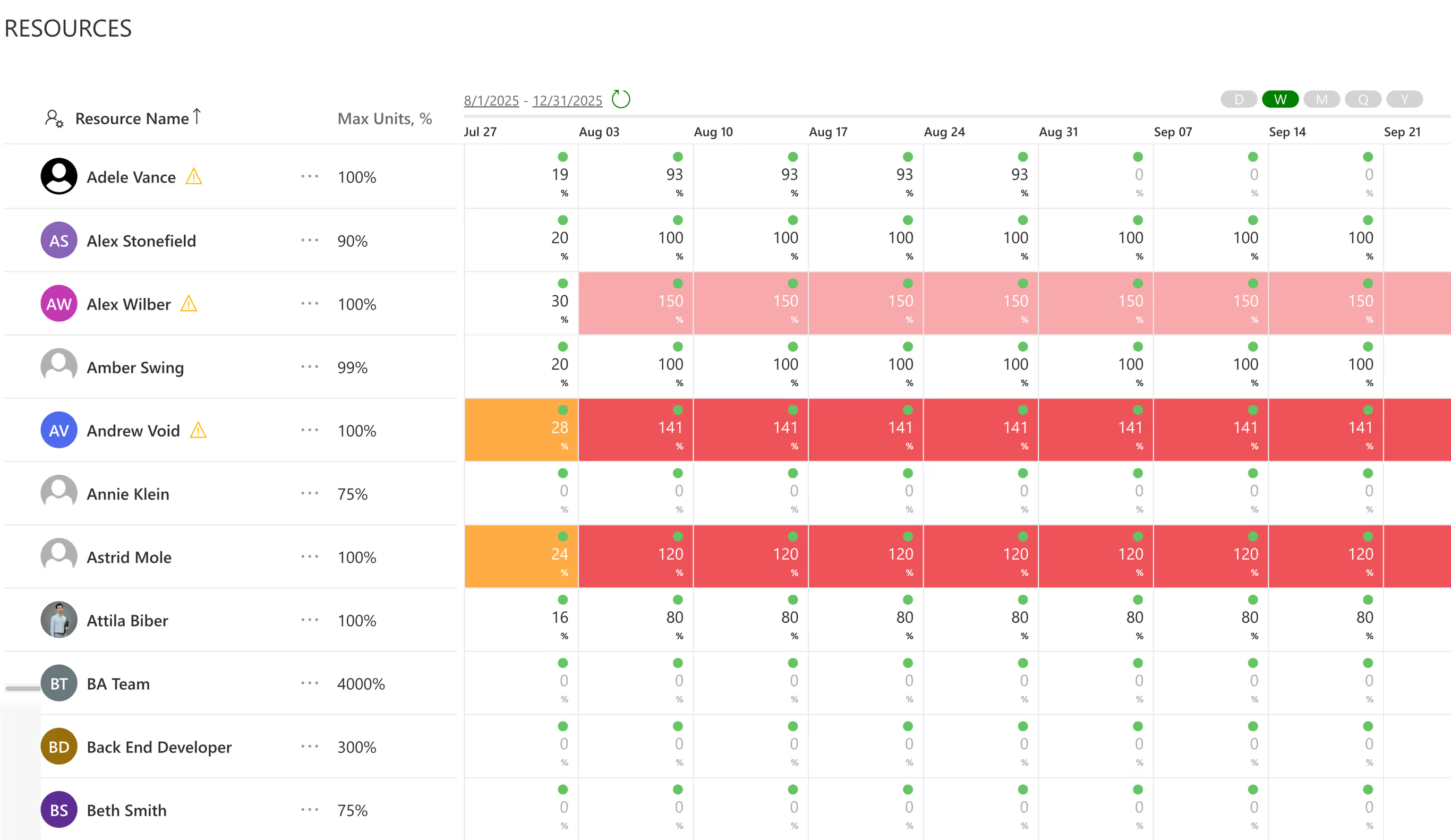
Model funding scenarios against one ceiling, including the reduced ceiling you may be handed, and test the selected work against availability in hours or % FTE. When the number changes, you produce the revised portfolio in the meeting rather than three weeks later.
Enterprise PPM platforms cover broadly the same ground. Where they differ most is what it costs to give your whole organization access to it.
| PPM Express | Planview | Planisware | Meisterplan | ServiceNow SPM | |
|---|---|---|---|---|---|
| Portfolio and programme hierarchy | Yes | Yes | Yes | Yes | Yes |
| Weighted scoring and prioritization | Yes | Yes | Yes | Yes | Yes |
| What-if funding scenarios | Yes | Yes | Yes | Yes | Yes |
| Resource capacity planning | Yes | Yes | Yes | Yes | Yes |
| Stage-gate intake and approvals | Yes | Yes | Yes | Yes | Yes |
| Budgets, forecasts and benefit realization | Yes | Yes | Yes | Yes | Yes |
| Dashboards and portfolio reporting | Yes | Yes | Yes | Yes | Yes |
| Multi-fund and multi-year appropriation tracking | Yes | Yes | Yes | Limited | Limited |
| Retained decision history for audit and oversight | Yes | Yes | Yes | Limited | Yes |
| Microsoft Project, Planner and Project for the Web | Native two-way | Yes | Limited | Limited | Limited |
| Jira and Azure DevOps | Native two-way | Yes | Limited | Limited | Yes |
| Power BI reporting pack | 200+ reports | Limited | Limited | Limited | Limited |
| Unlimited users included | Yes | No, per seat | No, per seat | No, per seat | No, per seat |
| Typical annual cost | $8,000 to $25,000 flat | $100,000+ | $100,000+ | Mid five figures | $100,000+ with platform |
Planview is the broadest suite in the category and the strongest analyst position. If you need enterprise architecture, value stream management and PPM from one vendor, it covers more ground than we do. It also carries the longest implementation and the highest cost, and per-seat licensing works directly against the transparency obligations most agencies operate under.
Planisware is genuinely excellent at R&D and new product development pipeline modelling, with depth we do not attempt to match. For an agency portfolio of capital, IT, grant-funded and mandated work, that depth is largely unused and still paid for.
Meisterplan is fast to deploy and very good at lean capacity and scenario planning. If staff conflict across divisions is your single problem, it will solve it quickly. It is deliberately lighter on financials, multi-fund tracking and gated intake, so agencies with appropriation and audit requirements tend to outgrow it.
ServiceNow SPM is a strong choice if the agency already runs ServiceNow for ITSM, because the platform and data are already there. If not, you are buying the platform to get the portfolio module, and the procurement, cost and implementation footprint follow.
PPM Express covers the same core portfolio capabilities on one flat annual subscription with unlimited users. We are not the deepest R&D pipeline tool or the broadest enterprise suite. We are the portfolio layer for agencies that run on Microsoft and Jira and need a defensible decision record without a six-figure line item.
A legislative mandate, a capital replacement, a grant-funded expansion and an IT modernization can all be justified and still compete for the same staff and the same year. Score each against published criteria, compare the scenarios that are genuinely fundable, and test the result against capacity before the plan becomes a public commitment.
Security & Trust
Enterprise-grade security is built into our platform. We offer US and EU data residency, full GDPR compliance, and custom DPAs to meet strict regulatory requirements.
Need app availability in your region/country to meet data residency requirements? We can provide.
Microsoft 365 and Okta SSO ensure secure identity management, while centralized user management, advanced permissions, detailed audit logs, and strict data isolation protect sensitive enterprise data.
Bring your security reviewers to the same call.
Book Enterprise Demo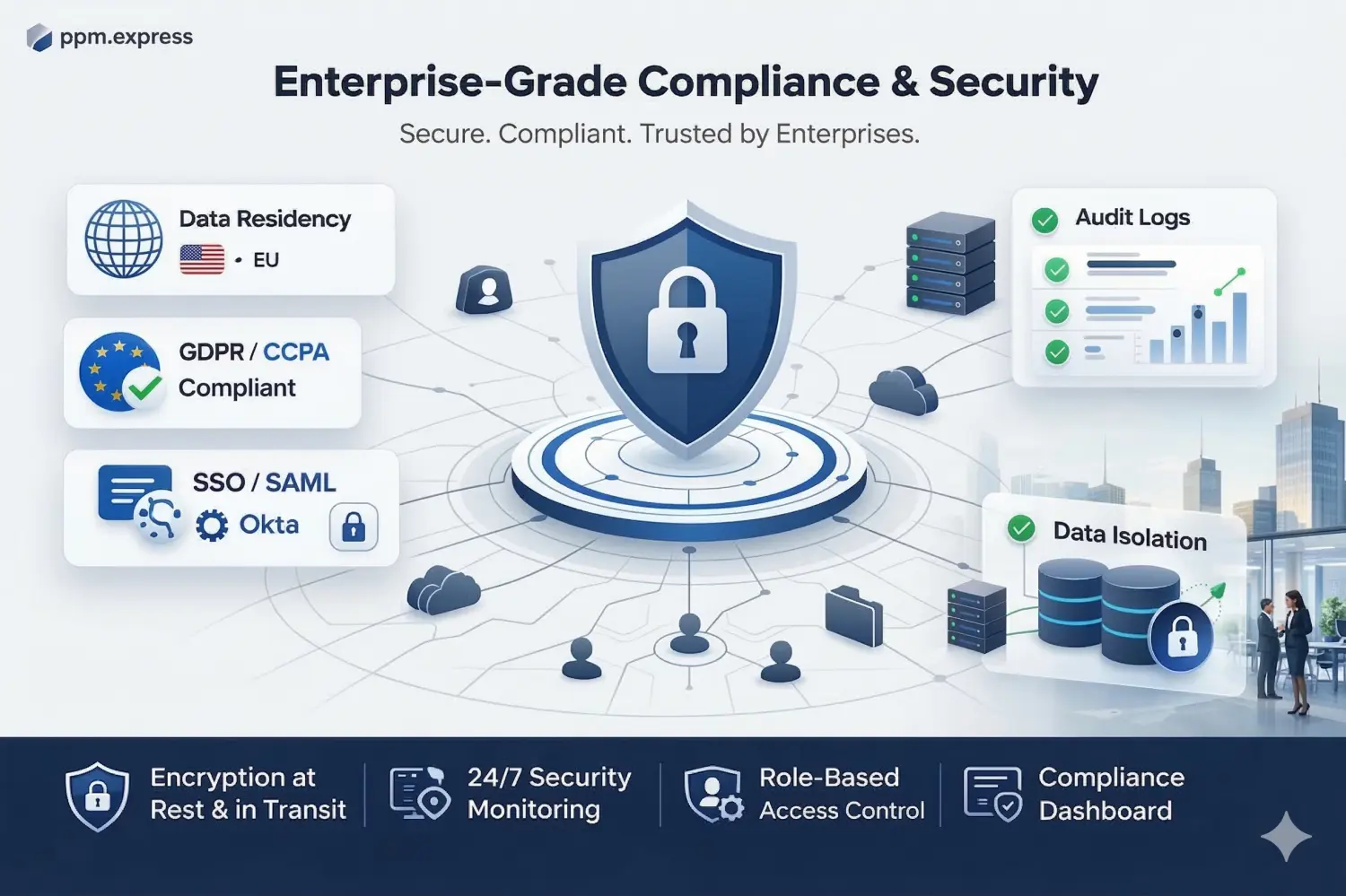


What our clients say
250+
Customers
use our software daily
100 hours
Saved every year
on monitoring state and statuses of projects, per PM
100K+
Projects
tracked on the PPM Express platform
Unlimited
Users
on every paid plan, so visibility is never rationed
Data residency
US & EU Data Residency
Encrypted in transit and at rest, with SSO, audit logs and tenant isolation. No customer data used to train AI models.
Reporting
200+ ready-to-use reports
Power BI reports built on live portfolio data, so stakeholders get self-service dashboards instead of a request queue.
Pricing
One flat annual subscription
$25,000/year for large enterprises, $8,000/year for SMB. No per-seat penalty.

Streamline Project Portfolio Management and Visibility at Scale
Integrations


Capture new project request, streamline evaluation and prioritization
Product

Structured Approach for prioritizing and aligning portfolios with strategic priorities and resource constraints
Product
Last updated 7 September 2026
Public sector portfolio management, answered.
Managing every programme the agency funds as one portfolio rather than as separate divisional, capital and grant-funded plans. The structural reason agencies need it is that funding arrives through several streams with different rules and cycles, while delivery draws on one shared set of engineers, procurement staff and programme managers. Independent plans against separate funds therefore produce a staffing collision that no single budget process catches.
Yes, and this is the core use case. An analysis holds a budget ceiling, a scoring model and the candidate programmes. Build one scenario at the requested figure and others at reduced ceilings, and each is judged by the same rules, which is what makes comparing them meaningful. When the actual number arrives, you are selecting between prepared options rather than starting the analysis.
You do not rank them against each other; you sequence around them. Mandated work enters the portfolio with its constraint recorded, consuming capacity like anything else. The value of putting it in the same view is that you can see what it displaces. Most agencies absorb mandates invisibly, and the discretionary work that quietly disappeared is never accounted for.
The programme runs a configurable process of phases and stages with gates between them, and you choose which gates require approval. Assigned approvers review in the Approval Center and all must approve before the programme advances. On a multi-year capital programme this is what keeps each tranche honest rather than treating the original authorization as settled.
Budget, forecast, benefits and impact are tracked against each programme and baselined at the funding decision. Programmes and portfolios can be structured to match how you actually govern — by division, by fund, by capital plan — and reporting is built on live data through 200+ Power BI reports rather than assembled by hand each cycle.
Fairness comes from the scale, not the ranking. When strategic and risk factors carry published value ranges, a 3 from public works means what a 3 from health and human services means and the comparison holds. You can also run two frameworks side by side, a full weighted model and something lighter like MoSCoW, then look at where they disagree. That disagreement is often the most useful output.
Re-test the portfolio at each funding cycle instead of treating the original authorization as settled. Baselines set at the initial decision stay available, so leadership and oversight can see how far the current forecast has drifted from the case that was approved. On a multi-year capital programme that is the single most useful governance question, and the one least often asked.
Allocation shows against calculated capacity in hours, percent or FTE, with overallocation flagged before anyone commits. In practice this surfaces the shared engineering, procurement and programme management staff who appear in several divisional plans at once. Each plan looked entirely plausible on its own, which is why the clash never gets caught in a divisional review.
Yes. Resources can be filtered by role, department or skill, and utilization displays in hours, percent, FTE or chart view. Capacity is calculated from each person's work week and calendar exceptions, and actual hours from time tracking feed the same views. So you can look at your engineers or procurement specialists as a group across every division rather than hunting for them plan by plan.
Yes. Project Online and Project for the Web connect directly. For plans built in the Microsoft Project Desktop client, PPM Express Project Publisher is an add-in that publishes an open schedule up into PPM Express. Desktop 2016, 2019 and 2021 are supported, and each published plan carries up to 2,000 tasks across ten levels of hierarchy.
No. Pricing is one flat annual subscription with unlimited users. This matters more in the public sector than most sectors, because transparency obligations and the number of interested parties mean per-seat pricing tends to force agencies into exactly the opposite of what they are required to do.
The retained decision history shows which scenario was selected, on which model, with which numbers at that moment. Models scoring live programmes must be cloned before they can be edited, so the basis of an earlier decision cannot be rewritten after the fact. Detailed audit logs, data residency options and custom DPAs cover what agencies are typically asked for in a records or audit request.
PPM Express connects to the tools teams already use rather than replacing them, so the portfolio view assembles from current delivery activity. Agencies typically get a working portfolio view well inside a single budget cycle, which matters because a portfolio system that takes two budget cycles to stand up has missed the decisions it was bought to inform.
.svg)


