
Australia-based mining company considered expanding PPM Express beyond a small group of project managers, scale became the next issue.
Manually creating users, granting access to every project, keeping Microsoft 365 Groups synchronized with the PPM system, and configuring every new project separately would quickly become unsustainable.
When membership and access have to be maintained manually across multiple systems, inconsistencies inevitably appear over time.
The company faced a similar challenge with resource management.
Detailed task-level effort planning can theoretically provide very precise resource information. In practice, previous approaches requiring extensive effort tracking created too much administrative overhead.
For many parts of the organization, resource owners needed a much simpler answer:
How much of this person's capacity is already committed, how much is proposed for upcoming projects, and how much capacity actually remains?
A resource who on paper had 100% availability for projects might in reality have only 20%, with the rest consumed by operational work, maintenance, infrastructure activities, and other business-as-usual responsibilities.
The company combined identity automation, project provisioning, and high-level resource planning.
The company used Microsoft Entra ID synchronization to simplify user management and maintain consistent identity information.
PPM Express permissions were structured around portfolios, programs, projects, and user roles so access could inherit through the portfolio structure rather than being configured repeatedly for every individual project.
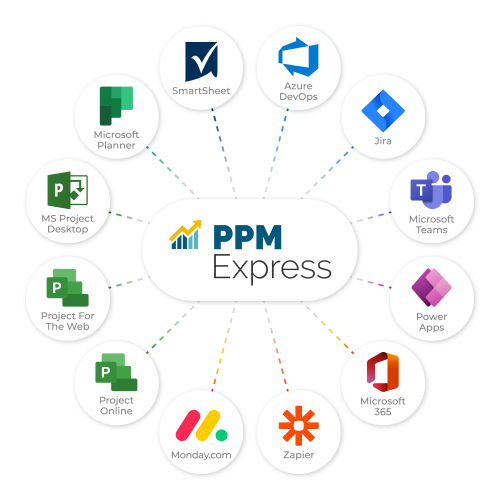
The organization also developed an automated provisioning approach connecting its existing Microsoft 365 environment with PPM Express.
A project creation workflow could create the appropriate Microsoft Teams workspace, Planner or Planner Premium plan, and PPM Express project, then connect those elements through APIs and integrations. This moved the company toward a repeatable project setup rather than asking every project manager to assemble the environment manually.
For resource management, the organization deliberately adopted a simpler model.
Instead of requiring detailed effort estimates everywhere, project managers could plan high-level allocations such as 20%, 30%, or 50% of an individual's capacity over a given period.
Non-project work and business-as-usual activities could also be represented, so resource owners saw realistic capacity rather than assuming every employee was fully available for projects.
The company turned PPM Express from another application that needed to be administered into part of an integrated project delivery environment.
New projects could follow a consistent setup, access management became more systematic, and Microsoft 365 and PPM Express could operate as parts of the same project ecosystem.
Resource planning also became practical enough to use across the organization.
Rather than chasing perfect resource data that employees would struggle to maintain, the company gained a portfolio-level view of committed capacity, proposed demand, and operational workload.
Project and resource managers could make better allocation decisions without the administrative burden that had limited previous resource management approaches.


Reviewed by PPM Express in August 2026.
.svg)


