

Every PMO leader knows the feeling. The tool is live. The training is done. The executive sponsor gave a rousing speech at the launch event. Six months later, half the team is still tracking projects in spreadsheets.
The problem isn't the software. The problem is that most organizations treat user adoption as an event — a go-live milestone — rather than what it really is: an ongoing organizational capability that must be actively built, maintained, and adapted over time.
Measuring the Wrong Thing
The classic failure mode is this: success is declared when the system goes live. Licenses are purchased, the implementation partner is paid, and someone flips the project status to green. But "live" is not the same as "used." And "used" is not the same as "embedded."
After years of working with organizations on portfolio and project management, I've seen the same pattern repeat: enormous investment in the platform, chronic underinvestment in the behavioral change required to make it stick. The gap between capability and adoption is where PMO value goes to die.
The fix isn't more training sessions or a better help center. It's recognizing that different user groups have fundamentally different relationships with a PPM tool — and designing for that reality from day one.
The Three Adoption Personas Every PMO Manages
Think about who actually touches a PPM platform:
1. Portfolio Leaders want insight, not input. They need status in 30 seconds, risk surfaced automatically, and resource conflicts flagged before they become crises. They will never log into a tool to fill out a status form. If you design your adoption strategy assuming they will, you've already lost them.
2. Project Managers are the engine of the system. They're entering data, updating timelines, managing dependencies. For them, friction is the enemy. Every extra click, every mandatory field that doesn't match how they actually work, every report they have to export to Excel to make readable — that's adoption erosion happening in real time.
3. Team Members are often an afterthought. They're assigned tasks, asked to update percent complete, and expected to report into a system they didn't choose and can't see the value of. Their engagement is lowest, yet their data quality determines whether the whole stack is worth anything.
A mature adoption capability means having a deliberate strategy for each of these groups — not a single "change management plan" that treats them as one homogeneous audience.
Where AI Changes the Equation
This is where things get genuinely interesting.
The traditional friction points of PPM adoption — complex interfaces, unfamiliar navigation, the cognitive overhead of context-switching from email to Teams to a project portal — are increasingly solvable by a new category of interaction model: conversational AI as a PPM client.
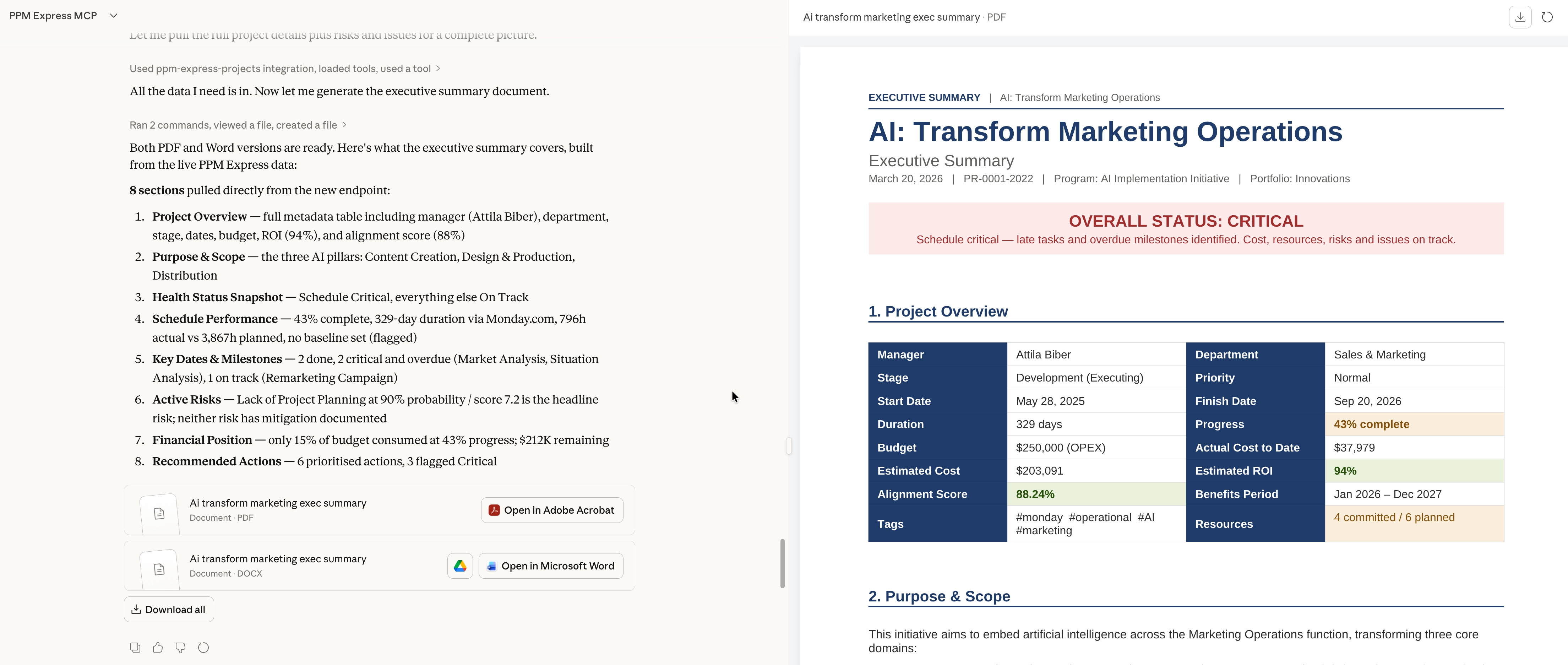
Consider what becomes possible when a project manager or portfolio leader can simply open Claude Desktop, connect it to PPM Express via MCP (Model Context Protocol), and interact with their entire project portfolio through natural language.
Instead of: Log in → Navigate to portfolio view → Filter by status → Export report → Paste into email
They get: "Show me which projects are at risk this week and draft a status summary for the steering committee."
Instead of: Open the tool → Find the resource planner → Cross-reference with the timeline → Check with a colleague on Slack
They get: "Do we have capacity to bring a new initiative into Q3 without impacting the existing portfolio?"
This isn't a UI improvement. It's a behavioral unlock. The resistance that kills adoption — the "I'll just use my spreadsheet because it's faster" instinct — evaporates when the interface meets people where they already are.
PPM Express + Claude Desktop: Adoption by Design
The integration between PPM Express and Claude Desktop via MCP is a concrete expression of this principle. Rather than forcing users to learn a new tool's navigation paradigm, it lets them access portfolio data, project status, resource information, and reporting through the same conversational interface they're already using for other work.
For portfolio leaders, this means getting the insight layer they actually want — without navigating dashboards.
For project managers, it means faster updates, smarter prompts, and the ability to generate reports without reformatting data.
Adoption Is a Capability, Not a Campaign
The mindset shift I keep coming back to: user adoption isn't something you do once at launch. It's a muscle you build over time, with continuous feedback loops, persona-specific engagement strategies, and a willingness to evolve how the tool is positioned as the organization's needs change.
That means:
- Measuring behavioral change, not just license utilization
- Segmenting by user persona and designing touchpoints accordingly
- Removing friction progressively — each quarter asking "what's still making this hard?"
- Celebrating workflow wins, not just system milestones
- Using AI interfaces to meet users at their level of technical comfort
The organizations that will get the most from their PPM investments in the next three years aren't the ones with the most features turned on. They're the ones that figured out how to make the tool feel like the easiest path — not the mandated one.

.svg)


