
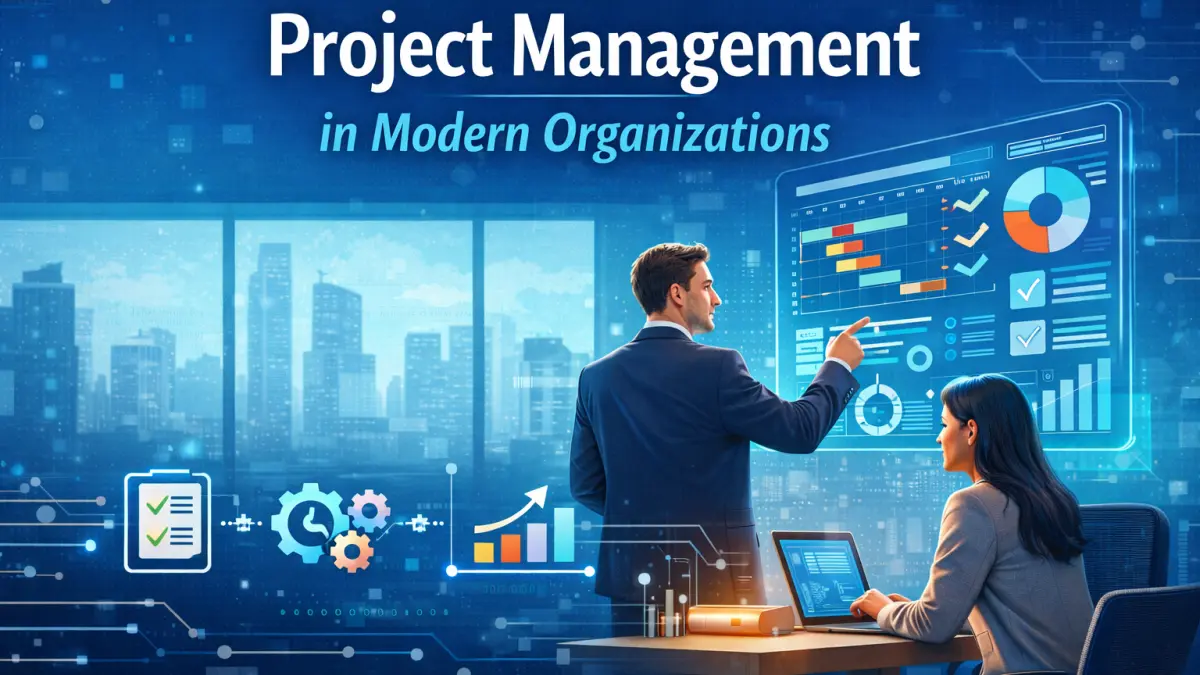

Artificial intelligence is no longer a future consideration for project management — it's happening right now, across organizations of every size and industry. The question business leaders face is not whether to embrace AI-powered PMO, but how: what to look for, what genuinely matters, and where to begin.
This post covers the key dynamics reshaping project portfolio management today, the criteria to use when evaluating AI tools, how PPM Express delivers on these capabilities, and what is coming next. If you want the full picture — with an 8-criteria buyer's framework, a phased adoption guide, and a detailed comparison against Planview, Monday AI, and Microsoft Project — our white paper has everything you need.
The AI Moment in Project Management
For decades, project management software helped organizations record what was happening. The best systems today don't just record — they think. They analyze patterns across hundreds of projects, surface risks before they materialize, generate reports in seconds, and give every project manager the analytical power that previously required a dedicated analyst team.
Three forces are driving this shift simultaneously:
- Large language models — GPT-4 and equivalent models can now read, write, and reason about project data with near-human quality, making AI narrative generation and intelligent Q&A genuinely useful rather than gimmicky.
- Connected work ecosystems — Microsoft 365, Teams, Copilot, and Azure DevOps create a unified data layer. AI embedded in these environments can access project context wherever work actually happens.
- Real-time cloud data — Cloud-based PMO platforms hold rich, live project data — tasks, risks, budgets, resource plans — that AI can analyze continuously, not just at reporting intervals.
Four Dynamics Every PMO Leader Needs to Understand
1. The information gap
Most organizations collect vast amounts of project data. The problem is that executives rarely see it in a form that enables action. By the time a status report reaches a leadership meeting, it's already out of date. AI closes this gap by monitoring data continuously and surfacing what matters proactively — without waiting for a PM to find time to write the update.
2. Portfolio complexity at scale
As organizations grow, the number of concurrent projects increases exponentially — but the cognitive capacity of portfolio managers does not. A portfolio of 50 projects generates more interdependencies, resource conflicts, and risk interactions than any human team can reliably track. AI-powered portfolio management tools analyze the full picture simultaneously, surfacing conflicts that would otherwise go unnoticed until they become delays.
3. The resource allocation paradox
Your highest-performing people are also your most overallocated. The individuals with the skills and track record to drive critical projects are precisely those most at risk of burnout — and whose departure would have the largest impact. AI-powered resource management monitors utilization continuously, flags overallocation before it becomes a retention risk, and helps organizations make staffing decisions based on real capacity data.
4. The Microsoft ecosystem advantage
For the majority of organizations, Microsoft 365 is the operating system of work. PMO tools that live outside this ecosystem face an adoption problem: the more context-switching required, the less the system gets used, and the less value it delivers. Organizations deploying PMO tools with deep Teams integration and Copilot connectivity report significantly higher adoption rates — because the tool meets users where they already are.
How to Evaluate AI PMO Tools: The Eight Questions That Matter
The market is full of products claiming AI capabilities. Separating genuine value from marketing noise requires asking the right questions. Here are the eight we recommend putting to any vendor:
- Is AI embedded in the daily workflow, or do you need to open a separate dashboard to use it?
- Does it integrate natively with Teams, Copilot, and the tools your team already uses?
- Is the AI proactive (alerts you) or reactive (only answers when asked)?
- Does it span the full PMO lifecycle — planning, risk, governance, reporting, financials?
- What happens to your project data — is it used to train AI models?
- Are AI-generated suggestions explainable — does the system show its reasoning?
- Can it scale to 100+ projects with portfolio-level health aggregation?
- What is the vendor's AI development roadmap — and do they have the engineering maturity to execute it?
Watch out for vendors who describe AI features exclusively in future tense. Ask to see every capability demonstrated live in the product before signing. If it's not in the current release, treat it as aspirational — not a buying criterion.
What PPM Express Delivers Today
PPM Express was built for organizations running on Microsoft — Teams, Azure DevOps, Planner, and now Copilot. It brings AI-powered PMO capabilities to mid-market and enterprise organizations that have historically been forced to choose between expensive enterprise platforms and lightweight tools that can't handle real portfolio complexity.
- AI Agents — Three Types: Identification, Insights, and Quality Insights Agents run automatically on schedule — flagging risks, surfacing overdue items, and checking data completeness across your portfolio without manual effort.
- AI Project Digest: Generate a complete, human-quality project narrative from live project data in seconds. Review and email to stakeholders directly — no more hours spent on manual status reports.
- Native Teams Integration: PPM Express lives inside Microsoft Teams. Project managers update risks, log issues, and receive AI alerts without leaving the environment where they spend their day.
- Microsoft Copilot via MCP: Ask "Which projects are at risk this week?" or "Who is overallocated?" and get AI-powered answers from live PPM Express data — directly inside Microsoft Copilot.
- Generate Tasks & Risks with AI: Create structured task lists and risk registers from project descriptions. PMs review and refine — AI accelerates, humans decide.
- PPM Insights AI: A dedicated project health section aggregates all AI signals — overdue items, at-risk milestones, budget signals, data quality gaps — in one view, updated continuously.
What's Coming: Portfolio & Resource AI in Active Development
PPM Express is making its most significant near-term investments in two areas where AI has the highest leverage for business leaders: portfolio intelligence and resource management.
Portfolio & Program Management AI
- Portfolio-Level AI Health Aggregation — A single AI-generated view of your entire portfolio's health, updated continuously, not weekly.
- Natural Language Portfolio Analytics — Ask your portfolio questions in plain English. No dashboards to configure, no reports to run.
- What-If Scenario Modelling — Simulate the impact of pausing a project or reallocating resources before making the decision, not after.
- AI Portfolio Scoring & Prioritisation — Data-driven composite scoring across strategic alignment, ROI, risk, and resource feasibility.
Resource Management AI
- Skills-Based Resource Matching — Match people to projects based on skills, proficiency, availability, and current utilization.
- 12-Month Capacity vs. Demand Forecasting — Identify future resource shortfalls before they become delivery blockers.
- Burnout & Overload Risk Prediction — ML monitoring of rolling workload data to get ahead of burnout before your best people hit the wall.
Where to Start: A Three-Phase Approach
For most organizations, the right approach is a phased adoption that delivers quick wins first, then expands scope as confidence grows:
- Phase 1 — Visibility (Weeks 1–8): Enable AI-generated status reports, activate automated exception alerting, connect Teams, and run AI risk identification on your highest-priority projects.
- Phase 2 — Portfolio Intelligence (Months 2–6): Connect to Microsoft Copilot via MCP, establish AI-monitored governance standards, use AI Project Digest for board reporting, and audit resource allocation with AI.
- Phase 3 — Predictive AI (Months 6–18): Portfolio scenario modelling, skills-based resource matching, and institutional knowledge capture from historical project data.
Practical tip: Don't wait for perfect data to start. AI generates value from the data you have today. Begin with Phase 1 and improve data quality incrementally as AI agents flag what's missing.
Download the Full White Paper
For the complete guide — including the full 8-criteria evaluation framework, a detailed competitive comparison, and a step-by-step adoption roadmap — download the white paper below. No registration required.
.svg)


