
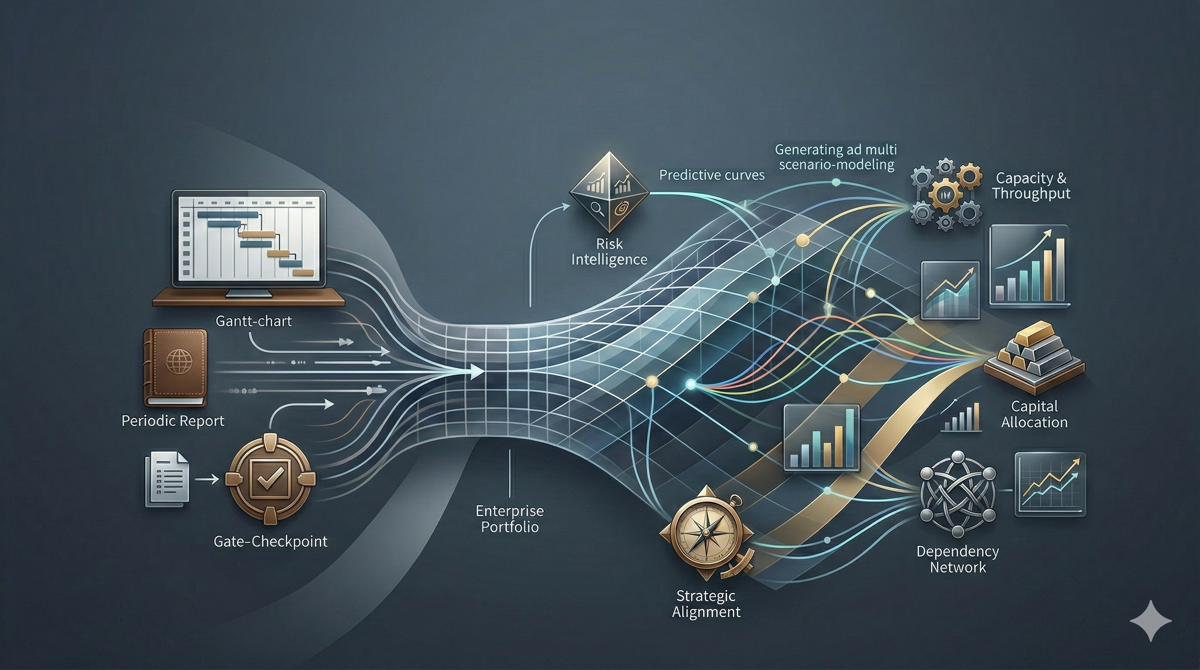

From Traditional PPM to Agent-Enabled Portfolio Intelligence
Published: February 28, 2026
For more than two decades, Project Portfolio Management systems have provided organizations with structure, visibility, and governance discipline. They have helped enterprises standardize processes, track investments, and bring transparency to complex delivery landscapes.
That foundation remains essential.
However, the scale and speed of modern business now expose the limits of static portfolio reporting. Leadership teams are managing larger transformation agendas, tighter capital constraints, and higher expectations for predictability. In that environment, visibility alone is no longer sufficient.
Organizations need portfolio systems that not only report what is happening — but help anticipate what will happen next and quantify the impact of alternative decisions.
This is where agent-enabled portfolio intelligence becomes relevant.
Why Traditional PPM Is Under Pressure
Traditional PPM tools were designed around structured governance cycles:
- Periodic portfolio reviews
- Status reporting cadences
- Stage-gate approvals
- Funding checkpoints
These mechanisms remain valuable. However, they are often retrospective in nature. By the time issues appear clearly in reporting, corrective options may be limited.
Common enterprise challenges include:
- Portfolio risks discovered late in the delivery cycle
- Capital tied to initiatives that no longer align with shifting priorities
- Limited transparency into cross-project dependencies
- Trade-off discussions lacking quantified scenario analysis
As portfolios grow more interconnected, manual interpretation and periodic reporting introduce delay.
Reducing that delay is increasingly a strategic priority.
What Agent-Enabled PPM Means in Practice
Agent-enabled PPM introduces specialized, continuously operating analytical agents within the portfolio platform. Rather than replacing governance processes, these agents strengthen them by surfacing decision-ready insights between formal review cycles.
Each agent focuses on a specific executive question:
- Risk Intelligence Agent
Identifies emerging systemic risks and clusters correlated issues across projects. - Capacity & Throughput Agent
Monitors resource utilization patterns and models the impact of reallocations. - Capital Allocation Agent
Simulates funding scenarios and evaluates marginal return trade-offs under real constraints. - Strategic Alignment Agent
Measures how current investments align with declared strategic themes. - Dependency Network Agent
Analyzes cross-project linkages to identify fragility and potential cascade effects.
These agents operate continuously, drawing on historical and real-time data to provide:
- Quantified impact assessments
- Scenario comparisons
- Confidence-based forecasts
- Escalations when thresholds are exceeded
The objective is not automation for its own sake. It is earlier insight and more informed governance.
Business Impact for Enterprise Leaders
Agent-enabled portfolio intelligence supports executive roles in distinct ways.
For CFOs
Capital allocation scenarios are modeled dynamically. Leaders can evaluate the projected impact of funding adjustments before decisions are finalized, strengthening capital discipline.
For COOs
Delivery forecasts incorporate capacity constraints and historical performance trends, improving predictability and reducing late-cycle surprises.
For CROs
Emerging risk patterns are identified across programs, enabling earlier mitigation and more focused intervention.
For Transformation Leaders
Strategic alignment can be measured continuously rather than annually, helping ensure portfolio investments remain consistent with enterprise priorities.
For Business Unit Executives
Benefit realization tracking provides visibility into whether projected outcomes are being achieved, enabling timely “scale, adjust, or exit” decisions.
A Measured Evolution of Governance
Agent-enabled PPM does not eliminate existing governance structures. Instead, it enhances them.
Portfolio reviews become more focused because:
- Analysis is pre-processed continuously
- High-impact issues are surfaced proactively
- Trade-offs are quantified before debate
Meetings shift from data collection to structured decision-making.
Over time, organizations benefit from:
- Reduced escalation intensity
- Improved forecast accuracy
- Faster funding rebalancing
- Greater confidence in strategic alignment
Building the Foundation for Agent-Enabled PPM
Successful adoption requires disciplined preparation.
- Data Integrity
Historical execution data must be structured and reliable. Metadata standards should be enforced consistently. - System Integration
Delivery, financial, and strategic planning systems should be connected to ensure comprehensive visibility. - Phased Deployment
Organizations may begin with three high-impact agents:- Risk Intelligence
- Capacity & Throughput
- Capital Allocation
- Executive-Level Synthesis
Insights should be presented through a consolidated executive view that translates analytical outputs into clear, decision-ready recommendations.
The Long-Term Advantage
As agent-enabled systems operate over time, their predictive accuracy improves. Historical data strengthens modeling precision. Governance processes become increasingly data-informed.
This creates cumulative organizational advantage:
- Better-informed capital allocation
- Earlier risk intervention
- Stronger alignment between strategy and execution
- Increased stakeholder confidence
Agent-enabled PPM represents a natural evolution of portfolio management — one that preserves governance rigor while introducing continuous intelligence.
PPM Express and Agent-Enabled Portfolio Intelligence
PPM Express provides AI agents across identification, insight generation, and quality monitoring — including Copilot capabilities, AI Status Reports, Risk Identification, and Outcome Insights.
Organizations can activate these capabilities incrementally, integrate with existing work management systems, and scale toward more advanced portfolio intelligence without introducing operational disruption.
The transition from traditional PPM to agent-enabled portfolio intelligence is not abrupt. It is a structured progression toward more resilient, data-driven governance.
Enterprises that begin this progression now position themselves for stronger predictability, improved capital discipline, and more confident strategic execution in the years ahead.
.svg)


