

AI Chatbots vs. Agentic Portfolio Intelligence: What Actually Moves the Needle in PPM
Published: February 28, 2026
AI has entered project management.
Most vendors have responded the same way: add a chatbot.
You can now ask your PPM tool to summarize a status report, draft a risk description, or explain a variance. That is useful. It saves time. It improves productivity.
But productivity is not portfolio performance.
The real question for enterprise leaders is not, “Does our PPM system have AI?”
It is, “Does our PPM system improve how we allocate capital, manage risk, and enforce strategy?”
There is a structural difference between AI chatbots and an agentic portfolio intelligence model.
Understanding that difference is critical.
AI Chatbots in Project Management: What They Do Well
AI chatbots — often called copilots — are interactive assistants embedded in PM or PPM platforms.
They are designed to respond to prompts such as:
- “Summarize this project status.”
- “Rewrite this risk description.”
- “Generate a weekly update.”
- “Explain why this task is late.”
They are reactive by design.
Strengths of Chatbot AI in PPM
- Content generation
- Drafting status updates
- Creating risk statements
- Writing executive summaries
- On-demand analysis
- Explaining data in plain language
- Answering user-specific questions
- Assisting with navigation
- User productivity
- Reducing manual writing
- Helping structure documentation
- Speeding up routine tasks
For individual project managers, this is valuable.
But at the portfolio level, chatbots do not fundamentally change how decisions are made.
They wait for questions.
They do not continuously monitor the portfolio.
They do not escalate systemic issues.
They do not simulate trade-offs automatically.
They assist. They do not govern.
The Limitation of the Chatbot Model
In a chatbot-driven PPM environment:
- The system waits for a human to ask the right question.
- The human must suspect there is a problem.
- The human must interpret the answer.
- The human must initiate action.
This preserves the traditional governance model:
Report → Interpret → Debate → Decide.
The speed of improvement is limited by human bandwidth.
In large enterprises managing hundreds of initiatives, that bottleneck is material.
The Agentic Approach: Continuous Portfolio Intelligence
An agentic PPM model is fundamentally different.
Instead of one general-purpose assistant, the system deploys specialized, continuously running agents — each focused on a specific executive problem.
Agents do not wait to be asked.
They monitor.
They model.
They escalate.
They quantify.
They recommend.
This transforms PPM from a reporting tool into a decision-support system operating in real time.
Chatbots vs. Agentic PPM: A Structural Comparison
DimensionAI Chatbot ModelAgentic PPM ModelTriggerUser promptContinuous monitoringScopeSingle project or questionCross-portfolio analysisOutputText explanationQuantified decision recommendationsTimingOn-demandReal-time, threshold-basedGovernance ImpactProductivity improvementDecision accelerationStrategic ValueIncrementalStructural
Chatbots reduce effort.
Agents reduce risk and capital waste.
That distinction matters at the executive level.
How Agentic PPM Is Implemented in PPM Express
PPM Express integrates both conversational AI capabilities and specialized agents — but the architectural focus is agentic.
1. AI Copilot & Status Automation (Productivity Layer)
PPM Express includes AI-powered features such as:
- AI Status Reports
- Copilot assistance
- Risk and issue identification support
- Outcome insights
These capabilities streamline project-level communication and documentation.
They improve individual productivity.
But they are only the first layer.
2. Specialized Portfolio Agents (Intelligence Layer)
PPM Express extends beyond chatbot interaction by deploying agents that continuously evaluate portfolio health.
Examples include:
Risk Identification & Insight Agents
- Detect overdue risks and issues
- Surface exposure patterns
- Highlight emerging threats before escalation
Outcome Insight Agents
- Compare projected outcomes against current performance signals
- Identify underperforming initiatives early
Quality Guardrail Agents
- Flag missing or inconsistent portfolio metadata
- Strengthen data integrity to improve downstream analysis
These agents operate on schedules and triggers, not prompts. They generate actionable cards and alerts rather than waiting for user interaction.
3. Moving Toward Full Portfolio Autonomy
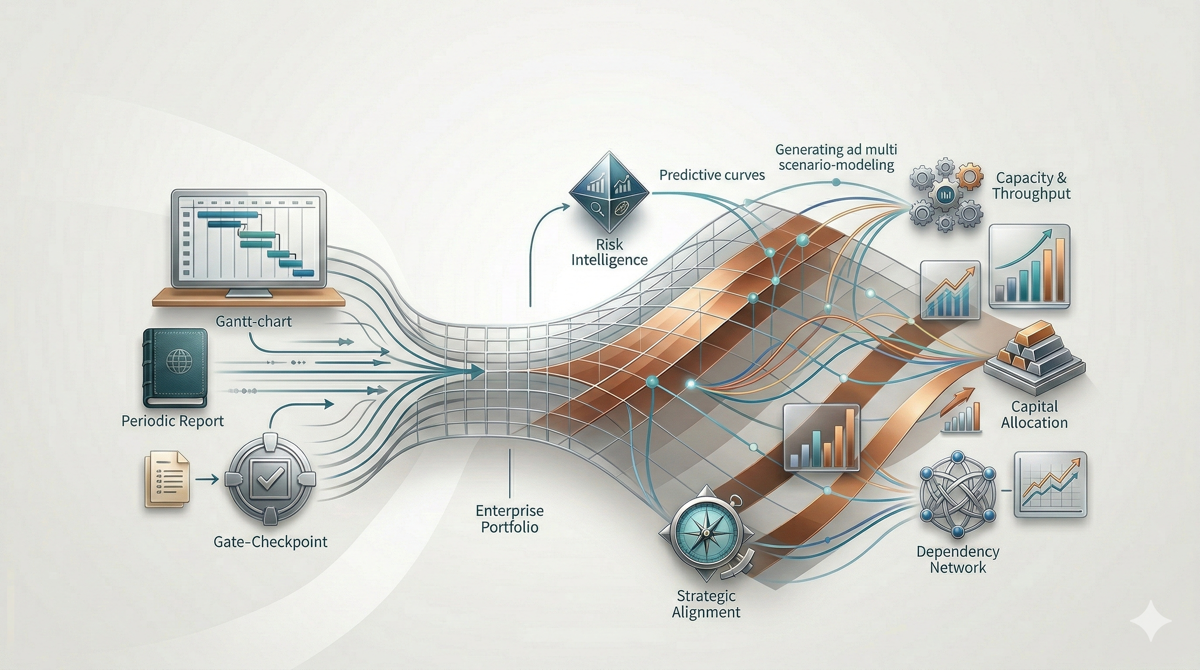
The agentic architecture in PPM Express supports expansion into higher-order intelligence:
- Portfolio Risk Exposure modeling
- Capacity and throughput forecasting
- Capital allocation scenario analysis
- Strategic alignment scoring
- Dependency network fragility mapping
This progression shifts the platform from:
System of record
to
System of continuous portfolio intelligence.
Why This Matters for Enterprise Governance
In a chatbot-only environment:
- Portfolio reviews still require manual aggregation.
- Risk discussions still rely on color coding.
- Trade-offs are debated without dynamic scenario modeling.
In an agentic environment:
- Risks are clustered and escalated before they become red.
- Capacity bottlenecks are modeled with forecast confidence.
- Funding shifts are evaluated using marginal return logic.
- Strategic drift is measured continuously.
Governance meetings shift from reviewing status to approving decisions.
That is a material difference.
When Chatbots Are Enough — And When They Are Not
Chatbots are sufficient when:
- The portfolio is small.
- The organization is focused on documentation efficiency.
- Decision cycles are infrequent and low-stakes.
Agentic PPM becomes necessary when:
- The portfolio spans multiple business units.
- Capital allocation is dynamic.
- Interdependencies are complex.
- Leadership demands predictive insight.
- Margin pressure makes late corrections expensive.
In large enterprises, the second scenario is the norm.
The Future of AI in PPM
The market will continue to market “AI-powered” tools.
But AI-powered does not automatically mean intelligence-driven.
The next phase of PPM evolution will not be defined by how well systems answer questions.
It will be defined by how effectively systems surface the right decisions at the right time — with quantified impact.
PPM Express is building toward that model.
Not just AI-enhanced reporting.
But agent-enabled portfolio governance.
Enterprises that move beyond chatbots and adopt continuous portfolio intelligence will operate with:
- Lower systemic risk
- Higher capital efficiency
- Faster governance cycles
- Stronger alignment between strategy and execution
AI chatbots improve how teams work.
Agentic PPM improves how enterprises decide.
The difference defines the next generation of portfolio management.
.svg)


