
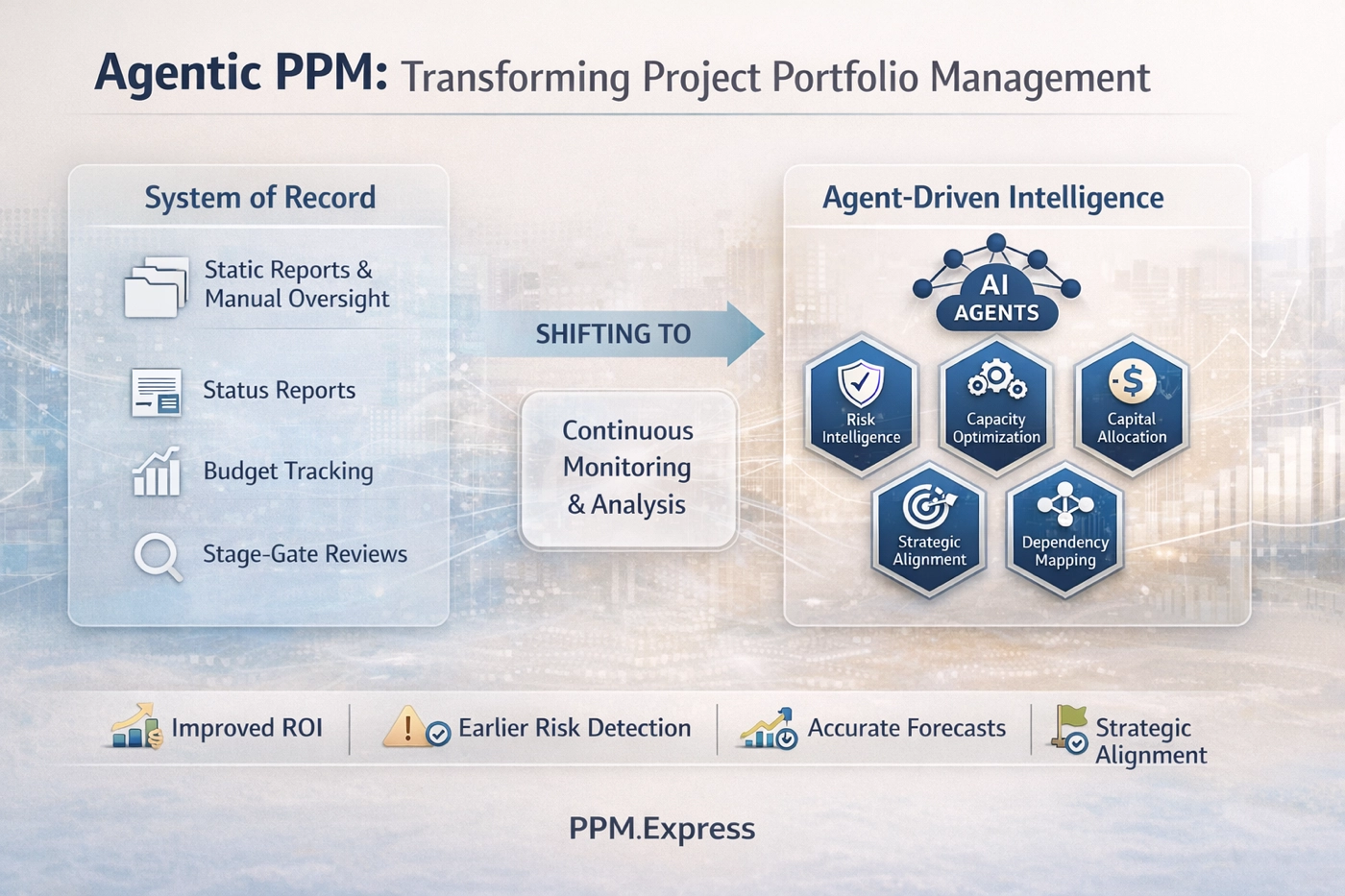

For twenty years, most Project Portfolio Management tools did the same job: collect the projects, track the dollars, make sure someone fills out a status report, and spit out dashboards for a steering committee. Those systems of record brought order to chaotic delivery teams, but order alone is no longer a competitive advantage. Capital is tighter, transformation programs overlap, and boardrooms expect answers in hours, not quarterly reviews. We need portfolio intelligence that works while people sleep.
Agentic PPM is the step change. It keeps the discipline of a system of record but layers on a set of always-on agents that watch the portfolio, run scenarios, and escalate decisions before a meeting invite even goes out.
Why the old model can’t keep up
Traditional PPM software is built for documentation:
- submit the status report
- route the stage-gate approval
- update the risk log
- double-check resource allocations
- refresh the portfolio dashboard
Those workflows tell you **what already happened**. They do nothing to answer the question executives care about: **what should we do next and what happens if we’re wrong?** The manual layer in between—people spotting patterns, modeling trade-offs in spreadsheets, deciding which risks deserve airtime—has become the bottleneck. Late risks, stranded capital, and strategy drift are symptoms of that lag.
What changes in an agent-driven model
Agentic PPM swaps a reactive reporting loop for continuous decision support. Instead of one monolithic “AI assistant,” the platform runs a bench of specialists, each focused on an executive question and each running 24/7:
- **Risk intelligence agents** watch for correlated signals across programs so exposure is flagged before status turns red.
- **Capacity and throughput agents** simulate bottlenecks, confidence intervals, and trade-offs when delivery teams juggle competing work.
- **Capital allocation agents** test funding rebalances, showing the marginal return of moving dollars from one initiative to another.
- **Strategic alignment agents** compare live spending patterns with declared priorities and call out drift the moment it starts.
- **Dependency agents** map cross-project links and warn when one slip will cascade through the portfolio.
Each agent runs on the same underlying data, but they don’t wait for a human to ask a question. They push alerts, prep decision packs, and tee up recommendations before the weekly governance call.
From system of record to system of decision
Here’s how the operating rhythm changes:
Data entry → weekly report → committee debate → decision after the fact
to
Continuous evaluation → real-time scenarios → auto-prepared recommendations → meeting time spent on the decision itself
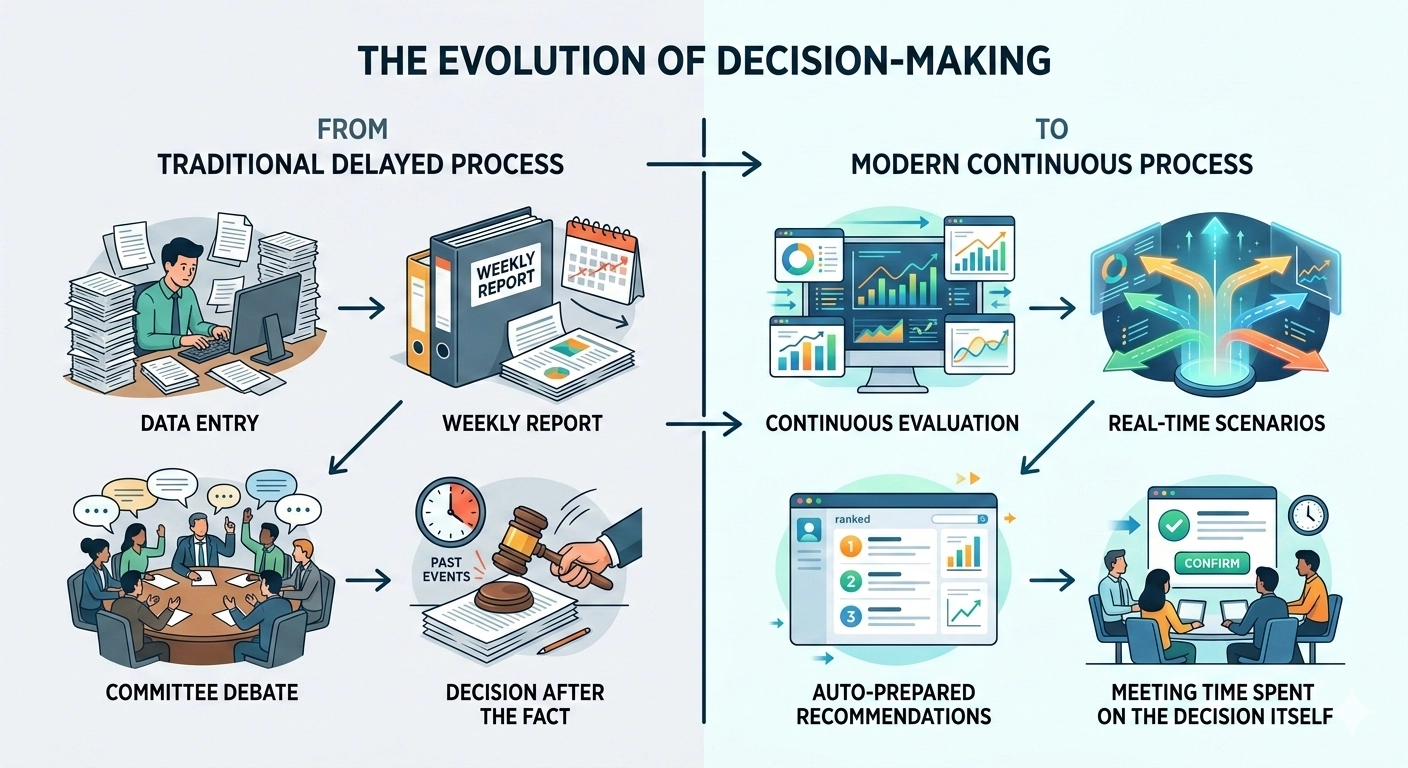
When the heavy analysis happens in the background, governance shifts from PowerPoint defense to actual steering.
What executives get out of it
1. **Better capital efficiency.** Funding trade-offs are quantified before budget meetings, so investment dollars flow to higher-yield work faster.
2. **Earlier risk response.** Risk agents surface patterns across programs before escalation. Teams mitigate early and avoid the expensive fire drill.
3. **Forecasts with confidence ranges.** Capacity models produce probabilistic delivery forecasts, which makes board updates a lot less hand-wavy.
4. **Continuous strategic hygiene.** Alignment checks run every day—not just during annual planning—so priorities stay linked to spend.
5. **Shorter governance cycles.** If the analysis is already done, meetings focus on yes/no calls instead of walking through status slides.
How to phase the transition
You don’t have to blow up governance to deploy agentic PPM. A practical rollout looks like this:
1. **Clean / Prepare the data.** Enforce metadata standards and reconcile historical delivery data so the agents have something trustworthy to ingest.
2. **Wire up the signal paths.** Connect delivery tooling, finance, and strategy systems so capital, capacity, and outcome data flow in near real time.
3. **Launch the core agents.** Risk, capacity, and capital allocation agents deliver obvious value out of the gate.
4. **Layer on strategy and dependency intelligence.** Once the basics are running, add the agents that watch alignment, interlocks, and benefits realization.
Within a few quarters, the organization moves from reactive reporting to proactive steering.
Why the architecture matters
Agent-driven portfolios get smarter with age. The longer the agents run, the better the models become at spotting recurring patterns, estimating delivery confidence, and predicting the actual impact of a funding change. That compounding intelligence turns into:
- Faster, better-informed capital calls
- Lower systemic risk
- Delivery dates leadership can defend without caveats
- Higher trust from boards and regulators
Looking ahead
Systems of record still matter. They keep the contracts, the approvals, and the audit logs. But on their own they simply document performance. Agentic PPM lets enterprises shape performance. In markets where capital, speed, and credibility determine who wins the next planning cycle, that is not a minor upgrade—it is the difference between keeping up and leading.
Explore how PPM Express can transform your portfolio into an AI-driven, agent-powered decision engine — visit our platform overview and see how to activate intelligent agents in your environment today.
.svg)


