
Fund the mandatory work and still move the strategy forward
PPM Express gives banks and credit unions one portfolio across regulatory change, core modernization, cyber, operations and customer programs, so leaders can fund the right mix with cost, dependencies and capacity visible.
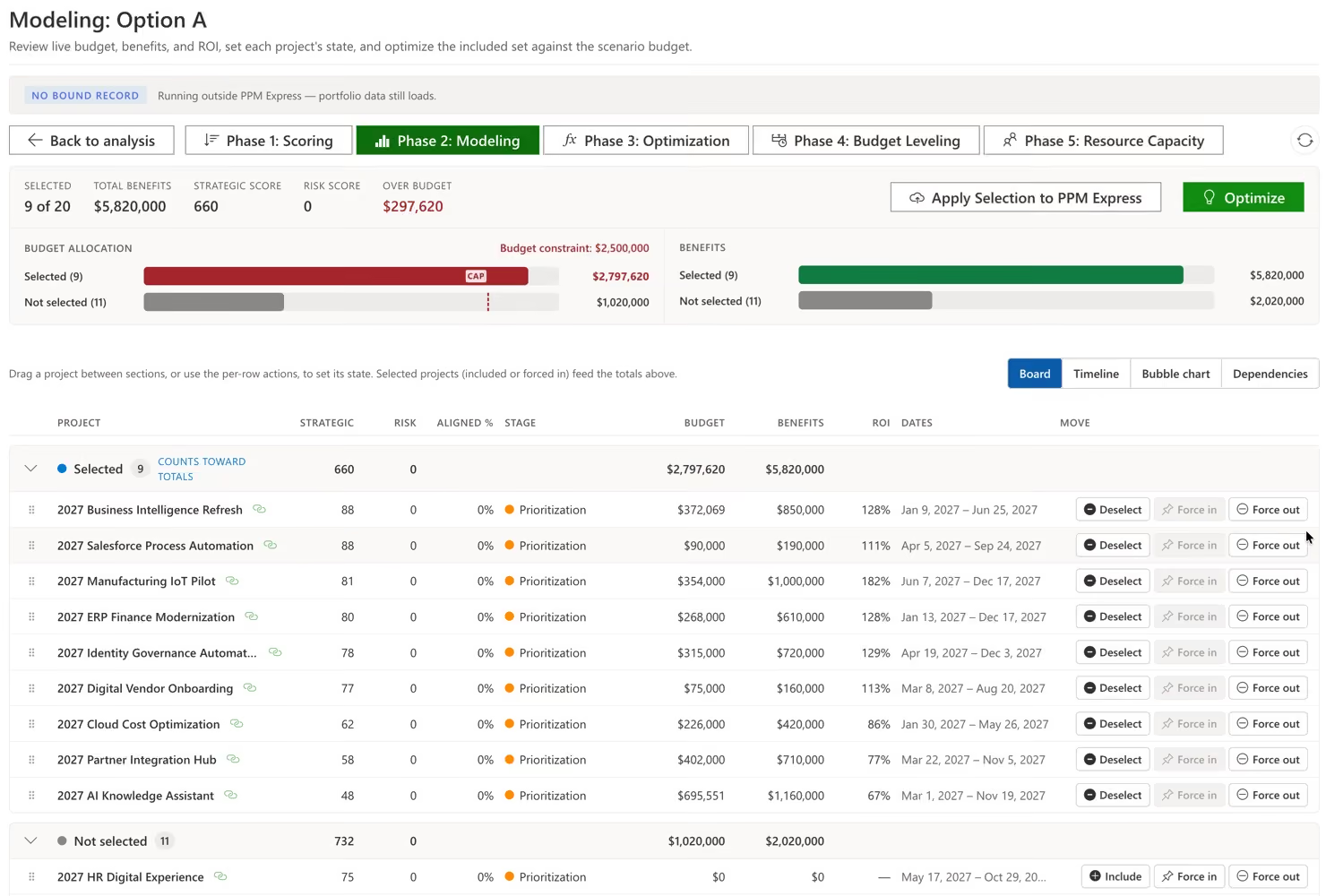


Mandatory work and strategic work share one budget, one set of teams and one calendar
Regulatory commitments cannot simply be postponed, but neither can every modernization, resilience and customer initiative be treated as equally urgent. Work enters through different functions and is delivered in different tools, while the same architects, security specialists, data teams and operations leaders appear in every plan. By the time the conflict reaches the steering committee, the dates are public and the trade-off has become an escalation.
Mandatory work absorbs the year
Regulatory commitments take capacity first because they have to. What is left funds the strategy, and nobody has costed what that actually means until the year is half gone.
Decisions you can't defend to a board
A sponsor asks why their program fell below the line and the honest answer is seniority. Trust erodes, and the next review restarts the argument from first principles.
The same specialists in every plan
Architecture, security and data teams appear in the resourcing of nearly every initiative, each one assuming it has them. The collision surfaces when a date is already public.
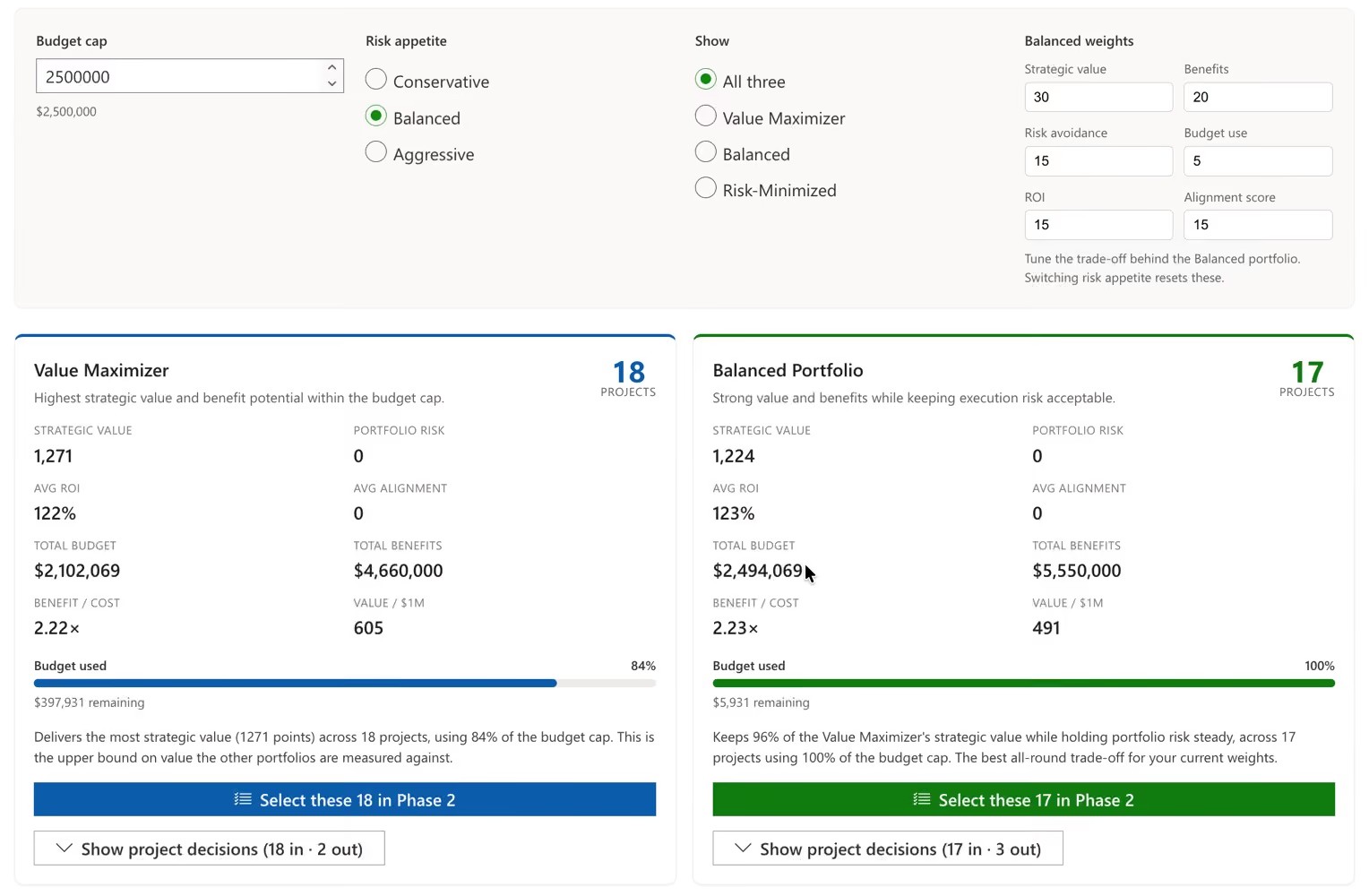
Three steps, from fragmented demand to a portfolio you can defend
Assemble the portfolio from the tools teams already use
Bring work from Azure DevOps, Jira, Microsoft Project, Planner, Project for the Web, Smartsheet and Monday.com into one portfolio view. Teams keep their delivery workflows while leadership sees regulatory, technology, operational and customer initiatives together.
Separate obligation from opinion without hiding the trade-off
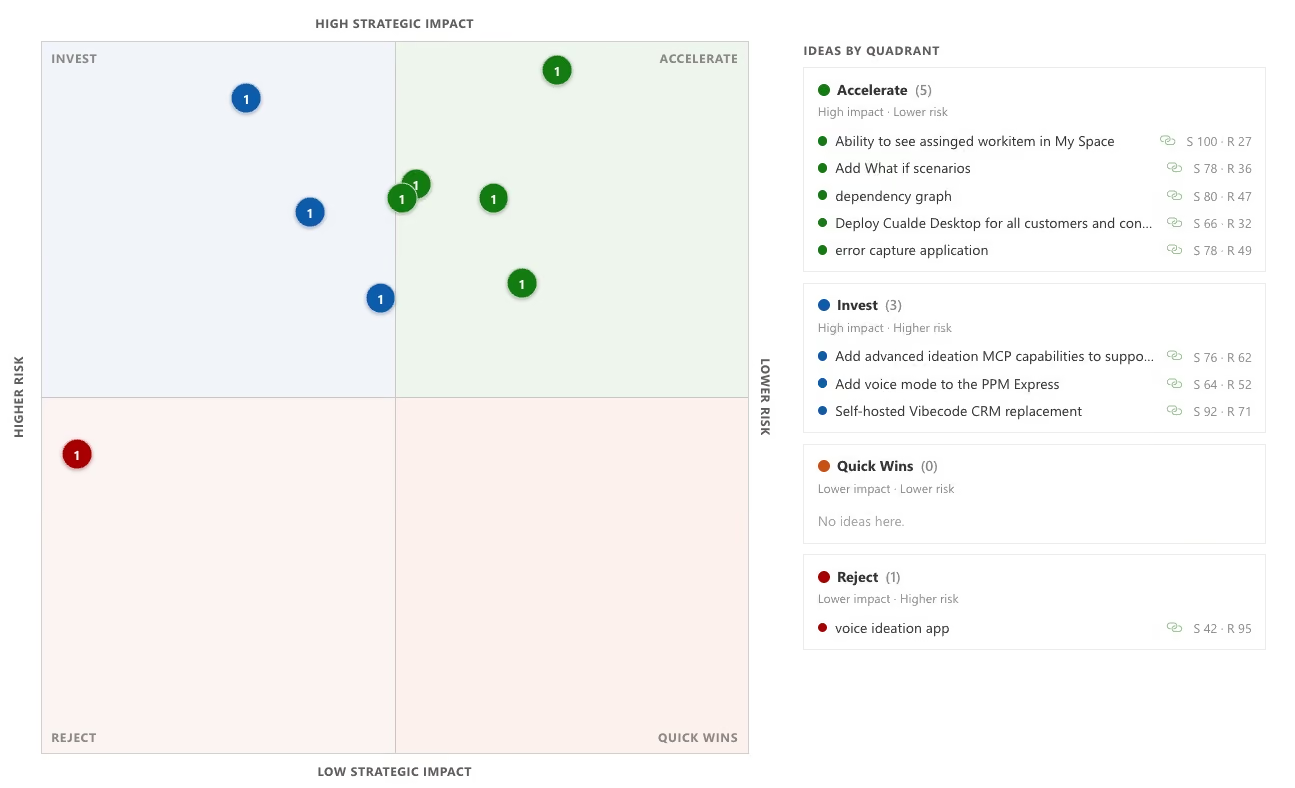
Capture requests and score them against published strategic and risk criteria, with budget, forecast, benefits and impact next to each initiative. Mandatory work stays identifiable as mandatory, and the cost and capacity consequences of protecting it stay visible rather than absorbed silently.
Test each scenario against the people available
Build competing funding scenarios against one ceiling, then check the survivors against real availability in hours or % FTE. Over-allocation appears before the portfolio is approved, not after four programs discover they all depend on the same security team.
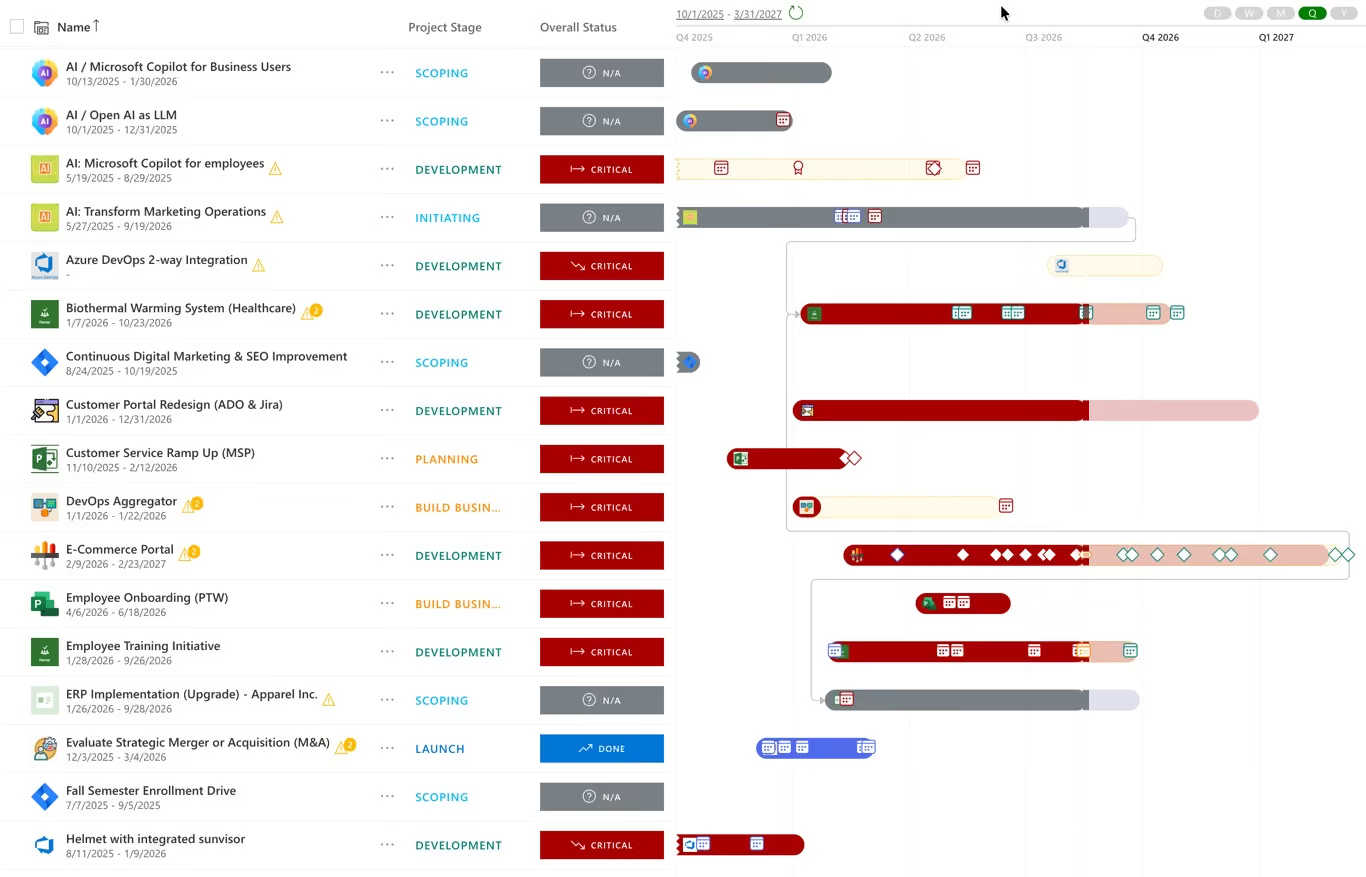
Answer what gets funded, what moves, and what the decision costs
One portfolio across mandatory and strategic change
Regulatory, risk, technology, operations and customer initiatives are reviewed together rather than through separate queues that never meet until the numbers are added up.
Capacity conflicts before commitments
Shared architecture, security, data and operations capacity is tested across the whole portfolio before dates and budgets are approved.
A decision trail you can return to
The selected scenario, the baseline numbers and the alternatives considered stay available when leadership asks, months later, why an initiative was funded, deferred or stopped.
The live portfolio, not a copy built for the pack
Budgets, benefits, dates and resource plans sit in PPM Express as they are now — nothing to export before the board pack, nothing to reconcile after it.
Movement in the numbers is surfaced, never silent
If numbers change after you built the analysis, you are shown exactly what changed and asked whether to take it.
The model behind a funding decision is protected
A model already scoring live change has to be cloned before it can be changed.
Your data stays in your tenant
Isolated to your tenant, enforced with your verified sign-in.
Built for change portfolios at bank scale
Financial data is cached and refreshed when a project actually changes, so a full change portfolio opens in seconds.
Sits on the Microsoft estate you already run
Project Online, Project for the Web, Planner and Microsoft 365 identity connect directly, so the portfolio layer runs on infrastructure your bank has already reviewed and audited.
Fund mandatory change and strategic progress from one constrained portfolio
The question is rarely whether regulatory, resilience, modernization and customer initiatives matter. It is which combination fits the budget and the delivery capacity without creating unmanaged risk somewhere else. Build comparable scenarios, keep the mandatory commitments visible inside them, and choose with the full trade-off on screen.
Three methods, not one
A weighted scoring model, MoSCoW with columns that total budget and benefits, or a quick ICE score. Use the one the funding round deserves — or run two and see where they disagree.
Value defined explicitly
Weighted strategic and risk factors, each with a published value range, so a 3 means the same thing to every risk owner who enters one.
Budgets and benefits in view
For every initiative, collect and track budget, forecast, benefits and impact, so the conversation happens in money rather than in opinion.
The genuine trade-off frontier
Pareto optimization shows the options where you can't improve strategic value, benefits, risk or cost without giving something up, so the executive committee chooses a point on the frontier instead of arguing toward a number.
A capacity reality check
Every plan is tested against people's free capacity: what is left after the commitments they already carry. Over-allocation is flagged before the bank commits to it.
Decisions that stick
Select one scenario and every funded initiative is stamped with the outcome in PPM Express, with the numbers baselined at the moment of decision and the full decision history kept.
Built for the questions your examiners ask
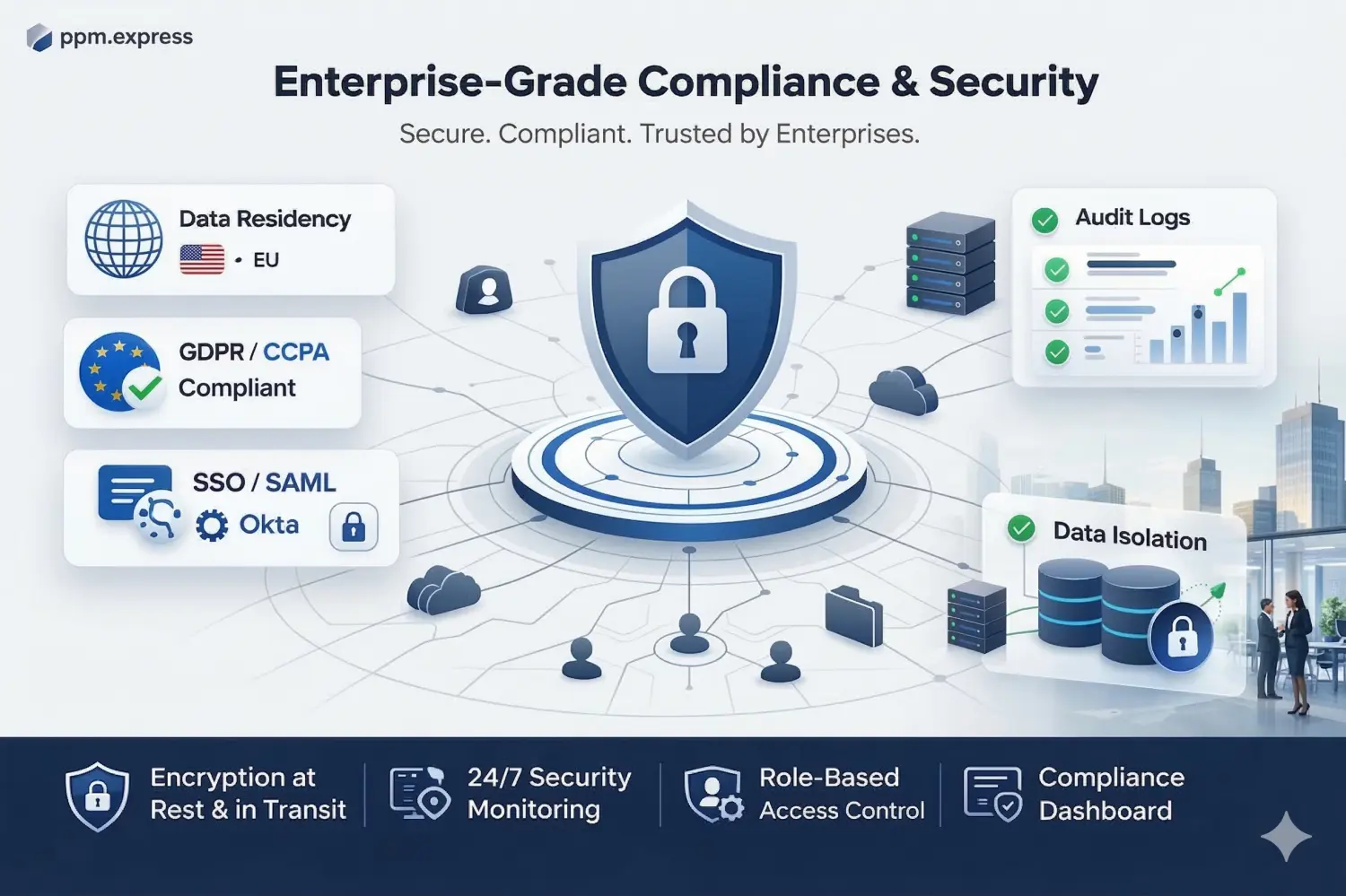
Enterprise-grade security is built into the platform. US and EU data residency, full GDPR compliance and custom DPAs meet strict regulatory requirements. Microsoft 365 and Okta SSO handle identity, while detailed audit logs and strict data isolation protect regulated change data.
EU & US data residency
GDPR and custom DPA
Microsoft 365 & Okta SSO
Detailed audit logs
Strict tenant isolation
Encrypted at rest and in transit
Role-based access control
No customer data used to train AI
Bring your security and architecture reviewers to the same call.
Book Enterprise DemoIntegrated Project Portfolio Management
Streamline Project Portfolio Management and Visibility at Scale
Innovation Management
Capture new project request, streamline evaluation and prioritization
What-If Scenario Planning
Structured Approach for prioritizing and aligning portfolios with strategic priorities and resource constraints
Frequently asked questions
Banking portfolio management, answered.
What is the difference between run-the-bank and change-the-bank?
Run-the-bank is the cost of keeping the bank operating: existing systems, operations, support, licenses. Change-the-bank is investment in doing something different, whether that's new products, regulatory change, modernization or efficiency work. The distinction matters because both come from the same pot and the boundary gets fought over. A lot of what sits in run is really deferred change, and reclassifying it honestly is often the first useful thing a portfolio review does.
What is a book of work in banking?
The agreed set of change initiatives a division or the whole bank has committed to deliver in a period, with funding, sequencing and ownership attached. It's different from a project list because it's a commitment: the book of work is what leadership said it would do and will be held to. The usual problem is that it mixes mandatory regulatory commitments with discretionary investment and treats both the same way.
How do you balance mandatory regulatory change against discretionary strategic change?
Score both on the same model instead of exempting one of them. Mandatory work should rank high because its risk factor is genuinely severe, not because it skips assessment. Once regulatory change carries a score, the cost it imposes in displaced strategic investment becomes visible, and leadership can see exactly how much of this year's capacity the compliance agenda is consuming.
Can we enforce gate approvals and evidence them for audit?
Yes. Projects run a configurable process of phases and stages with gates between them, and you choose which gates require approval. Named approvers review in the Approval Center and approve or reject with comments, and every approver has to sign off before a project advances. The decision history is retained, and a scoring model already being used on live work has to be cloned before anyone can change it.
Can gate approvals be routed through our existing workflow system?
They can. Alongside standard approvals handled inside PPM Express, there's an API-based option built for organizations already running an external approval or workflow platform. PPM Express sends the approval request out to your system, and your system calls back to approve or reject the stage transition. For banks with an established change-governance toolchain, that avoids standing up a second approval queue.
Regulatory change keeps crowding out strategic change. How do we make that trade-off visible?
Run the scenario both ways. Pareto optimization shows the options where you can't improve strategic value, benefits, risk or cost without conceding something elsewhere, so the executive committee sees the actual frontier rather than one recommended plan. The aim isn't to underfund mandatory work. It's to stop the crowding-out from happening silently and then being discovered in December.
Internal audit asks how a funding decision was reached. What can we produce?
The model that was applied, the factor weights in force at the time, the scenarios compared, the one selected, and the numbers as they stood at that moment. Figures are baselined at the point of decision and the decision history is kept. Because a model scoring live change has to be cloned before it can be altered, the basis of a past decision can't be edited after the fact.
Regulatory scope keeps moving mid-program. How do we re-plan without starting over?
When numbers change upstream after you've built an analysis, PPM Express shows you exactly what moved and asks whether to take it, rather than absorbing the change quietly. A re-plan then starts from a known delta instead of another data-gathering round. On a multi-year program where technical standards and regulator clarifications arrive in installments, that difference compounds.
How do we tell whether the book of work fits our delivery capacity?
Each person's capacity comes from their work week and calendar exceptions, and allocation shows against it in hours, percent or FTE, with overallocation flagged. Books of work usually break on a specific group of people rather than on budget: the change specialists, data engineers or SMEs written into a dozen initiatives at once. That shows up as soon as the plans sit in one view.
Our schedules are maintained in Microsoft Project. Can we keep using it?
Yes. Project Online and Project for the Web connect directly, and for the Microsoft Project Desktop client there's PPM Express Project Publisher, an add-in your planners use to publish schedules up from inside Project. Desktop 2016, 2019 and 2021 are supported. Plans come across up to 2,000 tasks and ten levels of hierarchy.
How do we show the executive committee where change spend actually went?
Every initiative carries budget, forecast, benefits and impact, baselined at approval, so the current position can be set against what was funded. Because the portfolio reads live from the delivery tools, the committee sees the position as it stands rather than a reconciliation put together the week before. That week-before reconciliation is normally where the credibility-damaging discrepancies come from.
What data residency and security controls apply for a regulated bank?
You get data residency in the US or the EU, full GDPR compliance, and custom DPAs to meet strict regulatory requirements. Microsoft 365 and Okta SSO handle identity. Strict data isolation between customers, and detailed audit logs covering the portfolio of record. Prioritization models in active use are protected from silent edits, which tends to be the specific control an audit function asks about.
Does PPM Express replace our regulatory change management system?
No. Horizon scanning, regulatory interpretation and obligation mapping are a separate discipline with their own tooling. PPM Express handles what comes next: turning agreed obligations into funded, sequenced, staffed initiatives, and evidencing how those calls were made. The two work together, and conflating them is a common reason people end up disappointed with one or the other.
Fund the mandatory work and still move the strategy forward
General questions: sales@ppm.express · +1 855 358-3688